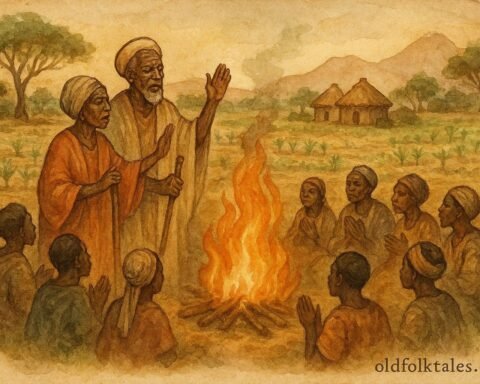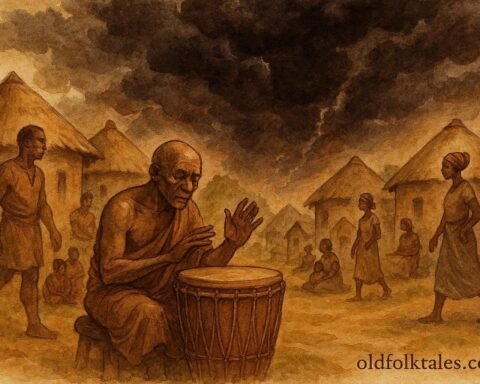
Gather close, children of the daylight. Press near to the fire’s warm heart. Listen to the story of the time when darkness ruled all, when the Sun-Mother turned her face away and left her children weeping in the endless night…
In the beginning-time, before your grandmothers’ grandmothers drew their first breath, there came a darkness so deep, so complete, that even the stars forgot how to shine. This was not the gentle darkness that comes each evening to rest tired eyes no, no. This was the darkness of despair, cold as winter wind, thick as river mud.
The Sun-Mother, she who brings life to all growing things, she who warms the hearts of her earth-children the Sun-Mother was angry. Angry, angry, like a lioness whose cubs have been threatened.
“Why should I rise?” she cried from her resting place deep beneath the red earth. “Why should I give my light, my warmth, my life-giving fire to creatures who do not honor me? The people take my gifts as their right. They curse me when I burn too hot, curse me when I hide behind clouds. The animals seek shade from my face, run from my presence. None remember that without me, all would be cold stone and empty sky.”
And so the Sun-Mother pulled her bright robes around herself and settled deep, deep into the earth’s heart, declaring she would never again climb the sky-path to bring day to the world.
Darkness fell like a great blanket thrown over all creation. The first day passed with no dawn. The second day came but how could it be called day when no light touched the world? On the third day, the cold began to bite. On the fourth, the plants started dying. By the seventh day, even the fires began to flicker and fail, for without the Sun-Mother’s blessing, even flame grew weak.
The people huddled together, skin against skin, breath against breath, trying to share what little warmth remained. The children cried for light that would not come. The old ones spoke in whispers of the end of all things.
But it was little Hare clever, quick-thinking Hare who first understood what must be done.
“Listen, all you creatures,” Hare called into the darkness, his voice carrying across the frozen world. “We have forgotten our manners! We have taken the Sun-Mother’s gifts without gratitude, received her blessings without thanks. No wonder she has turned away from ungrateful children.”
Tortoise, moving slow but thinking deep, agreed. “Hare speaks wisdom. We must humble ourselves, show the Sun-Mother that we know her value, that we understand our need.”
“But how?” growled Leopard, his spots invisible in the blackness. “How do we reach one who has hidden herself so far beneath the earth?”
Mole, who knew the underground ways better than any creature, spoke up: “I can dig deep, follow the root-paths and stone-corridors. But the journey is long and dangerous. I cannot go alone.”
“Then we go together,” said Elephant, her great voice rumbling like distant thunder. “Each creature will contribute what they can.”
And so began the greatest journey ever undertaken a pilgrimage through the earth’s dark heart to find the Sun-Mother’s hiding place.
Mole led the way, his clever paws reading the underground paths. Elephant used her mighty strength to move great stones. Ant and her countless sisters carried supplies along tunnels too small for larger creatures. Bat, comfortable in darkness, scouted ahead with her sound-sight. Even proud Lion humbled himself to help, using his powerful claws to dig when the way became blocked.
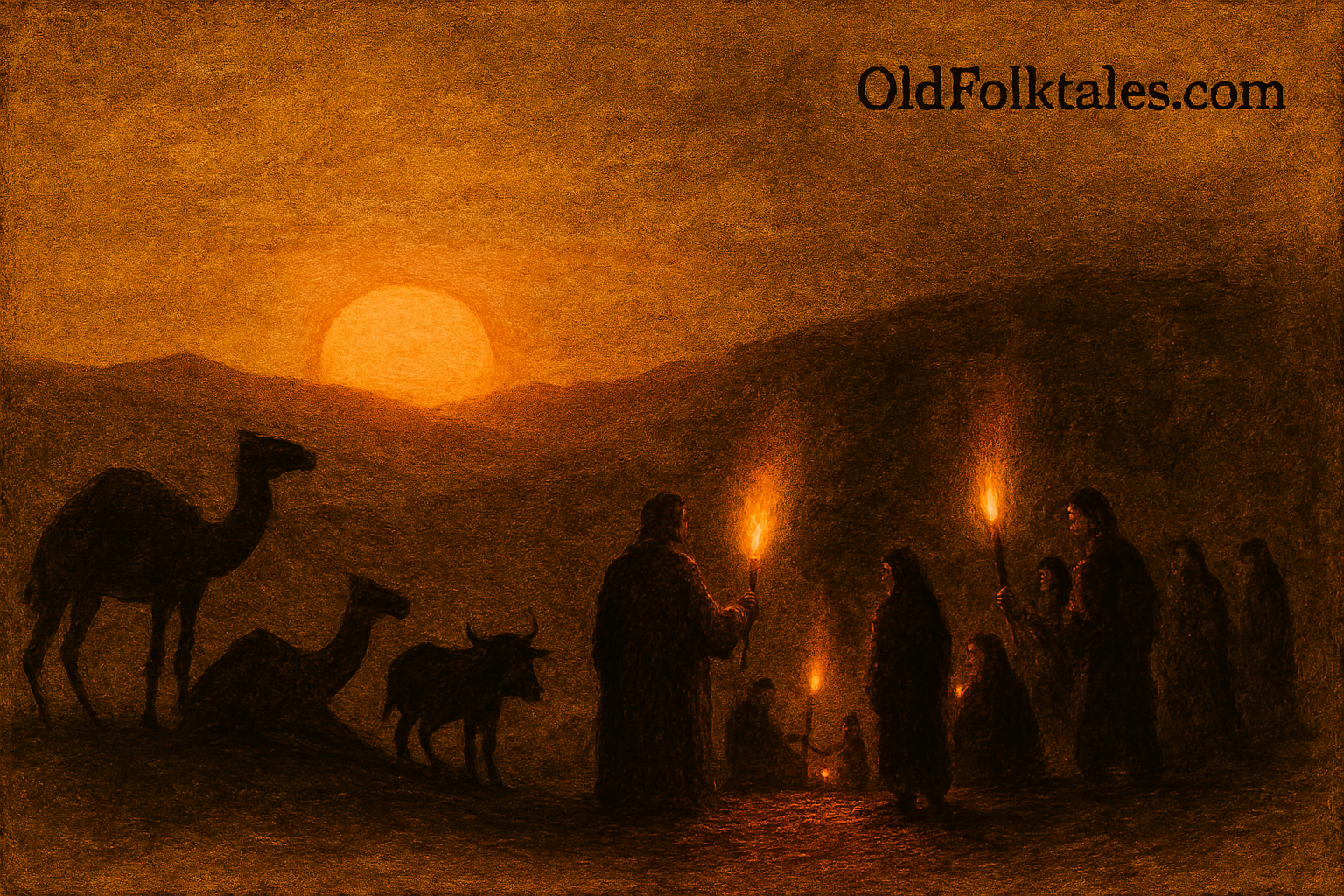
The people, too, joined this underground journey. They brought fire-sticks to light the way, carried water gourds for the thirsty diggers, sang the old songs to keep spirits strong during the long darkness of their descent.
Down, down, down they traveled, deeper than the deepest waterhole, farther than the farthest hunting ground. The earth grew warm around them as they approached the Sun-Mother’s refuge.
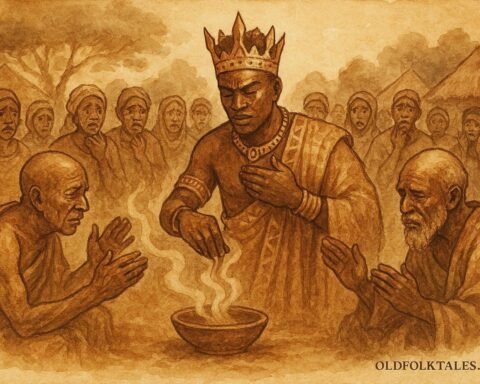
At last, they reached a great cavern filled with golden light, but it was light without joy, warmth without welcome. There sat the Sun-Mother, her face turned away, her brightness dimmed by sorrow and anger.
“Why have you come?” she asked, not looking at the gathering of creatures and people. “Do you seek to command me? To demand that I return to my duties?”
“No, Sun-Mother,” said Hare, speaking for all. “We come to ask forgiveness. We come to say the words we should have spoken every day: Thank you. Thank you for the light that lets us see beauty. Thank you for the warmth that keeps us alive. Thank you for making the plants grow and the waters flow.”
One by one, each creature and each person spoke their gratitude. Elephant thanked the Sun for helping the grasses grow tall and sweet. The people thanked her for ripening the fruits and nuts they gathered. Tortoise thanked her for warming the rocks where he loved to rest. Even tiny Ant gave thanks for the sun-warmth that helped her eggs to hatch.
As the voices joined together human voices, animal voices, all blending into one great song of gratitude the Sun-Mother’s anger began to soften. Her light grew brighter, warmer, more welcoming.
“You have learned,” she said, and now there was gentleness in her golden voice. “You understand that all life is connected, that my gifts are not rights but blessings to be cherished.”
“We understand, Sun-Mother,” the people replied. “We will teach our children to greet you each morning with thanks, to honor you with grateful hearts.”
“And we animals too,” added Hare. “We will bask in your warmth with appreciation, seek your light with joy, not take your presence for granted.”
The Sun-Mother smiled then, and her smile was like the first light breaking over the horizon after the longest night. “Then I will return to the sky-path,” she said. “But remember this always when gratitude fails, when appreciation dies, darkness returns. Unity brought you to me. Unity must welcome me back.”
Together, all the creatures and all the people formed a great procession. They sang as they climbed back toward the surface, their voices echoing through the tunnels, carrying the Sun-Mother’s light with them. And when at last they emerged into the world above, the Sun-Mother rose with them, painting the sky with colors more beautiful than ever before gold and pink and orange, a promise that light would always return to those who remembered to be grateful.
From that day forward, the people and animals have kept their promise. Each dawn is greeted with thanksgiving. Each sunset is blessed with appreciation. And when troubles come, when darkness seems to threaten, they remember the lesson of the Great Night that unity and gratitude can bring light to even the deepest darkness.
This is the story the dawn-wind carries, the story the first light whispers. May you remember it when darkness comes to your own journey, and may you always find your way back to the light through unity and hope.
Moral lesson
The tale of the Sun-Mother’s retreat teaches us profound truths about the power of unity and the importance of maintaining hope even in our darkest moments. When the world faced eternal night, salvation came not through individual heroism but through unprecedented cooperation between species that normally lived as competitors or predators and prey. This collaboration reveals that our greatest challenges often require us to transcend our usual boundaries and work together across differences.
The story emphasizes that genuine unity emerges not from convenience but from shared recognition of mutual dependence. Each creature contributed their unique gifts to the underground journey Mole’s digging expertise, Elephant’s strength, Ant’s organizational abilities, Bat’s navigation skills. This teaches us that effective cooperation honors and utilizes the diverse talents within our communities rather than demanding conformity or sameness.
The folktale reveals that many crises stem from taking blessings for granted rather than appreciating them with conscious gratitude. The Sun-Mother’s withdrawal was prompted not by malice but by the pain of being unacknowledged despite her essential contributions to all life. This reflects how relationships whether with people, communities, or the natural world deteriorate when appreciation is replaced by entitlement, reminding us that gratitude is not merely polite but essential for sustaining the bonds that support our existence.
The story also teaches that hope must be actively maintained through both individual and collective action. The journey to find the Sun-Mother required not just optimism but concrete steps taken in faith that light could be restored. The creatures and people had to descend into deeper darkness before finding illumination, suggesting that the path through crisis often requires courage to go deeper into difficulty rather than avoiding or denying it.
Finally, the tale emphasizes that lasting solutions require ongoing commitment rather than one-time fixes. The Sun-Mother’s return was conditioned on continued gratitude and unity, warning that the behaviors which create crisis will inevitably recreate it if not permanently changed. This teaches us that maintaining hope and preventing future darkness requires daily practices of appreciation, cooperation, and remembrance of our interconnectedness with all life.
Knowledge Check
Q1: How do San creation stories explain natural phenomena like sunrise and seasonal changes? A: San creation stories typically explain natural phenomena through relationships between personified forces and the consequences of human and animal behavior. Solar stories often portray the sun as a conscious being whose actions reflect responses to earthly conduct, teaching that natural cycles depend on maintaining proper relationships with spiritual forces. These tales emphasize reciprocity the sun provides light and warmth in exchange for gratitude and respect, reflecting the San understanding that humans must actively participate in maintaining cosmic balance.
Q2: What role does animal cooperation play in traditional San folktales and survival wisdom? A: Animal cooperation in San folktales reflects both practical survival knowledge and spiritual teaching about community interdependence. Stories often show different species working together, each contributing unique abilities to solve problems no single creature could handle alone. This mirrors San hunting and gathering practices where knowledge of various animal behaviors, tracking skills, and cooperative strategies were essential for survival in harsh desert conditions, teaching that diversity of skills strengthens communities.
Q3: How do San darkness and light stories teach lessons about hope during difficult times? A: San darkness and light stories typically emphasize that hope requires active effort rather than passive waiting, and that solutions often emerge through community cooperation rather than individual action. Tales like the hidden sun teach that darkness, whether literal or metaphorical, can be overcome through unity, gratitude, and willingness to undertake difficult journeys together. These stories provide practical emotional guidance for maintaining morale during challenging periods like droughts or conflicts.
Q4: What spiritual significance does gratitude hold in San culture and storytelling traditions? A: Gratitude in San culture is viewed not as mere politeness but as essential spiritual practice that maintains relationships between humans, animals, ancestors, and natural forces. Stories consistently show that taking blessings for granted leads to loss or crisis, while conscious appreciation preserves beneficial relationships. This reflects the San understanding that survival in harsh environments depends on recognizing and honoring the gifts that sustain life, making gratitude a practical as well as spiritual necessity.
Q5: How do San unity stories reflect their communal survival strategies and social values? A: San unity stories encode essential survival wisdom about the importance of community cooperation in harsh desert environments. These tales typically show that challenges requiring diverse skills, shared resources, and coordinated effort can only be overcome through setting aside individual pride or competition in favor of collective action. They reflect practical social values developed over millennia of small-group survival, where community cohesion often meant the difference between life and death.
Q6: What environmental and seasonal wisdom appears in traditional San solar folklore? A: San solar folklore contains sophisticated understanding of seasonal cycles, weather patterns, and the critical relationship between solar energy and ecosystem health. Stories about the sun often include knowledge about plant growing cycles, animal behavior patterns, and the timing of various survival activities. These tales serve as both entertainment and practical education, encoding information about when to gather certain foods, where to find water during different seasons, and how to read environmental signs that predict weather changes.