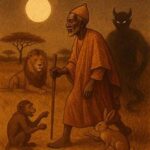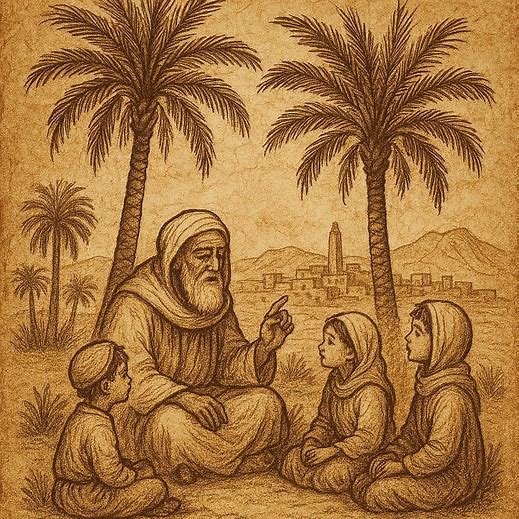
Long ago, when the desert winds carried voices of both mercy and warning, the Mozabite people of the M’zab Valley whispered stories of an oasis that did not appear on any map. It was not marked by palm trees or the sparkle of surface water, but by silence. They called it The Oasis of Hidden Wisdom, a place said to reveal truths to those patient enough to listen.
The tale begins with a young man named Yusuf, son of a modest potter. Yusuf was clever with his hands but restless in spirit. He often gazed beyond the walls of Ghardaïa, dreaming of treasures hidden in the desert sands. He believed that true greatness came from finding wealth, not from the patient labor of his father.
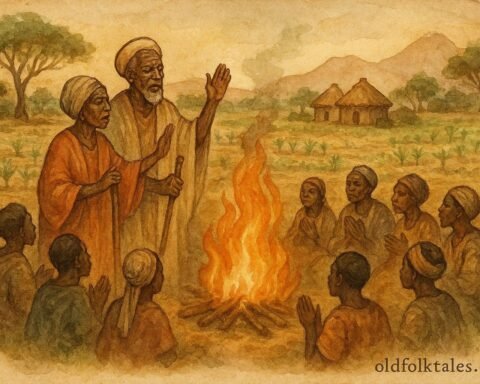
One evening, an elder storyteller sat in the market square, recounting the tale of the hidden oasis. Yusuf’s ears sharpened as the elder described it: “The oasis lies where the dunes whisper like women at the well, where shadows of the rocks stretch like old men in prayer. There, one does not find gold or jewels, but wisdom greater than either.”
Yusuf thought, What use is wisdom if it cannot fill the belly or buy fine robes? Yet his curiosity stirred, and before dawn the next morning, he set out with his camel, a skin of water, and his ambition.
For days, Yusuf wandered. The sun scorched his back, and the desert tested his will. At last, he reached a valley where wind swept through black rocks, making a sound like flutes played by unseen hands. It was just as the elder had described. Yusuf tied his camel to a palm tree and stepped forward.
There was no water, no shade beyond the rocks, no treasure. Only silence, broken by the breath of the wind. He grew angry. “Have I come all this way for nothing?” he cried.
Then a voice rose not from a man, but from the stones themselves. The rocks glowed faintly as if touched by moonlight, though it was day.
“Young seeker,” the voice said, “what do you desire?”
“Treasure,” Yusuf answered quickly. “Gold, silver, anything that will make me respected among men.”
The voice replied, “If you desire wealth, you will leave with empty hands. But if you desire truth, you may drink from the well that does not dry.”
Yusuf hesitated, but greed pushed his heart. “I want gold,” he repeated. The rocks dimmed, the voice vanished, and only the wind remained.
Disappointed, Yusuf stumbled back to his camel. But the journey had drained him, and his water skin was nearly empty. He feared he would perish. In desperation, he returned to the stones and whispered, “If not treasure, then truth. Show me what I do not see.”
The rocks brightened once more, and the ground trembled. Suddenly, a spring bubbled at his feet. Yusuf drank deeply, and as the cool water touched his lips, visions filled his mind. He saw his father shaping clay with careful patience, his mother carrying water jars with quiet strength, and the elders teaching children beneath the mosque’s arches. He realized then that the true treasure was the wisdom of his people, their endurance in the desert, their knowledge of survival, their faith woven into every breath.
When the vision faded, Yusuf filled his jar with the spring’s water. But as he walked away, the spring vanished, leaving only dry sand. He returned to Ghardaïa not with gold, but with a story. The people listened as he told of the oasis that revealed wisdom. He no longer sought wealth, but instead taught others that patience, humility, and respect for tradition were riches greater than silver or gold.
Moral Lesson
The story of Yusuf and the Oasis
of Hidden Wisdom teaches us that true wealth is not measured in gold or possessions, but in the wisdom, traditions, and values that sustain a people. Greed blinds the eyes, but humility opens the heart to treasures that never fade.
Knowledge Check: Oasis of Hidden Wisdom
1. What is the Oasis of Hidden Wisdom in Mozabite folklore?
The Oasis of Hidden Wisdom is a mythical place in the desert said to reveal truths and timeless wisdom to those who seek with humility.
2. Who was Yusuf in the Mozabite folktale?
Yusuf was a young man from Ghardaïa who set out in search of treasure but instead discovered the greater value of wisdom and tradition.
3. What did the stones in the Aurès Mountains symbolize in the story?
The stones symbolized the voice of ancestral wisdom, guiding seekers toward humility and truth.
4. What moral lesson does the folktale teach?
The folktale teaches that true wealth lies not in material possessions but in the wisdom, patience, and traditions that sustain communities.
5. Why did Yusuf fail to find gold at the oasis?
Yusuf failed because he sought material wealth with greed, not wisdom with humility. Only when he chose truth did the oasis reveal its hidden spring.
6. How does the folktale reflect Mozabite culture?
The folktale reflects Mozabite culture by highlighting the importance of survival in the desert, the strength of community, and the value of ancestral wisdom over material riches.