Once upon a time, when the earth was still soft and the sky was near, there was nothing but water stretching endlessly in all directions. The heavens floated above like a great calabash turned upside down, and the Orishas, the divine beings, lived close to Olodumare, the Supreme Creator. The earth below waited to be shaped, yet it had no form, no place for humans, no land for trees, and no home for animals. It was a restless sea of possibilities.
Olodumare, seeing the emptiness, decided it was time to bring balance into the universe. The Creator summoned the Orishas, who gathered in a shining courtyard in the heavens. Among them were Obatala, wise and gentle; Oduduwa, strong and determined; Orunmila, who knew the secrets of destiny; and Olokun, the ruler of the deep waters.
Olodumare spoke with a voice that echoed across eternity: “The time has come to shape the world. One of you must go down and bring land from the waters so that creation may begin.” The Orishas bowed, for this was a sacred task. Obatala, filled with humility and vision, stepped forward. “I will go,” he said, “and I shall create the earth where people may live.”
Olodumare gave him a golden chain long enough to reach the watery world below. Into his hands were also placed a snail shell filled with sand, a white hen with sharp claws, and a palm seed. Orunmila, the keeper of wisdom, whispered to him: “When you reach the waters, pour the sand upon it, release the hen, and plant the seed. These will bring forth land, life, and growth.”
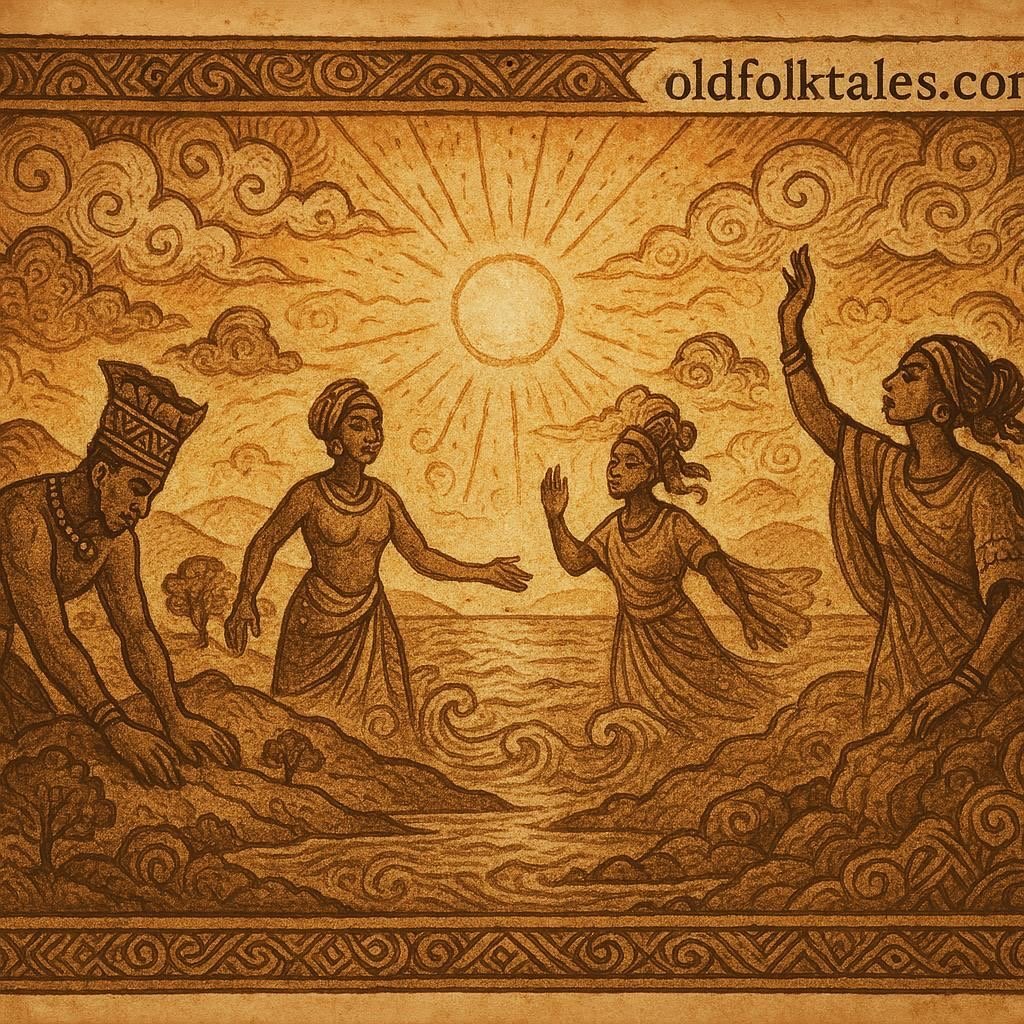
With great reverence, Obatala descended from the heavens. Down the shining chain he climbed, until he hung above the endless waters. He poured the sand from the snail shell, and at once the grains spread across the surface of the sea. Then he released the white hen, and as its claws scratched and scattered the sand, it spread wider and wider until dry land appeared. Where water had once ruled, earth now stretched like a new skin.
Obatala stepped upon the fresh ground and named it Ile-Ife, the sacred center of the world. There, he planted the palm seed, and from it grew the first mighty palm tree, its branches spreading like arms to shelter life. Birds came to perch on its crown, and the air filled with song. Creation had begun.
Soon, other Orishas descended to see the wonder. Oduduwa looked upon the land and claimed it with strength, declaring it the foundation of kingdoms to come. Orunmila blessed the soil with knowledge, so that humans who would one day walk it might know wisdom. Olokun, however, remained in the depths of the sea. She was angered that the Orishas had created land without asking her blessing, for the waters had once belonged to her alone.
Her fury rose like a storm. Waves crashed against the new land, threatening to swallow it. The Orishas trembled, but Orunmila, who could see what was hidden, warned them: “Only balance can calm the seas. We must honor Olokun, for creation cannot stand without water as much as it needs land.” So the Orishas brought offerings to Olokun, praising her power and asking for peace. In time, her anger cooled, and she agreed that both land and sea should share the world in harmony.
On Ile-Ife, Obatala began to mold figures out of clay. With gentle hands, he shaped arms, legs, and faces, and set them in the sun to dry. When he had made many forms, Olodumare breathed life into them, and thus the first humans awoke. They walked, laughed, and danced upon the earth, marveling at the wonders around them. The Orishas blessed them with gifts: Obatala gave purity and kindness, Oduduwa gave strength and leadership, Orunmila gave wisdom, and Olokun gave the riches of the sea.
But even the Orishas learned that creation was delicate. Once, when Obatala drank too much palm wine, his hands trembled as he molded clay, and some figures came out imperfect. When they were given life, these humans were born with disabilities. Obatala, filled with sorrow, vowed never to drink again and became the protector of all who were differently made. From then on, the Orishas understood that creation must be approached with respect, for even a small imbalance could change destiny.
As time passed, the earth grew full of trees, rivers, animals, and people. The Orishas continued to watch over them, guiding their paths. The palm tree spread to many places, giving food, wine, and shelter. Rivers carved the land, connecting humans to Olokun’s domain. The world thrived because the Orishas remembered balance: the land with the sea, the sky with the earth, and the spirit with the body.
And so, from a snail shell, a hen, and a palm seed, the great story of creation unfolded. To this day, Ile-Ife is remembered by the Yoruba as the cradle of existence, the place where heaven touched the earth and the Orishas walked among mortals.
Moral Lesson of The Orishas and the Creation of the World
This story teaches that balance is the foundation of life. Land cannot exist without water, and strength must be guided by wisdom. Respecting creation means honoring both its harmony and its diversity. Just as Obatala learned that mistakes can still give birth to purpose, we must remember that every being, every river, and every piece of earth has value in the circle of existence.
Knowledge Check on The Orishas and the Creation of the World
What task did Olodumare give the Orishas in this Yoruba folktale?
Olodumare tasked the Orishas with shaping the earth from the watery chaos so that life could begin.What items did Obatala receive to carry out the creation of the world?
He was given a golden chain, a snail shell filled with sand, a white hen, and a palm seed.Why was Olokun angry during the creation of the world?
Olokun was angry because the Orishas created land without seeking her blessing, even though the waters had originally belonged to her.What lesson did Obatala learn after drinking palm wine while molding humans?
He learned that mistakes and imperfections are part of creation, and he vowed never to drink again, becoming the protector of people with disabilities.Why is Ile-Ife considered sacred in Yoruba tradition?
It is believed to be the first place where land appeared on earth and where the Orishas shaped humanity, making it the cradle of existence.What is the main moral lesson of The Orishas and the Creation of the World?
The story emphasizes the importance of balance, respect for creation, and honoring the interconnectedness of all life.
Cultural Origin
This folktale comes from the Yoruba people of Nigeria, who believe Ile-Ife is the sacred birthplace of humanity and the center of creation.