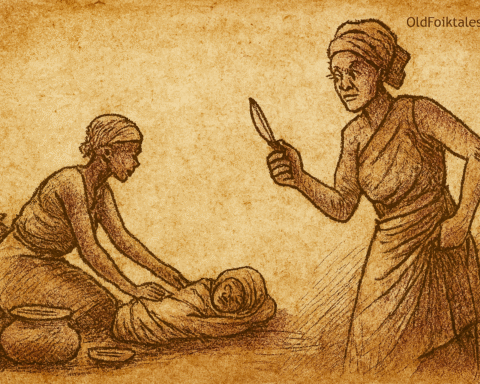
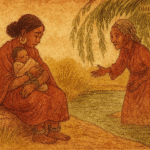
In a sun-baked village on the edge of the Algerian desert lived a young girl named Malika. Her parents had passed when she was barely walking, and since then, her life had been shaped by the hard hands of fate. Her uncle had taken her in, not out of love, but out of obligation, and his wife never let Malika forget it.
Their home was simple—mud-brick walls and a roof of woven palm leaves. But within its walls, warmth was scarce. Malika was made to work from dawn to dusk, scrubbing, hauling water, collecting firewood, and cleaning up after her cousins who mocked her for being an orphan. She ate last, slept on a mat near the cold door, and was scolded for things she hadn’t done.

Still, Malika carried herself with quiet strength. She spoke little, listened much, and found comfort in small things—the sound of birds at dawn, the way the wind played in the date palms, and the shimmer of stars in the night sky.
One scorching afternoon, her aunt shoved a basket into her hands. “The firewood’s nearly gone. Go to the forest. And don’t return with twigs this time or you’ll go to bed hungry.”
Malika nodded. Her feet were blistered, her dress torn, but she said nothing. She walked toward the edge of the village, past the goats and thorn bushes, and entered the forest.
The deeper she went, the quieter the world became. The trees grew taller, casting long shadows across the sand. Malika had been here before, but today she took a path she hadn’t tried. Her instincts tugged at her feet, leading her farther, until the forest opened into a hidden clearing she’d never seen.
And there, standing by a pool of crystal water, was a gazelle.
Its coat was golden-brown, speckled like stardust. Its eyes were deep and knowing, almost human. It watched her silently, without fear. Malika felt no fear either. Something about the animal calmed her.
The gazelle stepped toward the pool and dipped its head to drink. Then it looked at her again.
“I won’t hurt you,” Malika whispered.
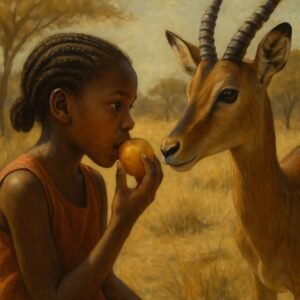
To her surprise, the gazelle walked toward a fig tree and, with one swift movement, nudged it with its head. A ripe fig dropped from a branch. The gazelle looked at her again.
Malika picked up the fig. She hadn’t tasted fruit like this in months. She bit into it. Sweet, fresh, almost like honey. “Thank you,” she said.
The gazelle stepped aside, and behind it, Malika saw a neat pile of firewood stacked beside a stone. Her eyes widened. It was as if the forest had prepared everything for her.
She gathered the wood and turned to thank the gazelle again, but it was already walking away. Before disappearing into the trees, it looked back once. Then it was gone.
That night, Malika returned home before sunset with more wood than expected. Her aunt narrowed her eyes but said nothing.
Days passed. Each time Malika went into the forest, the gazelle appeared. Always waiting, always watching. It led her to food, water, and shade. Sometimes it simply sat beside her while she rested. Malika began to smile more. The gazelle had become her secret — a friend in a world that had given her none.
But secrets, no matter how silent, eventually stir suspicion.
One morning, Malika’s jealous cousin, Laila, followed her into the forest. Hidden behind a tree, she watched Malika meet the gazelle and receive fruit and firewood without lifting a finger.
When Laila returned home, she told her mother everything.
“A magical gazelle?” the aunt scoffed. “If it’s giving her things, we’ll take them. All of them.”
That evening, the aunt whispered her plan to Malika’s uncle.
Two days later, the uncle sharpened his blade and followed Malika into the forest. She didn’t know he was there, crouched behind rocks, waiting.
As always, the gazelle appeared. It stepped forward, ears flicking, head held high. Malika smiled and reached for a fig.
Suddenly, a whistle of air—then a sharp cry. The gazelle stumbled.
“No!” Malika screamed.
Blood stained the sand. The uncle stepped out, proud and cruel. “Let’s see what magic this beast has now.”
But as he approached, the gazelle stood up — wounded, but not defeated. Its eyes locked with Malika’s, and in them she saw sorrow… and something else: forgiveness.
Then, in a blinding flash, the gazelle leapt—higher than any animal should—and vanished into the trees.
The uncle searched, but it was gone.
Malika ran home in tears, refusing to speak. That night, she didn’t eat. She didn’t sleep. She stared out the window, hoping.
The next day, she returned to the forest, though her aunt forbade it. She walked the same path. No gazelle. No firewood. Just silence.
She returned again the next day. And the next.
A week passed.
Then one morning, in the same clearing, she found it—not the gazelle, but a single fig on the ground beneath the tree. She picked it up and smiled.
From that day, Malika never saw the gazelle again. But she continued to visit the grove. Sometimes there was food, sometimes not. But in her heart, she knew the gazelle had never left her entirely.
And years later, when she had grown into a wise, kind woman with a home of her own, children would ask her about the golden gazelle.
She would smile softly and say, “Kindness is its own magic. And sometimes, magic leaves traces in the heart.”
✧ Commentary
This tale reflects the harsh realities faced by orphans and vulnerable children, especially in traditional communities where kinship care can sometimes lack warmth. Malika’s journey shows resilience amid adversity and the power of kindness—symbolized by the magical gazelle. The story uses natural elements like the forest and animals to connect the human spirit with nature’s quiet strength. It teaches us that even when people around us fail, unexpected sources of grace can provide hope. The gazelle’s presence is both a literal and metaphorical guide, reminding us that help and magic often come in gentle, mysterious ways.
✧ Moral
True kindness, even when unseen or unreturned, has a lasting impact. Compassion and courage can help us survive hardship and find light in dark times. Greed and cruelty harm not just others but ourselves. And sometimes, the greatest gifts come without expectation—pure and simple.
✧ Questions & Answers
1. Q: Why did Malika follow the gazelle into the forest?
A: Because the gazelle appeared calm and inviting, and Malika’s heart told her it was a friend offering kindness in a world that had been harsh to her.
2. Q: What does the gazelle symbolize in the story?
A: The gazelle symbolizes kindness, hope, and the magic of unexpected help that can come when one is suffering.
3. Q: How did Malika’s uncle and aunt treat her, and what does this reflect about her situation?
A: They treated her harshly and with suspicion, reflecting how orphans and vulnerable children can face neglect or cruelty even within their own families.
4. Q: What lesson can we learn about greed from the uncle’s actions?
A: Greed can blind us to the true value of kindness and lead us to harm those who are innocent, ultimately causing loss for everyone.
5. Q: Why do you think the story ends with Malika finding a fig and feeling hopeful?
A: It shows that even when we lose something precious, the memory and spirit of kindness remain with us, giving strength to move forward.