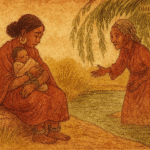
In the deep heart of Guinea-Bissau’s old forest lands, long before asphalt roads carved the paths between villages and city lights dimmed the stars, there lived a palm wine tapper named Bambo. Bambo was a cheerful man with quick feet, long arms, and the kind of laugh that made other men laugh too, even if they didn’t know the joke.
He lived at the edge of the forest in a round thatched hut painted with symbols his grandmother had taught him — symbols that kept mischievous spirits away and brought blessings to his wine gourd. His father had been a palm wine tapper before him, and his grandfather before that. The trees had raised him. Their roots whispered, their leaves sheltered, and their sweet sap was his bread and joy.
Every morning before the sun licked the dew off the leaves, Bambo would sling his climbing ropes and gourd onto his back, take a calabash of groundnut stew prepared by his sister Fatu, and disappear into the towering grove. There, he’d climb the oldest palms — the ones that leaned like sleeping elders — and coax the sap from their hearts.
But one season, something strange began to happen.
Bambo noticed that the wine from the trees near the Singing Bush had turned sour. The Singing Bush was an ancient thicket in the forest — a strange gathering of green that hummed like a woman’s lullaby whenever the wind passed through it. Elders said it was sacred, that spirits from old times lived there, watching and whispering. No one dared tap the trees near it.
Bambo, however, didn’t believe in such things. He thought stories were for old women’s lips and wide-eyed children. So, when his best tree — a giant palm that stood just five paces from the bush — began yielding bitter sap, Bambo blamed monkeys, the weather, and bad luck.
He muttered to himself, “Old fools and their forest tales. The bush sings because the wind dances. What spirits?”
Still, the sourness worsened. Each day, the sap became darker. Then his ropes snapped while he climbed — three times in a row. Then came the night voices. Not dreams. Voices.
“Leave the tree,” one voice said in a hiss.
“Go back to your old path,” another warned.
One night, he woke up outside his hut, bare feet muddy, gourd broken beside him, and the scent of sap smeared on his face.
Fatu found him the next morning.
“Bambo,” she said, washing his brow, “you must stop. You’ve angered something in the forest.”
He pushed her hand away gently. “Fatu, you believe these tales because they keep us safe. I believe in what I can see. That tree is the finest in the grove. I will not let shadows scare me from it.”
So the next day, Bambo set out again — stubborn, whistling, and defiant. He took a different gourd, stronger ropes, and even tied a charm from the village healer to his belt, just to silence Fatu’s worry. As he neared the Singing Bush, the forest grew quieter. Even the birds hushed.
He climbed the tree.
Just as he reached the top, the wind shifted. The Singing Bush began to hum again — not sweetly this time, but with a low, rattling tune, like bones clinking beneath soil.
Then came the voice.
“Bambo.”
He froze. The tree beneath him felt colder.
“Bambo, you have ignored us. You were warned.”
He looked around, heart pounding. “Who’s there?” he shouted.
“Do not ask. You know.”
“Let me take the sap and go!”
But instead of an answer, the tree shuddered violently. A gust knocked him off the trunk, ropes snapping once again. He fell, striking branches, landing hard on his back.
He woke under the gaze of three old women — their skin like folded bark, their eyes clouded but steady.
They were sitting in the forest, surrounding him.
“You trespassed,” the tallest one said.
“You knew,” said the second.
“But you didn’t listen,” said the third.
“I didn’t know it was real,” Bambo whispered.
“It’s real enough to break your bones,” one said, her mouth curling into a half-smile.
Bambo sat up, sore and shaking. “What do you want from me?”
“You must listen now,” they said together.
And so the oldest one told him the story of the Singing Bush.
It was once a young maiden — a forest spirit who fell in love with a palm wine tapper. She gave him the richest trees, the sweetest sap. But he betrayed her, sold the wine to greedy kings, and mocked her love. In her sorrow, she turned into a thicket, forever singing her song of warning.
“Every tree near her belongs to her,” the second woman explained. “And you’ve taken from her without asking.”
“She remembers,” the third said. “She always remembers.”
Bambo bowed his head. “I am sorry. I thought I was only taking sap. I didn’t know I was hurting anyone.”
Silence stretched long and heavy.
Then the oldest woman rose and handed him a small stone, shaped like a palm kernel but glowing faintly.
“Take this to the Singing Bush,” she said. “Place it at its root. Offer your apology. Then you will see what she chooses.”
Bambo nodded, clutching the stone, and made his way slowly back. His legs ached. His pride was broken. But something inside him had shifted.
He knelt before the Singing Bush as the sun dipped low.
“Spirit of the forest,” he said aloud, “I am sorry. I mocked what I did not understand. I took without asking, laughed when I should have listened. I bring this stone — a gift, an apology, a promise.”
He placed the glowing stone at the base of the bush. The wind stirred again, and the bush began to sing — not a hum now, but a melody, soft and sad. Then, from its leaves, a single drop of golden sap fell into his gourd.
The next day, Bambo returned home and tasted the sap. It was richer than anything he’d ever known. But he never sold it. He kept it in a small calabash near the hut’s shrine and poured a few drops each moon into the soil of the Singing Bush.
The villagers began to notice how the forest changed — greener paths, safer treks, and sweeter fruit. Bambo was no longer just the palm wine tapper. He was now the guardian of the grove.
Years later, when he was old and grey, children would gather around his stool in the evenings, listening to him tell the tale of the Singing Bush and how pride turned to humility under the eyes of the forest.
And when they asked if the story was true, Bambo would just smile, raise his empty gourd to the wind, and listen.
For the forest always sang — not with words, but with memory.
✧ Commentary
This folktale from Guinea-Bissau is a rich reflection of the respect West African cultures place on nature and spiritual balance. Bambo’s journey from arrogance to understanding mirrors the path many face when they ignore ancestral wisdom. The Singing Bush represents the living memory of nature, and through Bambo’s change of heart, we see how humility and apology can mend what pride has broken. The tale teaches that the forest is not just a resource but a sacred presence deserving reverence.
✧ Moral
Nature remembers what we forget. Respect and humility can restore what arrogance tries to take.
✧ Questions & Answers
1. Q: Who is Bambo, and what is his occupation? A: Bambo is a cheerful palm wine tapper who lives near the forest in Guinea-Bissau.
2. Q: What makes the Singing Bush unique in the story? A: It hums with a mysterious tune and is said to be inhabited by a spirit who guards the nearby trees.
3. Q: Why did the forest begin to turn against Bambo? A: Because he disrespected the sacred trees near the Singing Bush and ignored the spiritual warnings.
4. Q: What did Bambo do to make peace with the forest spirit? A: He offered an apology and a glowing stone to the Singing Bush as a sign of remorse.
5. Q: What did Bambo learn by the end of the story? A: He learned the importance of respecting nature and the wisdom of ancestral warnings.