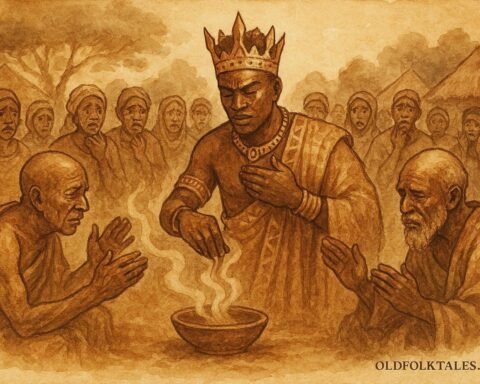
In the ancient lands of Ethiopia, there once lived a renowned physician whose wisdom was known throughout the region. When death claimed him, he left behind a young wife and an infant son. True to her husband’s dying wish, she named the boy Hasseeboo Kareem Ed Deen, hoping he would follow in his father’s footsteps.
As Hasseeboo grew, his mother sent him to learn various trades tailoring, silversmithing, carpentry but the boy’s hands seemed unwilling to master any craft. After many failed attempts, she allowed him to remain at home, though worry gnawed at her heart. One day, curiosity led Hasseeboo to ask about his father’s profession. When his mother mentioned the physician’s books, the young man searched until he found them hidden away, though insects had rendered them nearly useless.
Fortune seemed to smile when four neighbors approached with an offer. They were woodcutters who traveled to the forest daily, loading their donkeys with firewood to sell in town. “Let your son join us,” they proposed. His mother agreed, purchasing a donkey so Hasseeboo could begin this new venture.
Looking for more? Explore the magic of East African folktales here
For six days, the work went well, and money flowed steadily. On the seventh day, heavy rains drove them beneath rocky overhangs for shelter. While his companions huddled together, Hasseeboo sat alone, idly tapping a stone against the ground. The hollow echo that returned surprised him. “There’s something beneath us!” he called out.
Their digging revealed an extraordinary discovery, a deep pit filled to the brim with golden honey. Greed sparkled in the men’s eyes as they abandoned their woodcutting trade entirely. They devised a plan: Hasseeboo would descend into the pit to collect the honey while they hauled it up and sold it in town. For three profitable days, this arrangement worked perfectly.
When only dregs remained at the bottom, the neighbors instructed Hasseeboo to scrape together every last drop while they fetched rope to pull him out. But treachery darkened their hearts. Instead of returning, they divided his share among themselves and went to his mother with a fabricated tale of lions and disappearances in the forest. The poor woman wept bitterly, believing her only son devoured by beasts.
Deep in the pit, Hasseeboo’s hope faded with each passing hour. Three days of calling into emptiness convinced him of his abandonment. He paced the confined space, nibbling honey scraps and wrestling with despair. On the fourth day, a large scorpion dropped from above. After killing it, inspiration struck, where had it come from? Searching carefully, he spotted a thin crack of light. His knife became his salvation as he carved and scraped until the opening grew large enough to squeeze through.
The passage led to a world beyond imagination. Following a winding path, Hasseeboo discovered a magnificent house with doors of gold, locks of gold, and keys fashioned from pearls. Chairs inlaid with jewels adorned every room. Exhausted, he collapsed upon a splendid couch in the reception hall.
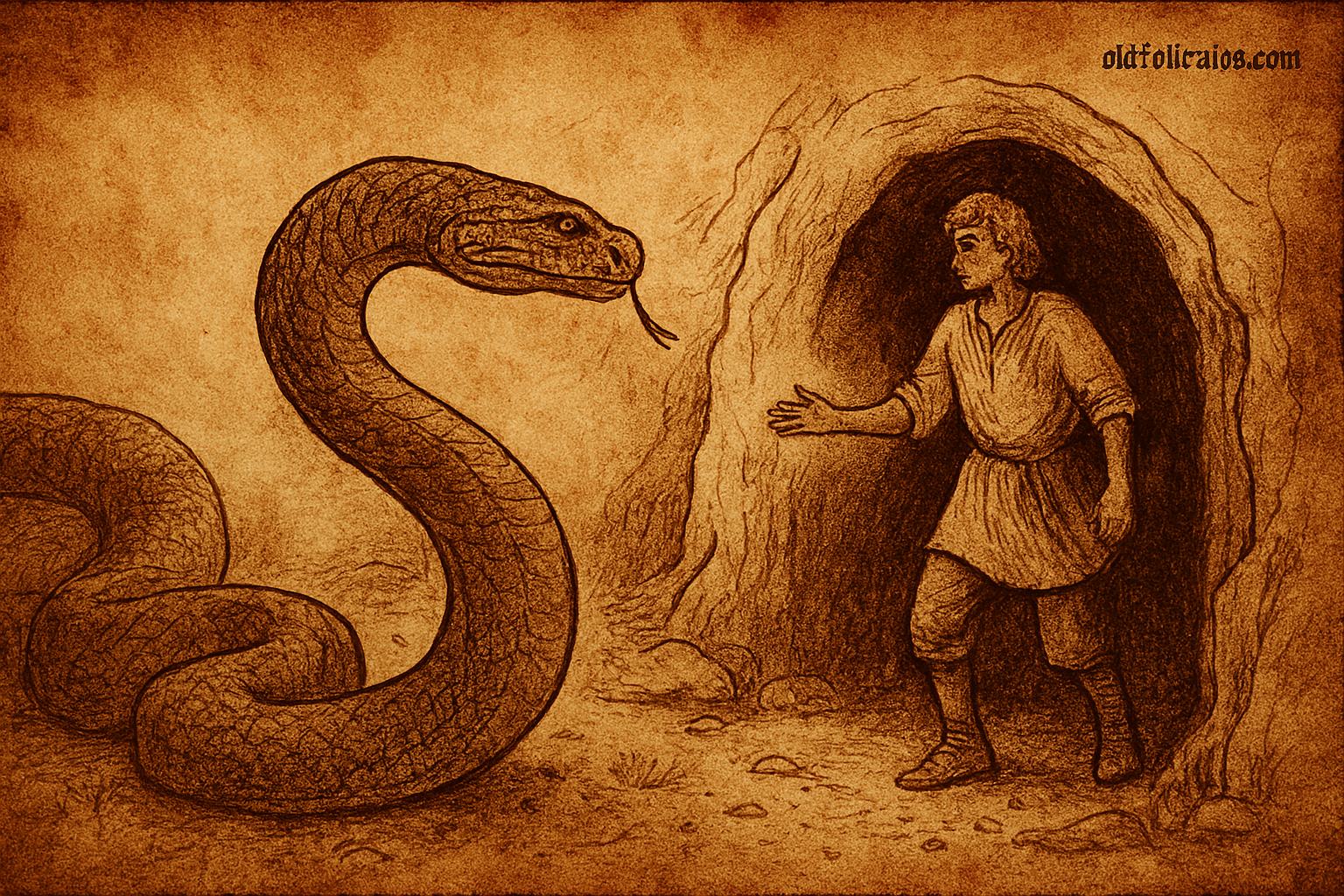
Gentle voices woke him. Opening his eyes, Hasseeboo found himself surrounded by serpents, their scales shimmering in the light. One wore colors of unmistakable royalty. “Who are you?” the young man gasped.
“I am Sultaanee Waa Neeoka, king of the snakes,” came the reply. “This is my dwelling. And who might you be?”
After introductions and a generous meal of the finest fruits, Hasseeboo recounted his betrayal. In turn, the snake king shared an extraordinary tale about a wanderer named Bolookeea who sought an unborn prophet, and another called Al Faan who coveted King Solomon’s magical rings. The story wound through betrayals, magical medicine that allowed walking on water, burnt sorcerers, and tragic love between a prince named Jan Shah and a genie’s daughter who could transform into a bird. Each tale nested within another like treasures in a box.
When the stories ended, Sultaanee Waa Neeoka spoke with sadness clouding his voice. “When you return home, you will bring about my death.”
“Never!” Hasseeboo protested. “How could I repay your kindness with harm? I swear I would never hurt you.”
The snake king’s eyes held ancient knowledge. “I believe your heart is true, but fate has its own design. Promise me one thing when you go home, do not bathe where many people gather.”
Hasseeboo gave his solemn word. The snake king sent him safely home, where his mother embraced him with tears of joy, scarcely believing her son lived.
Meanwhile, the sultan of their town had fallen gravely ill. His physicians declared that only one remedy could save him: soup made from boiling the king of the snakes. The vizir, for mysterious reasons, posted guards at the public bathhouses with orders to seize anyone bearing a particular mark upon their stomach.
Three peaceful days passed before Hasseeboo’s memory faltered. He went to the public baths and was immediately seized. The vizir demanded, “Take us to the snake king’s home.”
“I don’t know where it is,” Hasseeboo insisted, but his defiance earned him brutal beatings until his back was raw with wounds. Unable to bear more pain, he surrendered and led them to that golden house.
Sultaanee Waa Neeoka showed no surprise. “Did I not warn you?” he asked gently, then saw Hasseeboo’s injuries. “There is no hope for me now, but you must be the one to carry me.”
As they traveled, the snake king whispered final instructions about three skimmings from his cooked body how the first would bring revenge upon the cruel vizir, the second would transform Hasseeboo into a great physician, and the third would cure the sultan. Everything unfolded exactly as prophesied. The vizir died from his greed, the sultan recovered his health, and Hasseeboo became the most celebrated physician in all the land, finally honoring his father’s legacy.
The Moral Lesson
This Ethiopian tale teaches us that destiny often works through unexpected paths, and that true wisdom comes at a cost. Hasseeboo’s journey reminds us that betrayal and hardship can lead to unexpected friendships and ultimate redemption. The story also warns against breaking promises, as Hasseeboo’s forgotten oath led to tragedy for his friend, though it fulfilled both their destinies. Most importantly, it shows that knowledge passed down through sacrifice like the snake king’s final gift becomes the most precious inheritance of all.
Knowledge Check
Q1: Who was Hasseeboo Kareem Ed Deen and what was his father’s profession?
A: Hasseeboo was the son of a renowned physician in Ethiopia. Though his father died when he was a baby, Hasseeboo eventually followed in his father’s footsteps and became a great physician himself, though through an unexpected journey involving the snake king.
Q2: How did Hasseeboo discover the snake king’s palace?
A: After being betrayed by his woodcutting companions and trapped in a honey pit, Hasseeboo found escape by following a scorpion’s origin point. He carved through a small crack in the pit wall, which led him through a passage to Sultaanee Waa Neeoka’s magnificent golden palace.
Q3: What is the significance of the nested stories within the tale?
A: The snake king’s story about Bolookeea, Al Faan, and Jan Shah serves multiple purposes, it demonstrates the snake king’s wisdom and experience, shows the consequences of greed and broken trust, and parallels Hasseeboo’s own journey of betrayal and destiny. The nested structure reflects the rich oral storytelling traditions found throughout Ethiopian folklore.
Q4: Why did the snake king predict Hasseeboo would betray him?
A: The snake king possessed prophetic wisdom and understood that fate would force Hasseeboo’s hand. He knew the sultan would fall ill and that his own body would be needed as medicine. The prediction wasn’t about Hasseeboo’s character but about the unavoidable circumstances that would arise, showing the story’s theme of destiny versus free will.
Q5: What cultural elements from Ethiopia are present in this folktale?
A: The story reflects Ethiopia’s position as a historic crossroads of African and Middle Eastern cultures. Elements include Islamic-influenced names (Hasseeboo Kareem Ed Deen), references to sultans and viziers, the honey trade (Ethiopia is famous for its ancient beekeeping traditions), and the tradition of oral storytelling with nested narratives common in Ethiopian storytelling culture.
Q6: What does the transformation of knowledge symbolize in the story?
A: The three skimmings represent different types of knowledge and power: the first (revenge) shows knowledge as a weapon against injustice, the second (medical skill) represents inherited wisdom and professional mastery, and the third (healing) symbolizes knowledge used for the benefit of society. This progression mirrors Hasseeboo’s journey from victim to healer.
Source: Ethiopian folktale