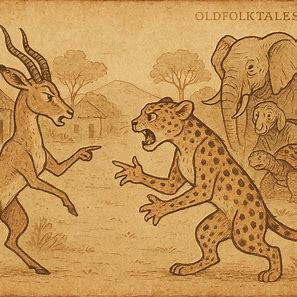
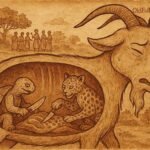
Once upon a time, four animals lived as neighbours in a small town: Njabu the Civet, Vyadu the Antelope, Uhingi the Genet, and Kudu the Tortoise. Each had their own home, yet their houses opened onto the same long street where they often gathered to talk. One afternoon, as famine gripped their land and food was scarce, they sat together in conversation. Tortoise, who was known for his slow but thoughtful words, spoke up: “Tomorrow, let us go out and seek food. We cannot survive here empty-handed.” The others agreed, answering, “Good! As soon as the day breaks, we shall go.”
That night, they returned to their homes to sleep. At dawn, they rose early and set out together. By sunrise, they were on their way, searching the forest and walking for miles. Eventually, they reached a plantation belonging to Njambo’s wife, Ivenga. The plantation was rich with food: sugarcane swayed in the breeze, yams and cassava filled the soil, and sweet potatoes stretched across the earth. Chickens scratched the ground nearby in search of worms.
READ THIS: A Journey for Salt: An Equatorial Guinea Folktale that Teaches Lessons on Disobedience and Delay
The sight tempted each of them. Civet was the first to cry out, “I’ll go no further! I love sugarcane.” He rushed to the cane patch and began eating greedily. Antelope followed, declaring, “I, too, shall stop here. The leaves of potato and cassava are my delight.” He started munching the tender greens. Genet spotted the chickens and exclaimed, “Yes! I see Kuba here! I’ll go no further.” He darted after the flock.
Before settling in, the three asked Tortoise, “And you, Kudu? What will you eat?” Tortoise replied calmly, “I have nothing to eat. But I will wait for you, even two days if needed, and I shall not complain.” Civet boasted, “I will not leave until I finish this cane, then I’ll return home.” Antelope added, “I too will stay here until the potato leaves are gone.” Genet agreed, “I shall remain until I’ve caught every last chicken.” Tortoise only said, “I have nothing more to say,” and went to rest beneath a great tree in the plantation.
For four days, they remained there, feasting. On the fifth day, Ivenga decided to visit her plantation. When she arrived, her heart broke. The cane had been stripped, the potato leaves nearly gone, and feathers from her chickens lay scattered. Lifting her voice, she wailed in sorrow, then ran back to tell her husband, Njambo. Breathless, she told him, “The plantation has been ruined, almost nothing is left!”
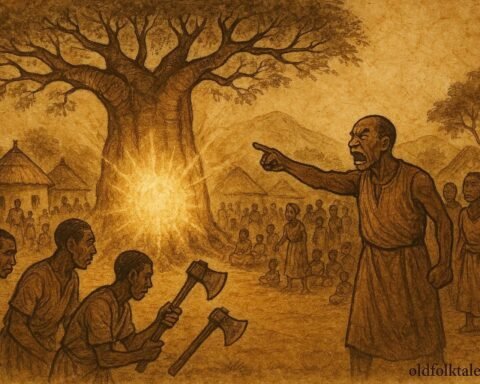
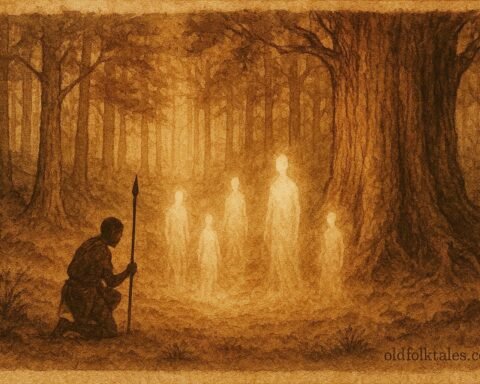
Njambo wasted no time. He gathered twenty men from the town, instructing them to take four nets and four dogs with bells tied around their necks. Armed with guns, machetes, and spears, the men marched into the forest. Soon, the dogs picked up the scent and barked furiously. The hunters came upon Antelope first and shot him dead. Next, they found Genet, who was quickly killed by a gunshot. Finally, they caught Civet and ended his life as well.
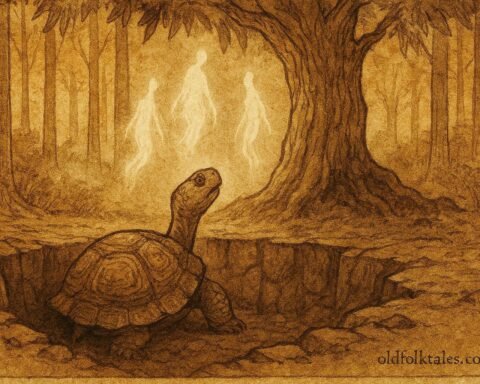
Carrying the carcasses, the hunters prepared to return. Along the way, they came upon the great tree and saw Tortoise lying quietly at its base. Unlike the others, he had harmed nothing. Still, they seized him and took him back with the others.
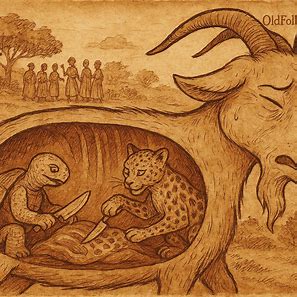
In the town, Njambo ordered, “Suspend Kudu from the roof in a house. Take the skins of Vyadu, Uhingi, and Njabu, and hang them in the same room.” The carcasses of the three were cut up, divided, and feasted upon for several days.
On the fourth day, Njambo told his wife, “I will visit a nearby town. While I am gone, prepare Kudu with nganda seeds for me to eat upon my return.” Ivenga prepared the seeds, then went to untie Tortoise. As she reached for the rope in the dim room, Tortoise spoke: “Wait a little.” Surprised, she paused. Then Tortoise asked, “This skin hanging here, whose is it?” She answered, “Vyadu’s. He ate my potatoes, and my husband killed him.” Tortoise nodded. “And this other skin?” She said, “Uhingi’s. He killed and ate our chickens, so he was killed.” “And this one?” Tortoise asked again. “Njabu’s,” she replied. “He ate the sugarcane, and my husband killed him.”
At last, Tortoise asked, “But you, woman, why will you kill me? What have I eaten?” Ivenga fell silent. She could find no reason. Instead of killing him, she cooked fish with the nganda seeds and served it to her husband.
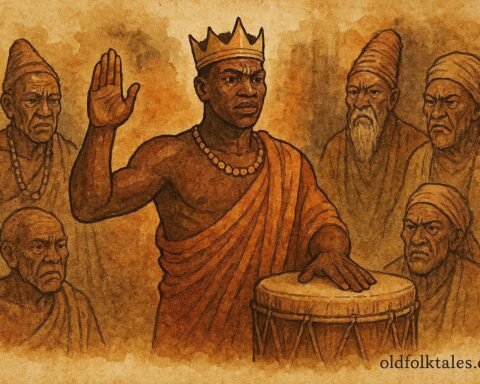
When Njambo returned, he questioned her: “Wife! I told you to cook Kudu, yet you have given me fish.” She replied, “First eat this food, then together we will see about Kudu.” After the meal, they went to the room where Tortoise was suspended. Njambo reached to take him down, but Tortoise spoke: “Wait, man! Tell me, whose skin is this?” Njambo replied, “Vyadu’s. He ate my potatoes, so I killed him.” “And that one?” Tortoise asked. “Uhingi’s,” Njambo said. “He ate my chickens, so I killed him.” “And the other?” “Njabu’s. He destroyed my sugarcane, so I killed him.”
Finally, Tortoise said, “Four of us entered the plantation. You have judged the others by what they ate. Tell me, what have I eaten?” Njambo could not answer. At last, he said, “I have found no reason against you.” He ordered his wife, “Untie him. Let Kudu go free.”
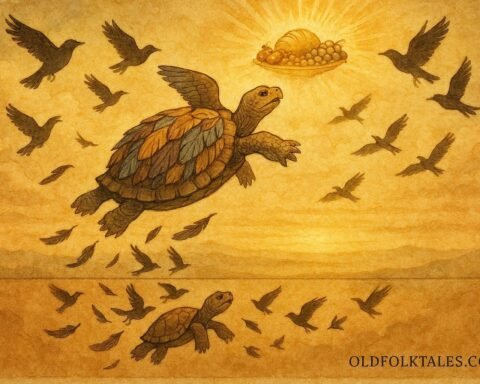
So, Tortoise was released. He hurried back to his town, safe and unharmed, because truth and patience had preserved his life.
Moral Lesson
This tale teaches that truth and innocence are stronger than false accusation or blind punishment. While others fell because of greed and wrongdoing, Tortoise endured patiently without partaking in destruction. His honesty saved him where others perished. The story reminds us that fairness requires judgment by deeds, not assumptions.
Knowledge Check
Q1: Who were the four animals in the story?
A: Civet, Antelope, Genet, and Tortoise.
Q2: What caused the animals to seek food?
A: A famine in their town.
Q3: Why were Civet, Antelope, and Genet killed?
A: They destroyed sugarcane, potato leaves, and chickens in the plantation.
Q4: Why was Tortoise spared?
A: He had harmed nothing and proved his innocence.
Q5: What role did Ivenga play in the story?
A: She owned the plantation and initially intended to cook Tortoise, but spared him when he spoke the truth.
Q6: What lesson does this Equatorial Guinea folktale teach?
A: Innocence, truth, and patience protect those who do no wrong.
Source: Folktale from Equatorial Guinea