In the ancient city of Carthage, where the sea met the desert winds, there lived a humble potter named Ammar. His home stood near the ruins of old temples, and each morning, he shaped his clay while listening to the whispers of the wind that swept through the broken stones. His pots were simple but strong, made for carrying water or storing grain, and though he earned little, his heart was at peace.
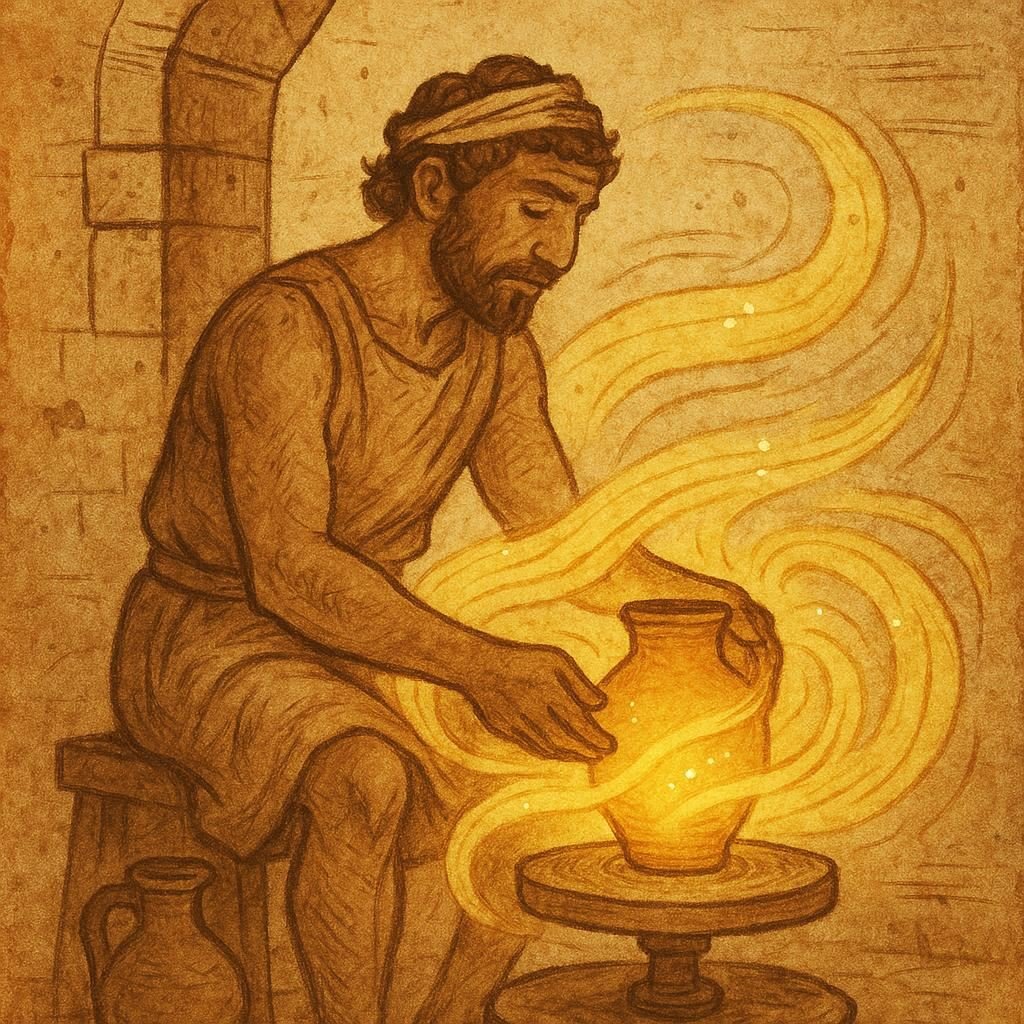
One moonlit evening, as Ammar worked late by his oil lamp, a strange breeze entered his workshop. It was not the dry wind from the desert nor the cool one from the sea. It danced and hummed like a flute. His clay began to move on its own, forming the graceful curve of a jar without his touch. Frightened, he stepped back, watching the wind shape his clay into a perfect vessel smoother than any human hand could make. Then a voice rose from the air.
Want to dive deeper? Read more North African folktales today
“Ammar of Carthage,” the wind said, “your hands are kind and your heart is patient. I am the Spirit of the Western Wind. I will shape your clay if you shape your soul.”
Ammar bowed low, trembling. “Great spirit, I am only a poor potter. Why choose me?”
“Because,” the wind replied, “you still listen.”
From that night, Ammar’s life changed. Each time he worked, the wind helped him. Together they made jars that sang when filled with water, plates that shone like sunlight, and lamps that glowed without fire. People from all over Carthage came to buy his work. Even nobles and priests sought his pots, calling him the man whose hands were kissed by the wind.
With fame came gold. Ammar moved from his small hut to a large house near the market. He began wearing bright robes and forgot the quiet mornings he once loved. When the wind came to help him, he shut the shutters and said, “I can do this myself.”
At first, his work remained beautiful, but without the wind’s touch, the clay grew heavy. The singing jars cracked, the shining plates dulled, and the lamps lost their light. Customers complained, yet Ammar’s pride would not bend. “It is only the clay,” he said. “I will find better soil.”
One night, when his pots broke again, he shouted into the darkness, “Where are you, Wind of Carthage? Why do you hide?”
The air grew cold. The spirit answered, not as music but as a storm. “You have forgotten the breath that gave your art life. You shaped clay, but greed shaped you.”
The storm tore through his workshop. His finest pots shattered into dust. The next morning, when the neighbours came to see what had happened, Ammar was gone. Only a small clay figure sat on his wheel — a tiny man bent over a pot, his face humble, his hands outstretched to the wind.
Some say Ammar became one of his own creations. Others say the wind carried him away to teach him once more the rhythm of patience and humility. But to this day, potters in Carthage still leave their workshop windows open when they work, hoping the Spirit of the Western Wind will pass through and bless their clay.
Moral Lesson:
The Potter and the Wind of Carthage teaches that every gift comes with responsibility. True art grows from humility and respect for the forces that inspire us. When pride replaces gratitude, even the most gifted hands lose their touch.
Knowledge Check
Who was Ammar and what was his craft in The Potter and the Wind of Carthage?
Ammar was a humble potter who created clay pots and vessels in ancient Carthage.How did Ammar meet the Wind Spirit?
He encountered the spirit one moonlit night when a strange breeze entered his workshop and shaped his clay.What message did the Wind Spirit give Ammar?
The spirit told him it would shape his clay if he shaped his soul, teaching balance between skill and humility.Why did Ammar lose his gift?
He became proud and stopped listening to the spirit, shutting it out and relying only on himself.What happened after the storm destroyed Ammar’s workshop?
He disappeared, leaving behind a small clay figure that reminded people of humility.What lesson does this folktale teach about creativity?
It teaches that true creativity comes from harmony between human effort and spiritual guidance, not from pride or greed.
Source: Folktale from Carthage traditions, Tunisia. Retold in La Mémoire de Carthage by Michel Duran (1960).