Long ago, in the heart of Equatorial Guinea’s lush forests, two unlikely companions lived as neighbors and friends, Squirrel, known as Ihendi, and Adder, the serpent Pe. They often visited each other, shared meals, and boasted of their strong bond. Each had two wives, and for a time, their friendship seemed unshakable. Yet, beneath the laughter and gestures of goodwill, a shadow of pride and rivalry lingered, waiting for its moment to erupt.
One afternoon, Squirrel and one of his wives visited Adder’s household. As custom demanded, Adder welcomed them warmly. He turned to his wife and ordered, “Prepare food for our guests.” Soon, a feast was laid out. But Squirrel, known for fairness, insisted that they should all share equally. He called his wife to join the meal and asked Adder to do the same. When all four sat together, the food seemed blessed with unity. Yet it was during this meal that a seed of conflict was planted.
As they ate, Adder leaned forward and spoke, “Ihendi, I have a question. Between the two of us, who is the elder? And between our wives, who holds seniority?”
READ THIS: What Caused Their Deaths? An Equatorial Guinean Folktale of Desire and Fate
Startled but composed, Squirrel answered, “I am the elder, and my wife is older than yours.”
Adder’s eyes flashed. “No! I am the elder, and my wife is the senior one.”
The quarrel could have erupted then and there, but Squirrel replied calmly, “Tomorrow, at my house, I shall give you my answer.” The two parted in uneasy silence.
That night, as Squirrel lay restless, he told his wife, “This question hides something dangerous. He does not know my birth, nor do I know his. What does this mean except trouble?”
His wife, wise and cautious, whispered, “Pe seeks a quarrel to kill you, or perhaps our children.” Their children, named Ikundu (Vengeance) and Ihana (Help), slept peacefully nearby, unaware of the storm brewing.
Squirrel resolved, “We will settle this not by words, but by a test of medicine.”
At dawn, Squirrel challenged Adder to the ordeal of kwai, the poison-charm used to reveal guilt. “Let us drink together,” he declared, “for we are friends, and suspicion must not fester.”
Adder agreed. Squirrel first gathered leaves and bark from the forest to brew the potion. When it was ready, he bravely drank, swearing an oath: “If I meet Pe’s family, I shall bring only peace.”
Then Adder drank, but instead of peace, he swore, “If I meet Ihendi’s children, I shall swallow them. His father, I shall eat. His mother, I shall devour!”
Squirrel cried out in horror. “Why do you twist the oath so wickedly?” But Adder stood firm. “I said it, and I will not take it back.”
That night, Squirrel and his wife left their children locked safely in their hut as they went to gather food. Yet safety is fragile when betrayal lurks close.
Adder slithered to their house, forced the door, and found Ikundu and Ihana asleep. Awakened, the boys innocently told him, “Our parents are in the forest.” Without hesitation, Adder swallowed them whole. Then he returned to his den, his belly swollen with stolen life.
In the forest, Squirrel’s heart beat heavily. “Something is wrong at home,” he murmured. They rushed back, only to find the door broken and their children gone.
Squirrel stormed to Adder’s dwelling and found him lying distended. “Chum! Have you been to my house?”
“Yes,” Adder replied coolly.
“Where are my children?”
“Did I not swear during the test,” Adder sneered, “that if I met them, I would swallow them? I have kept my word.”
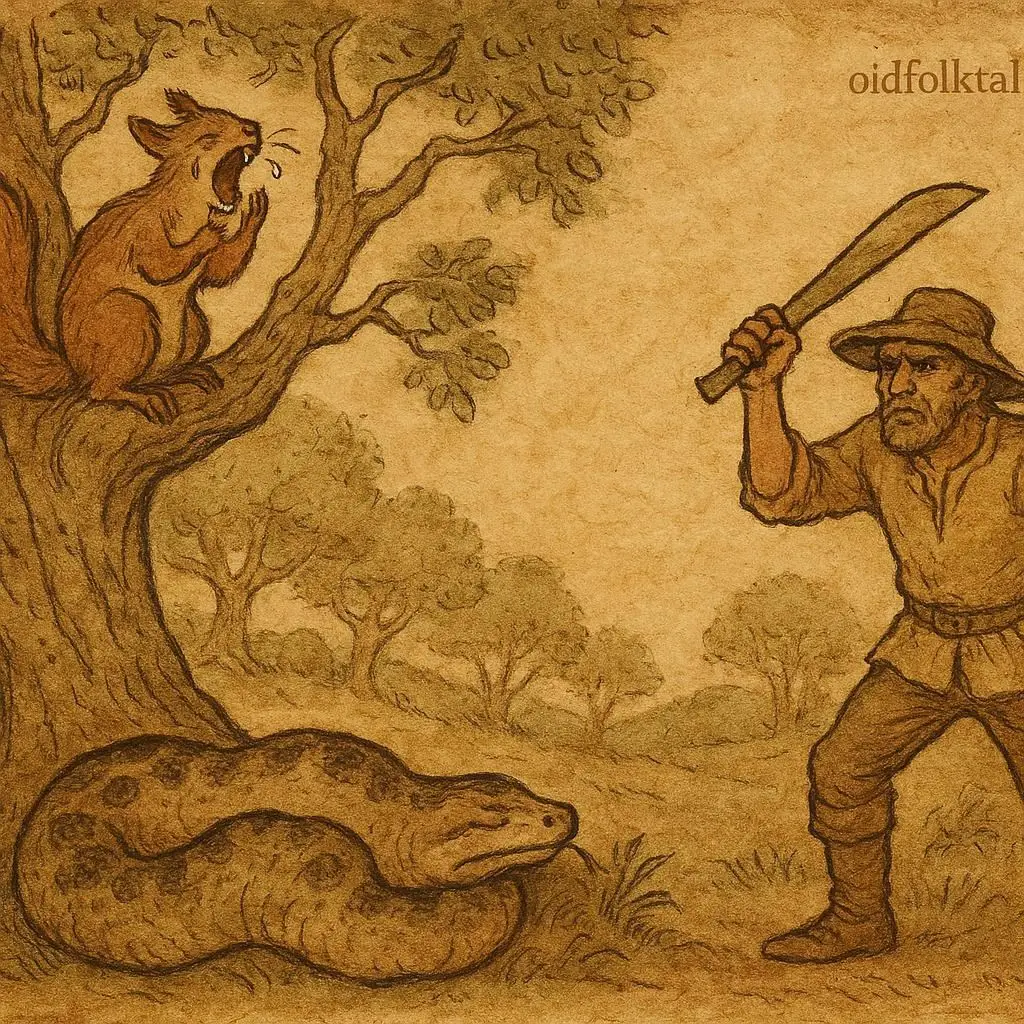
Squirrel, trembling with fury, climbed a great tree and cried out, “Ikundu ja ma! Ikundu ja ma!”, calling vengeance into the air. His wife wailed beside him. Soon, other squirrels gathered, echoing the cries until the forest pulsed with grief.
A passing hunter, hearing the noise, investigated. He saw the squirrels weeping from the treetop and traced their gaze downward. There, at the base of the tree, he discovered Adder, sluggish and swollen. With a swift blow of his machete, the hunter struck him dead.
From the branches above, Squirrel shouted, “You have seen my promised Ikundu!”, a bitter pun, meaning both his son Vengeance and the vengeance itself.
Thus ended the friendship between Squirrel and Adder, broken by pride, poisoned by suspicion, and sealed in betrayal.
Moral Lesson
This tale warns that pride and rivalry can destroy even the strongest bonds of friendship. Trust, once broken, leads only to ruin. Flattery may disguise evil intent, but true character is revealed in times of testing. The story also reflects the wisdom of listening to premonitions, our hearts often know danger before our eyes can see it.
Knowledge Check
Who were the main characters in the folktale?
Squirrel (Ihendi) and Adder (Pe), once friends turned rivals.
What sparked the quarrel between Squirrel and Adder?
A dispute over seniority between themselves and their wives.
What traditional test did they use to prove innocence or guilt?
The ordeal of kwai, a poison-charm ritual.
What happened to Squirrel’s children, Ikundu and Ihana?
Adder swallowed them after breaking into Squirrel’s house.
How was Adder finally killed?
A hunter struck him down with a machete after hearing the squirrels’ cries.
What is the main moral of the story?
Pride and broken trust destroy friendship, while suspicion often hides betrayal.
Source: Equatorial Guinean Folktale