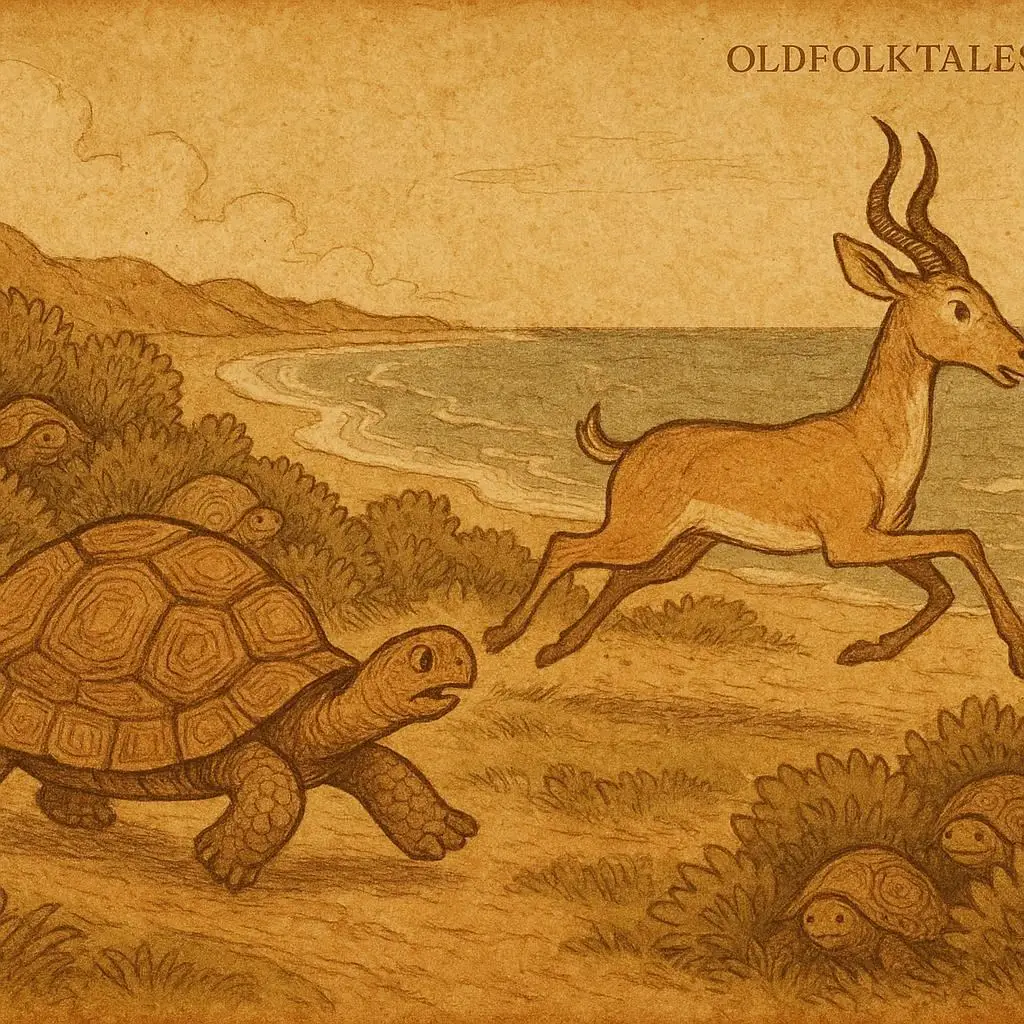
Long ago, in the rich forests and coastal plains of Equatorial Guinea, quarrels often arose among animals and men over the question of seniority. Who was the elder? Who deserved respect? Such disputes were common, and they often ended in rivalry. The animals were no different. It was said that the wide spread of tortoises across the lands of Batanga, Gaboon, Ogowe, and even the distant corners of the equatorial coast, came from a single contest in which the tortoise proved his superiority. From that day, the tortoise was remembered by many names and nicknames, Manyima, Evosolo, and countless others whispered with reverence and jest.
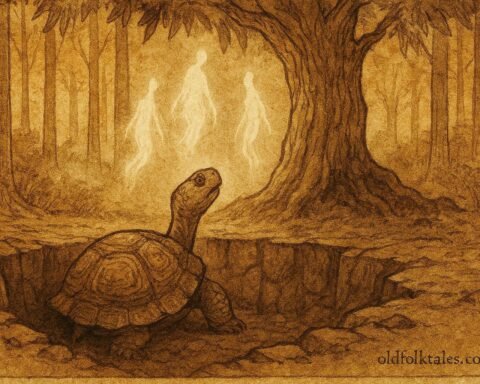
Tortoise once lived in a shared town with many other animals. For a time, peace reigned. But eventually, they quarreled and parted ways, each creature building its own village. Tortoise, restless by nature, decided one day to wander from his home, leaving behind his wife and two children.
As he traveled, he came to the village of Antelope. Antelope welcomed him warmly, killed a fowl, and served him food. They shared a meal in good spirits, until Antelope leaned back and asked, “Kudu, my friend, what is the purpose of your journey?”
Tortoise replied firmly, “I have come to ask you which of us is older.”
Antelope’s eyes gleamed with pride. “Surely, Kudu, I am older than you.”
But Tortoise shook his head. “No, I am the elder.”
“Then prove it,” Antelope challenged.
READ THIS: The Goat’s Tournament: An Equatorial Guinean Folktale of Strength, Pride, and Shame
“I will show you a sign of seniority,” said Tortoise. “Let us race.”
Antelope burst into laughter. “A race? Against you, Kudu? How could that test seniority? You do not run.” But Tortoise’s sharp gaze did not waver. Antelope, amused and a little prideful, agreed. “Very well. In three days, we shall race.”
Tortoise declared boldly, “You, Mbalanga, cannot defeat me.” Antelope laughed again, but the challenge was set.
The course was chosen: a long stretch of more than seventy miles, from the Campo River northward to the Balimba Country.
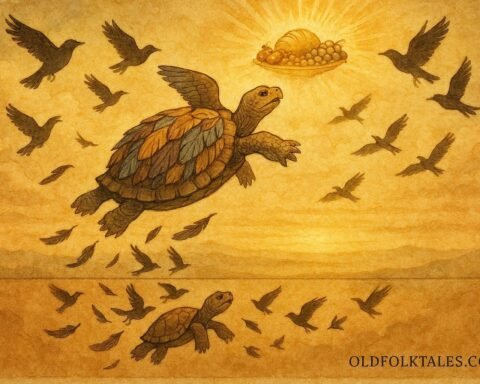
Tortoise returned home and summoned the entire Tortoise Tribe. They gathered, many of them, until the place was crowded with shells and quiet determination. Tortoise spoke: “I have challenged Mbalanga to a race. Alone, I cannot win. But with your help, victory is certain. Line yourselves along the bushes at the edge of the sea-beach from Campo to Balimba. Each of you shall wear a colored mark so we all look alike. When Antelope grows weary and looks back to see if I follow, he will call, ‘Kudu, where are you?’ Whoever is nearest must step forward and answer, ‘Here I am!’ In this way, Antelope will believe I am always beside him.”
The tortoises nodded, spreading themselves secretly along the path.
Meanwhile, Antelope told his wife, “Prepare food for me, for I will race Kudu at seven in the morning.”
On the appointed day, the race began. Antelope sprang forward, swift as the wind, his hooves striking the earth with power. He reached the town of Ubenji, ten miles away, and looked back. “Where is Kudu?”
A tortoise emerged from the bushes and called, “Here I am!”
Startled but determined, Antelope raced harder, galloping toward Ipenyenye. Again he looked back. “Where is Kudu?” Another tortoise answered calmly, “Here I am!”
Onward he flew to Beya, then to Lolabe, then to the rocky point of Ilale-ja-moto. At each stop, the same answer echoed: “Here I am!”
Antelope’s pride began to waver. His legs grew heavy, yet he pressed forward to the town of Bongaheli, then another twenty miles to Plantation Beach. Still the reply came, steady as shadow: “Here I am!”
Exhaustion gripped him. His breath came in sharp gasps. His body trembled. Yet he forced himself onward to Small Batanga, and finally toward Balimba, determined not to yield. But there, at the finish, Tortoise himself waited.
When Antelope stumbled into the settlement, froth foaming at his mouth, he collapsed to the ground, dead from weariness. Tortoise, who had prepared for this, gave him a magic medicine and revived him. Antelope opened his eyes, humiliated, while Tortoise beat his shell in triumph and declared, “Never again show me your audacity by daring to run with me. I have surpassed you!”
The two returned separately to their homes. But soon, the Tortoise Tribe and the Antelope Tribe gathered with all the animals in council. Tortoise stood before them and proclaimed, “Mbalanga doubted me. He said I could not surpass him. But today, you have all seen the truth.”
Ashamed, the Antelope Tribe admitted, “Yes, Kudu, you have surpassed our champion. We never thought a slow one such as you could defeat Mbalanga.”
So the council declared that among all animals, the tortoise would be held as greatest. From that day, Tortoise was given authority to rule, not for speed of foot, but for cleverness of mind.
Moral Lesson
This tale reminds us that true strength lies not only in speed or physical power but in wisdom, patience, and unity. Antelope’s pride blinded him, while Tortoise’s strategy and cooperation with his kin secured victory. It teaches that those underestimated may rise to greatness through cleverness, planning, and humility.
Knowledge Check
Q1: Who challenged Antelope to a race?
A1: The tortoise, known as Kudu.
Q2: How did Tortoise plan to win the race?
A2: He secretly stationed his relatives along the race path to answer for him.
Q3: What was the length of the race course?
A3: More than seventy miles, from the Campo River to Balimba.
Q4: Why did Antelope collapse during the race?
A4: He exhausted himself trying to outrun Tortoise, believing he was always behind him.
Q5: What was Tortoise given after winning the race?
A5: Authority to rule over the animals, recognized as the greatest.
Q6: What is the main lesson of the story?
A6: Wisdom and strategy can overcome speed and pride.
Source: Equatorial Guinean folktale