Long ago, when the plains of the Kalahari stretched wider than the eye could see and the sun’s breath turned the earth to powder, there lived a man who could speak to the clouds. His name was Kuba, the Rainmaker. It was said that with a song and the shake of his gourd rattle, he could call storms from the far edges of the sky.
The people depended on him, for without rain, there would be no grass for the antelope, no roots for the women to dig, and no water for the children to drink. But even the greatest rainmaker cannot fight a stubborn sky forever. One season, the clouds turned their backs on the land. For many moons, no drop fell, and the earth cracked like an old calabash.
ǂKuba’s daughter, !Nasi, watched the people grow thin and weary. She was young, with eyes that shone like pools in the moonlight, but her heart carried the weight of her people’s thirst. Every morning she woke to the sight of dust drifting over empty wells.
A Dying Village
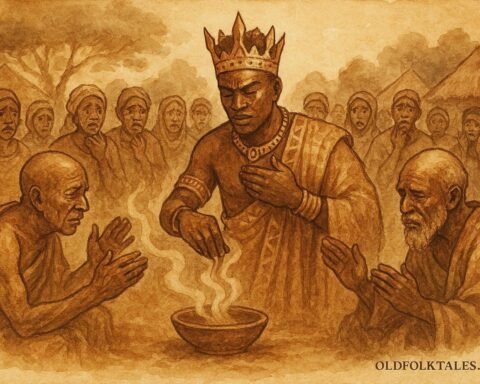
By the third moon of drought, children cried from thirst, and the hunters returned empty-handed. Even the wind seemed to carry no life, only the hot sigh of the desert. The elders whispered that perhaps the rain spirits had turned away forever.
ǂKuba tried all his songs. He danced until his feet bled, rattled his gourd until his arms shook, and painted his body with white clay to call the sky’s attention. But the heavens stayed silent.
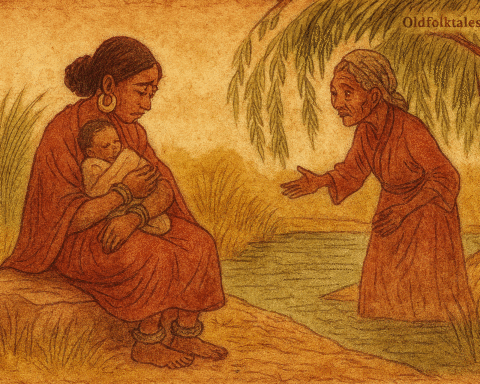
One night, as !Nasi fetched water from the last shallow pool, an old woman appeared from the darkness. Her hair was white as baobab flowers, her cloak made from the skins of waterbirds. She spoke in a voice like the rustle of reeds:
“The rain spirits are angry because men have grown greedy. They take from the land but do not give back. Only one who is pure of heart, who seeks not for herself but for her people, can walk the path to the Rain’s dwelling.”
The Journey to the Rain’s Dwelling
!Nasi’s heart beat fast. “Tell me the path,” she begged.
The old woman pointed toward the horizon. “Three days’ walk to the east you will find the Mountain of Mists. At its peak lies the Pool of Beginnings. If you reach it and give an offering of your life’s truest gift, the rain spirits will listen.”
Without telling her father, !Nasi set out before dawn. She carried no food, only a small gourd of water and her mother’s necklace of carved bone beads—the only thing she treasured more than life.
The journey was harsh. The first day, the sun clawed at her back and her lips split from dryness. On the second day, she crossed a plain where thorn bushes tore at her legs and hyenas laughed in the distance. By the third day, her water was gone, and the Mountain of Mists rose before her like a sleeping giant.
The Sacrifice
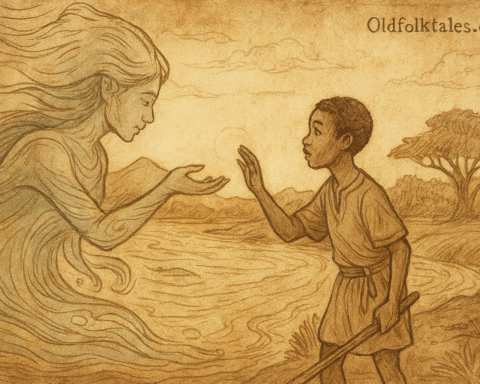
She climbed until her legs shook and her breath came in ragged gasps. At the summit, the Pool of Beginnings shimmered, though no river fed it. Mist curled above the water like spirits whispering secrets.
!Nasi knelt at the edge and spoke aloud: “Rain spirits, I am the daughter of ǂKuba, but I come not with my father’s power. I come with my own heart. My people are dying. Take what you must from me, but let the rains return.”
She removed her mother’s necklace and placed it in the water. The mist thickened, curling around her like a living thing. Then a voice, soft as a falling drop, spoke:
“You give us your greatest treasure, but the earth needs more than beads. Will you give us your voice, that your songs may call us whenever we are far away?”
!Nasi hesitated, for she loved to sing more than anything. But she remembered the cracked earth, the thirsty children. “Yes,” she whispered.
The mist swirled higher, and suddenly the pool erupted with light. !Nasi felt her voice lift from her throat like a bird taking flight. Her body shrank, her arms became wings of brown and white feathers, and her mouth became a sharp beak.
She had become the first rainbird.
The Return of the Rain
From that day, whenever the people heard the cry of the rainbird, they knew rain would follow. !Nasi flew over the Kalahari, her call carrying to the clouds, beckoning them to return. The rains came that very week, drumming on the earth, filling the rivers, and bringing green back to the land.
ǂKuba searched for his daughter, but the old woman appeared again, telling him the truth: “She walks the skies now, your child, and calls the rain for all who live.”
And so, the Bushman people tell this tale whenever they hear the rainbird’s cry—reminding them of the girl who gave her voice so her people might live.
Moral of the Story
In the traditions of the Bushman people, “The Rainmaker’s Daughter” teaches that true leadership and courage come from sacrifice, not power. !Nasi’s journey shows that the greatest gift is not what we keep, but what we give for the good of others. When our hearts act for the benefit of the community, our deeds ripple outward, carrying blessings long after we are gone.
Knowledge Check
1. What is the origin of “The Rainmaker’s Daughter” in African folklore?
This tale comes from the Bushman (San) oral tradition of Southern Africa, where rainbirds hold symbolic meaning as messengers of rainfall.
2. Why does !Nasi leave her village in the story?
She leaves to find the Rain’s dwelling and plead with the rain spirits to end the drought threatening her people.
3. What transformation happens to !Nasi at the Pool of Beginnings?
She is transformed into the first rainbird after sacrificing her greatest treasures—her necklace and her singing voice.
4. How does the story explain the rainbird’s cry?
The rainbird’s cry is !Nasi’s voice calling to the clouds, summoning rain to the land.
5. What lesson does “The Rainmaker’s Daughter” teach about sacrifice?
It teaches that selfless sacrifice for the good of others creates lasting change and blessings beyond one’s lifetime.
6. How is “The Rainmaker’s Daughter” an origin tale?
It explains the origin of the rainbird and its role as a harbinger of rain in Bushman belief.