In the days when the moon still felt like a beloved neighbor whose name you could whisper into the tropical night, the island of Mauritius held fast to its ancient ways. Fishermen possessed the gift of reading the restless sea as clearly as scripture, their weathered hands tracing meanings in every wave and current. Cane-cutters would rise before dawn to whistle melodies that danced with the trade winds, their songs blessing the sugar fields with hope for a sweet harvest. And the grandmothers, ah, the grandmothers carried such wisdom in their silver-crowned heads that they could tell which spirit had visited a household simply by studying how the cooking fire embers had cooled through the night.
Between the coral bays that sparkled like scattered jewels and the endless sugarcane fields that swayed like a green ocean, there wound a narrow road that villagers called La Route des Veillées, the Road of Night-Watches. This path earned its name because island folk traveled it at all hours: farmers heading to distant markets before sunrise, plantation workers returning home under starlight, and families journeying to visit relatives scattered across the island like seeds carried by the wind.
On the edge of one such village lived a young man named Ti-Jean, whose heart was as warm as the morning sun but whose spirit carried the restlessness of youth. During the day, Ti-Jean labored in the fields where the red earth stained his hands and the humid air filled his lungs. When evening painted the sky in shades of mango and flame, he would return home to play his buri, a simple flute whose melodies could make even the cicadas pause their singing or help his beloved mother, Mama Anila, repair the fishing nets that meant survival for their small family.
Also read: The Ghost That Walked at Midnight
One particular rainy season brought hardship to the island like an unwelcome guest. The rains that should have blessed the hills with life-giving water failed to come, leaving the earth cracked and thirsty. Rivers that once flowed strong and sure shrank to angry ribbons of muddy water. Rice paddies that should have been emerald mirrors reflecting the sky turned into fields of brittle, brown stalks that crumbled at the touch. In those desperate weeks, many island folk began traveling by night to seek work in distant places, moving through the darkness like boats cutting across a black sea of uncertainty.
One evening, as the last cicadas sang their twilight chorus and stars began to wash the heavens with liquid silver, Ti-Jean prepared for such a journey. He needed to walk to the neighboring village to collect wages owed to his mother money they desperately needed to buy rice and oil. He tied his leather satchel securely across his chest, kissed Mama Anila’s weathered brow with all the tenderness in his young heart and promised to return home before the first roosters crowed at dawn.
The road stretched before him that night, empty except for the ancient chorus of crickets and a salt-sweet wind that carried memories of sugar mills and ocean waves. The moon hung above like a benevolent guardian, casting silver shadows that danced between the towering sugarcane stalks.
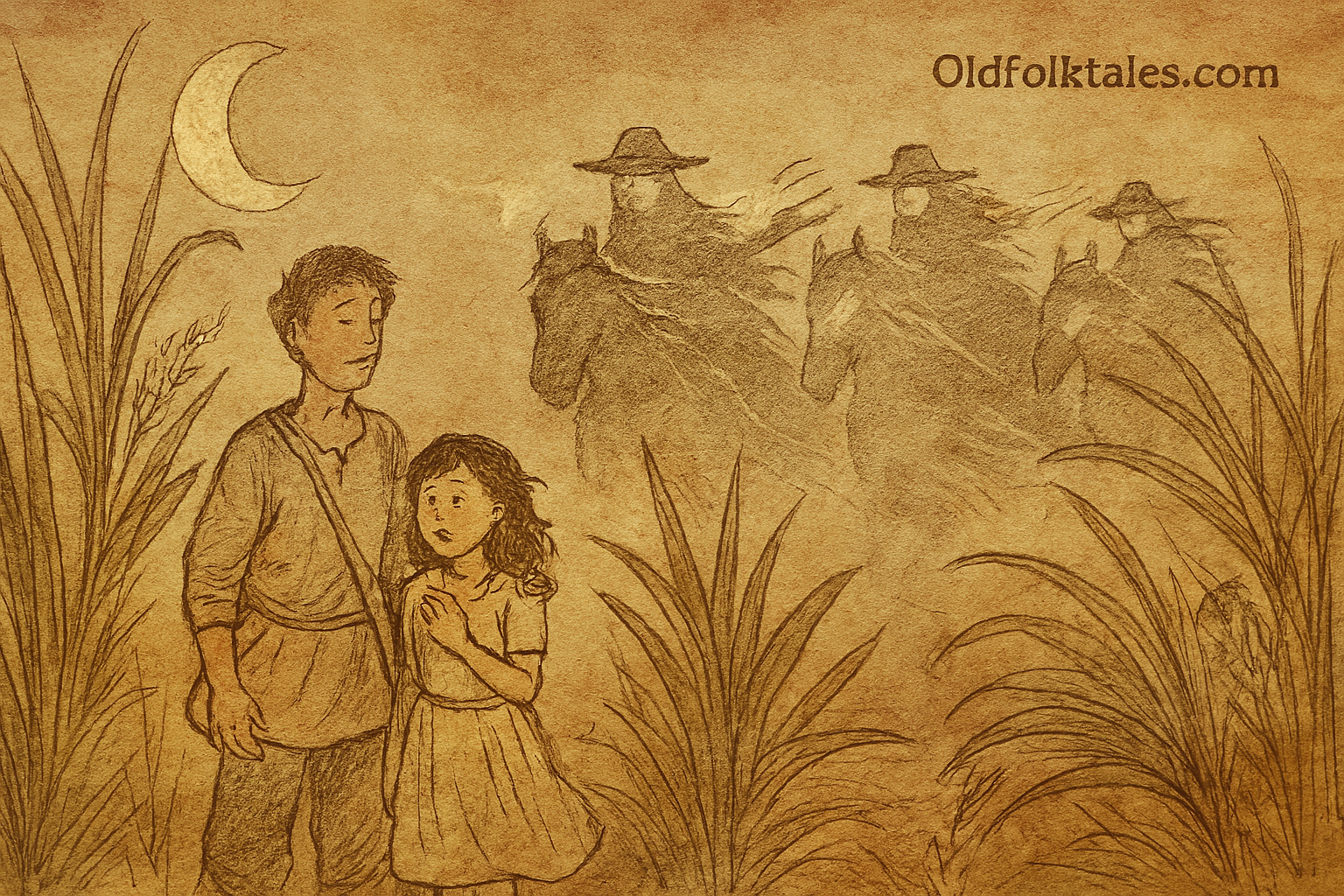
Halfway between the two villages, where the cane grew taller than the tallest man and formed green walls on either side of the path, Ti-Jean’s ears caught a sound that stopped his heart, the frightened cry of a child. He paused, every muscle tense with concern, and from the shadowed path emerged a small figure: a little girl named Lali, her dark eyes wide with terror that reflected the moonlight like pools of water. She had chased her family’s wayward goat into the maze of cane fields and lost her way completely. Her tin lantern held only the dying glow of a wet wick, barely bright enough to illuminate her tear-stained cheeks.
“Don’t worry, little sister,” Ti-Jean said gently, extending his hand to her trembling fingers. “I know these roads like the lines on my palm. I’ll take you home safely.”
Together they walked along the moonlit path, but the night seemed to press around them like a living thing with intentions of its own. From deep within the cane rows came strange sounds: the hollow echo of something that might have been a hoof but felt wrong somehow, and the rustling whisper of something riding the night wind with purposes unknown to mortal hearts. Lali’s lantern flickered like a dying heartbeat as she clutched Ti-Jean’s sleeve with desperate fingers, whispering fearful tales her grandmother had told her, stories of dark riders who stole the voices of careless travelers and left them mute forever.
Ti-Jean offered what comfort he could to the frightened child, but he could not deny the way his skin prickled with ancient warnings, the way his neck hairs stood on end as if lightning were about to strike.
Suddenly, the lost goat they sought began to bellow with terror, then silence fell so complete and absolute that Ti-Jean felt as though the entire world had been swallowed by some enormous mouth. Lali’s lantern guttered and died as if invisible fingers had pinched out its flame. The darkness tightened around them like a fist closing.
And then from the soundless void, from the spaces between the swaying cane, came the steady, rhythmic trampling of many hooves. Not the ragged, frantic scrambling of wild animals, but the measured, purposeful beat of horses bearing riders with clear intentions. Shapes began to separate themselves from the night sky like black leaves detaching from an invisible tree: mounted figures cloaked in darkness deeper than the moonless spaces between stars, their faces hidden beneath wide-brimmed hats that cast shadows within shadows.
They rode in perfect silence, yet the very air seemed to bow before them in respect. These were the legendary Chasseurs de Nuit, the Night Hunters.
Ti-Jean felt no fear in their presence, no sense of threat or danger. Instead, a surprising wave of relief washed over him, for these mysterious guardians wore no masks of cruelty or menace. Their clothing was black as storm clouds gathering on the horizon, but when they turned their hidden faces toward him, their eyes shone with something warm and steady as lighthouse beacons guiding ships safely home.
The tallest rider, who seemed to command the others through presence rather than words, lifted something that glimmered like captured moonlight, a white feather so delicate it seemed woven from mist itself. He tossed it gently into the air, where it hung for a heartbeat before drifting down to land softly on little Lali’s trembling shoulder.
“Walk on,” the tall rider spoke, his voice ringing clear as temple bells across water. “Keep the child close to your heart. Make no loud sounds to disturb the night’s peace. Do not look back when the path turns toward home.”
Ti-Jean bowed his head respectfully, understanding that he was in the presence of something far greater than himself. The hunters’ horses moved like whispers along the road, flowing between the sugarcane and moonbeams as if they were made of the same ethereal substance. Wherever their hooves touched the earth, shadows rearranged themselves into protective hollows, and even the thorns that grew wild along the path seemed to fold their sharp teeth away in deference.
To their joy and relief, Lali’s lost goat suddenly bleated from the reeds beside the road, then trotted out to the little girl’s squealing delight, as if the Chasseurs’ presence had broken whatever spell had held it captive in the darkness.
As they continued their journey, the oppressive weight of the night began to lift like morning mist. When the path curved gently downward and the warm lights of the plantation houses winked like distant planets, Lali’s home came into blessed view. There on the low veranda, her mother stood weeping and calling her daughter’s name into the darkness, her voice breaking with worry and love.
Ti-Jean gently set the child down and noticed that the mysterious feather still rested on her shoulder, no bigger than a baby’s fingernail but soft as cloud-silk and warm to the touch when he brushed it with his palm.
“Keep it safe,” the tall rider’s voice came from somewhere beyond sight. “When dark roads fill your heart with doubt, carry it close and remember: the Chasseurs ride not to frighten the innocent, but to guard them.”
Before Ti-Jean could offer his grateful thanks, the riders had melted back into the sugarcane fields as if the earth itself had opened to swallow them. The green stalks swayed back into their natural positions, and the night wind resumed its ordinary conversation with the leaves and stars.
Ti-Jean reached his mother’s house before dawn’s first blush painted the sky, and he told Mama Anila every detail of their miraculous encounter. She listened with the knowing smile of someone remembering a half-forgotten story from her own childhood, then nodded with deep satisfaction.
“Ah, mon fils,” she said, her voice carrying the salt wisdom of the sea, “the island keeps its ancient promises. We must always be good to the road and to all those who walk upon it.”
Word of the Chasseurs’ protection spread quietly through the villages like seeds carried on gentle winds: fishermen who had lost their way in thick ocean fog found themselves guided safely back to shore; merchants traveling with precious, fragile goods discovered their loads mysteriously protected from thieves and storms; children who feared the deep shadows beneath the mango trees learned that kind protectors watched over them in the darkness.
Years flowed by like the tide, bringing new seasons of joy and sorrow. During one particularly harsh dry season, a wealthy landowner named Monsieur Duval, a man whose pride was as vast as his ignorance, decided to build a fence directly across La Route des Veillées. His plan was to create a shortcut across a sacred hollow that had been blessed by generations of island ancestors. Without asking permission from the villagers who had used the road since time immemorial, he ordered his workers to chop down the ancient fig tree that grew there and to pile stones across the beloved path.
“What harm can an old road suffer?” he scoffed to anyone who dared question his actions. “The land exists to serve my convenience, not the superstitions of simple folk.”
The night after his workers completed their destructive task, the island itself seemed to tremble with outrage. The hired men fled their quarters at the sound of ghostly trumpets that echoed from empty air. Lanterns flickered and died without explanation, leaving their holders trembling in supernatural darkness. When Monsieur Duval attempted to drive his fine carriage along the newly blocked road to demonstrate his power over the land, his coach wheels sank deep into soft, black mud that appeared from nowhere and held his vehicle like quicksand.
Then the Chasseurs de Nuit appeared, riding as slowly and deliberately as justice itself. They dismounted from their spirit horses, and the tall rider, his voice now carrying the weight of distant thunder, spoke words that would change the arrogant landowner’s heart forever:
“This road belongs to all who use it with respect and kindness. What you have destroyed is not merely wood and stone, but the living memory of our people. Restore the sacred hollow. Plant a new tree where the old one stood. Go to the villagers whose path you have stolen, tell them why you acted so thoughtlessly, and seek their forgiveness.”
Humiliated but finally awakened to wisdom, Monsieur Duval obeyed every word. He personally cut away the planks that barred the path and replanted young seedlings beside the ancient fig’s wounded stump. Most importantly, he walked to the village with a humble heart and listened, truly listened, to the people he had dismissed as unimportant. He learned the old names of every lane and path and discovered the stories that made the land a living, breathing part of the island’s soul.
And the Chasseurs de Nuit? They continued their eternal patrol, sometimes appearing as mounted hunters in the moonlight, sometimes as a cooling breeze that refreshed weary travelers, sometimes as a white feather found on a doorstep or a stone mysteriously turned upright beside a difficult path. They never demanded offerings or payment, but those who left bowls of fresh water for stray dogs or took time to sweep the road outside their homes often discovered their harvests were more abundant than expected.
Ti-Jean grew to manhood, married a kind woman who shared his generous heart, and taught his children the names of stars reliable enough to navigate by. He kept Lali’s precious feather in a small wooden box carved with island flowers, taking it out on nights when storm clouds gathered and the air crackled with potential danger. Though he never again saw the tall rider face to face, some mornings he would wake to find the road swept clean, as if caring hands had mended every rut and pothole through the night.
The Moral Lesson
This beautiful Mauritian folktale teaches us that kindness and respect for others especially travelers and strangers creates a protective spiritual force in our communities. The Chasseurs de Nuit represent how our collective goodness manifests as guardianship for the vulnerable. The story emphasizes that roads, paths, and public spaces belong to everyone and should be treated with reverence, while showing how arrogance and selfishness can be transformed through humility and genuine remorse.
Knowledge Check
Q1: Who was Ti-Jean and what circumstances led to his encounter with the Chasseurs de Nuit in this Mauritian folktale? A1: Ti-Jean was a kind young man who worked in the fields and helped his mother Mama Anila. During a failed rainy season, he traveled at night to collect wages owed to his mother and encountered lost child Lali, leading to their meeting with the Night Hunters.
Q2: What was La Route des Veillées and why was it significant to the island community in this traditional story? A2: La Route des Veillées (Road of Night-Watches) was a path between villages used by islanders traveling at all hours farmers going to market, workers returning from plantations, and families visiting relatives across the island.
Q3: How did the Chasseurs de Nuit appear and behave toward Ti-Jean and Lali according to Mauritian folklore? A3: The Chasseurs appeared as silent figures on horses, dressed in black with wide-brimmed hats. They showed kindness by giving Lali a white feather, guiding them safely, making thorns fold away, and helping find the lost goat.
Q4: What did Monsieur Duval do wrong and how did the Chasseurs de Nuit respond to his actions in this legend? A4: Monsieur Duval arrogantly blocked La Route des Veillées with a fence, cutting down a sacred fig tree without permission. The Chasseurs appeared, trapped his carriage in mud, and ordered him to restore the path and seek villagers’ forgiveness.
Q5: What symbolic meaning did the white feather carry in this Mauritian guardian spirit tale? A5: The white feather symbolized protection and served as a promise that the Chasseurs watched over good travelers. Ti-Jean was told to keep it close when facing doubt on dark roads, representing spiritual guardianship.
Q6: According to the folktale, how can people ensure the Chasseurs de Nuit remain benevolent protectors rather than threats? A6: People should treat roads with respect, be kind to travelers and strangers, leave water for stray animals, keep paths clean, and remember that public spaces belong to everyone in the community.
Source: Traditional Mauritian folktale