In a peaceful Mauritian village nestled between endless fields of emerald sugarcane and the sparkling Indian Ocean, there stood a magnificent banyan tree whose presence commanded awe and reverence. Its massive trunk, weathered by countless seasons, rose like a cathedral pillar toward the azure sky. The tree’s branches stretched in every direction like the arms of a gentle giant embracing the world, while its aerial roots cascaded down like silken curtains, creating natural chambers and sacred spaces beneath its sprawling canopy.
The villagers called this ancient guardian Grand-Mère Bwa Grandmother Tree, for it was older than any living memory, older than the eldest person in the village, older perhaps than the village itself. Its shade was so vast and welcoming that a dozen families could gather beneath its protective embrace during the heat of midday, finding blessed relief from the tropical sun that beat down mercilessly on the sugarcane fields.
But Grand-Mère Bwa was no ordinary tree, according to the weathered elders who had spent their lives in its shadow. They spoke in hushed, reverent tones of the spirit that dwelled within its ancient heartwood, the very essence of nature itself, watching over the land with eternal vigilance. On moonless nights, when the world lay wrapped in velvet darkness, travelers passing by swore they witnessed soft lights flickering among the hanging roots, like fallen stars that had chosen to rest in the tree’s embrace rather than return to the heavens.
Also read: The Mermaid Love Story
The village children learned early to approach the banyan with respect and wonder. Their grandmothers warned them with wagging fingers never to mock or harm the sacred tree, for those foolish enough to disrespect Grand-Mère Bwa would surely bring misfortune upon themselves and their families. The tree remembered everything, they said, every kindness and every cruelty.
Yet those who approached with reverence in their hearts, leaving humble offerings of food, cool water, or whispered prayers at the base of its mighty trunk, often found unexpected blessings flowing into their lives. Fishermen who tied bright red cloth strips to the aerial roots would return from the sea with nets so full of silver fish they could barely haul them ashore. Women who carefully laid fresh fruits and fragrant flowers at the tree’s base discovered their gardens blooming with unprecedented abundance, their vegetable patches yielding harvests that fed their families through even the leanest months.
Weary travelers who sought rest beneath the banyan’s natural pavilion spoke of waking feeling completely refreshed, as if they had slept under a loving mother’s protective gaze. They claimed their dreams beneath the tree were filled with peace and wisdom, and that they arose with solutions to problems that had troubled them for months.
However, one dry season brought a challenge that would test both the tree’s power and the village’s faith. A wealthy landowner named Ramdial, whose sugarcane plantation bordered the sacred grove, cast his calculating eyes upon the land where Grand-Mère Bwa stood. Where the villagers saw a living temple deserving of reverence, he saw only wasted space—valuable acreage where rows of profitable sugarcane could grow under the scorching sun.
His cold heart remained unmoved by the gentle warnings of the village elders, who tried to explain the tree’s sacred nature and the disasters that would surely follow any attempt to harm it. Ramdial dismissed their concerns with a contemptuous wave of his hand, his mind focused solely on the additional wealth the land could generate.
“Superstitious nonsense,” he scoffed, his voice carrying the arrogance of a man who believed money could purchase anything, even the right to destroy the sacred. “It is nothing but wood and leaves. No spirit hides in dead timber.”
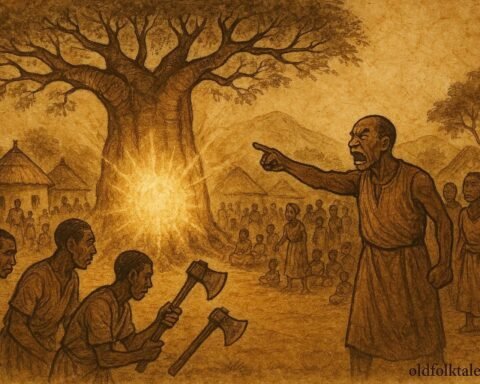
Against the desperate pleas of the entire village, Ramdial ordered his workers to cut down the ancient banyan. With heavy hearts and trembling hands, the laborers approached the tree, axes glinting ominously in the morning sunlight.
The moment the first axe blade bit into the sacred bark, the very air around the tree seemed to thicken with an almost tangible presence. The sky, moments before a brilliant tropical blue, began to darken with unnatural speed as storm clouds gathered from nowhere. Every bird that had made its home in the tree’s vast branches took flight at once, their cries piercing the suddenly oppressive air like the wails of mourning children. Even the workers hesitated, their axes frozen in midswing as an inexplicable dread filled their hearts.
But Ramdial, blinded by greed and stubborn pride, shouted at his men to continue. “It is nothing but a tree!” he bellowed, though his voice carried a tremor he tried desperately to hide.
That very night, as if summoned by the tree’s wounded spirit, a storm unlike any in living memory descended upon the village with supernatural fury. Lightning bolts, brilliant as liquid silver, struck again and again at Ramdial’s sugarcane fields, setting the dry stalks ablaze in columns of fire that reached toward the angry heavens. Torrential rain flooded his carefully tended crops, while winds of impossible strength tore the roofs from his warehouses and scattered his stored grain like offerings to the storm gods.
By the time dawn broke gray and subdued over the devastated landscape, Ramdial’s entire harvest lay in ruins—months of work and thousands of rupees destroyed in a single night of nature’s wrath. Yet remarkably, Grand-Mère Bwa stood completely untouched in the midst of the destruction, its leaves glistening with raindrops like jewels, as if the tree had drunk deeply of the storm and been nourished by it.
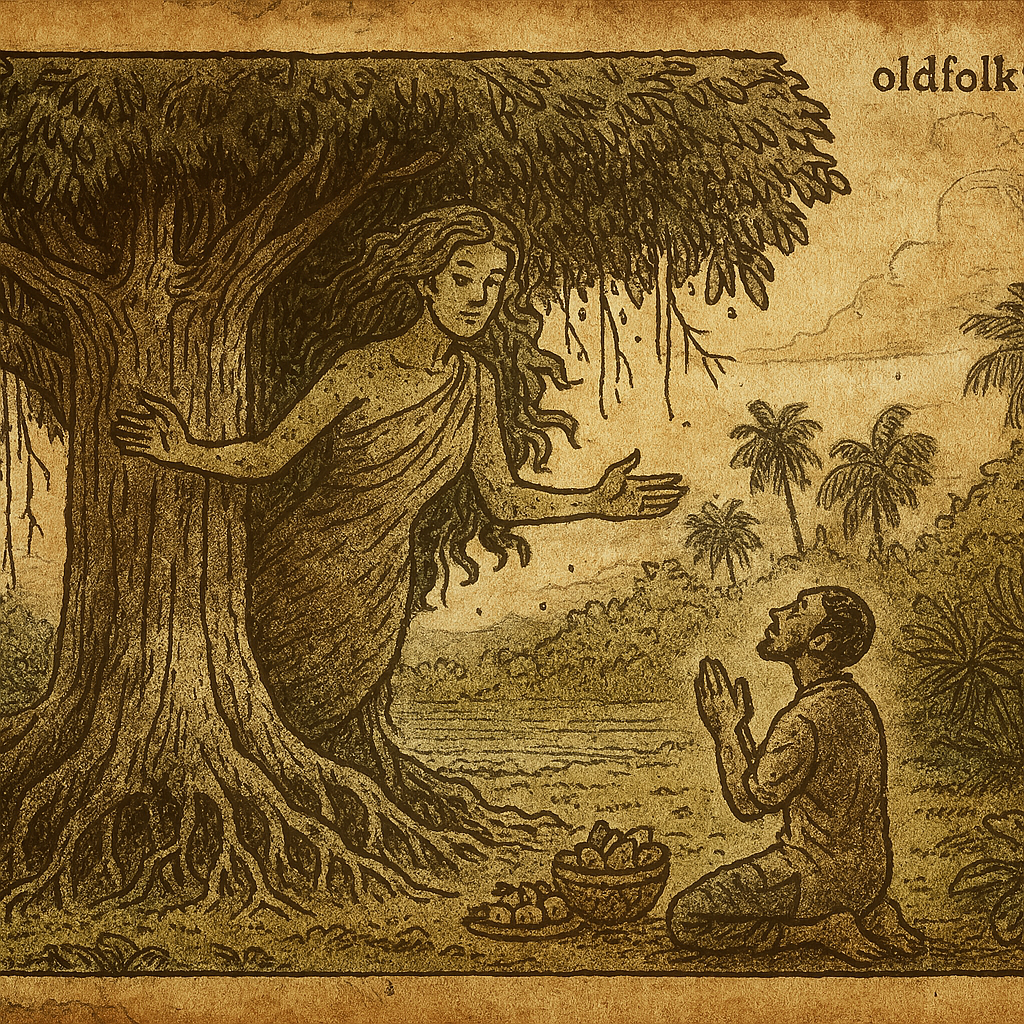
Humbled beyond words and facing financial ruin, Ramdial finally understood the magnitude of his error. With his pride shattered and his heart heavy with genuine remorse, he returned to the banyan tree that he had tried to destroy. Kneeling at its base like a penitent child, he laid offerings of fragrant basmati rice, fresh milk still warm from the cow, and garlands of marigolds and jasmine flowers, the same offerings his grandmother had taught him to make in his youth, before wealth had hardened his heart.
For seven long days and seven longer nights, Ramdial remained beneath the tree, barely eating or sleeping, begging forgiveness from the spirit he had so foolishly challenged. His voice, once commanding and arrogant, became a humble whisper as he confessed his greed and promised to spend the rest of his life protecting rather than exploiting the natural world.
On the seventh dawn, when the sun broke through the lingering clouds like a golden promise of hope, Ramdial discovered something miraculous. Young green shoots were sprouting from the earth throughout his ruined fields, not sugarcane, but wild plants that would restore the soil and prepare it for new growth. It was a sign that the land itself had forgiven him, that nature’s mercy was as powerful as its wrath.
From that transformative day forward, Ramdial became the tree’s most devoted guardian. He ensured that fresh offerings were placed at its roots daily, that no one dared approach it with harmful intent, and that the wisdom of respecting nature was passed down to every child in the village.
The story of Grand-Mère Bwa and Ramdial’s lesson spread throughout Mauritius, carried by traveling merchants and visiting relatives to every corner of the island. To this day, many Mauritians approach banyan trees with deep reverence, tying offerings of food, colorful fabric strips, and flickering candles to their aerial roots. They believe that when you stand quietly beneath a banyan’s sprawling shade, breathing in the earthy scent of its ancient wisdom, you can hear the whispers of ancestors long passed and feel the eternal heartbeat of the island itself pulsing through the ground beneath your feet.
The Moral Lesson
The legend of Grand-Mère Bwa teaches us that nature is not merely a resource to be exploited, but a living force deserving of respect and reverence. The tale demonstrates how greed and disrespect for the natural world bring consequences, while humility and proper stewardship yield blessings. It reminds us that the relationship between humans and nature should be one of mutual respect, where we serve as guardians rather than destroyers of the earth’s sacred gifts.
Knowledge Check
Q1: What was the sacred banyan tree called by the Mauritian villagers and why was it given this name? The villagers called the banyan tree Grand-Mère Bwa, meaning “Grandmother Tree,” because it was older than any living person in the village and its vast shade could shelter multiple families, like a grandmother caring for her extended family.
Q2: Who was Ramdial and what motivated him to want to destroy the sacred banyan tree? Ramdial was a wealthy landowner who owned sugarcane plantations. He was motivated purely by greed, seeing the sacred tree’s land as wasted space where he could plant more profitable sugarcane crops, dismissing the villagers’ spiritual beliefs as superstition.
Q3: What supernatural signs appeared when Ramdial’s workers first tried to cut down Grand-Mère Bwa? When the first axe struck the sacred bark, the sky darkened unnaturally with storm clouds, all the birds fled the branches crying like children, and the air grew heavy with an oppressive presence that filled the workers with dread.
Q4: How did nature punish Ramdial for his disrespect toward the sacred banyan tree? Nature unleashed a devastating storm that struck lightning at his sugarcane fields, flooded his crops with torrential rain, and tore the roofs from his warehouses with powerful winds, destroying his entire harvest while leaving the banyan completely untouched.
Q5: What did Ramdial do to seek forgiveness from Grand-Mère Bwa’s spirit? For seven days and nights, Ramdial knelt at the tree’s base offering rice, milk, and flower garlands while humbly begging forgiveness. He confessed his greed and promised to protect rather than exploit nature for the rest of his life.
Q6: How do modern Mauritians continue to honor banyan trees according to this folktale tradition? Many Mauritians still approach banyan trees with reverence, tying offerings of food, colorful fabric strips, and candles to their roots. They believe standing quietly beneath the trees allows them to hear ancestral whispers and feel the island’s heartbeat.
Source: Mauritian nature folklore