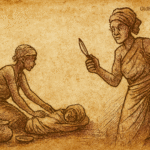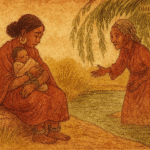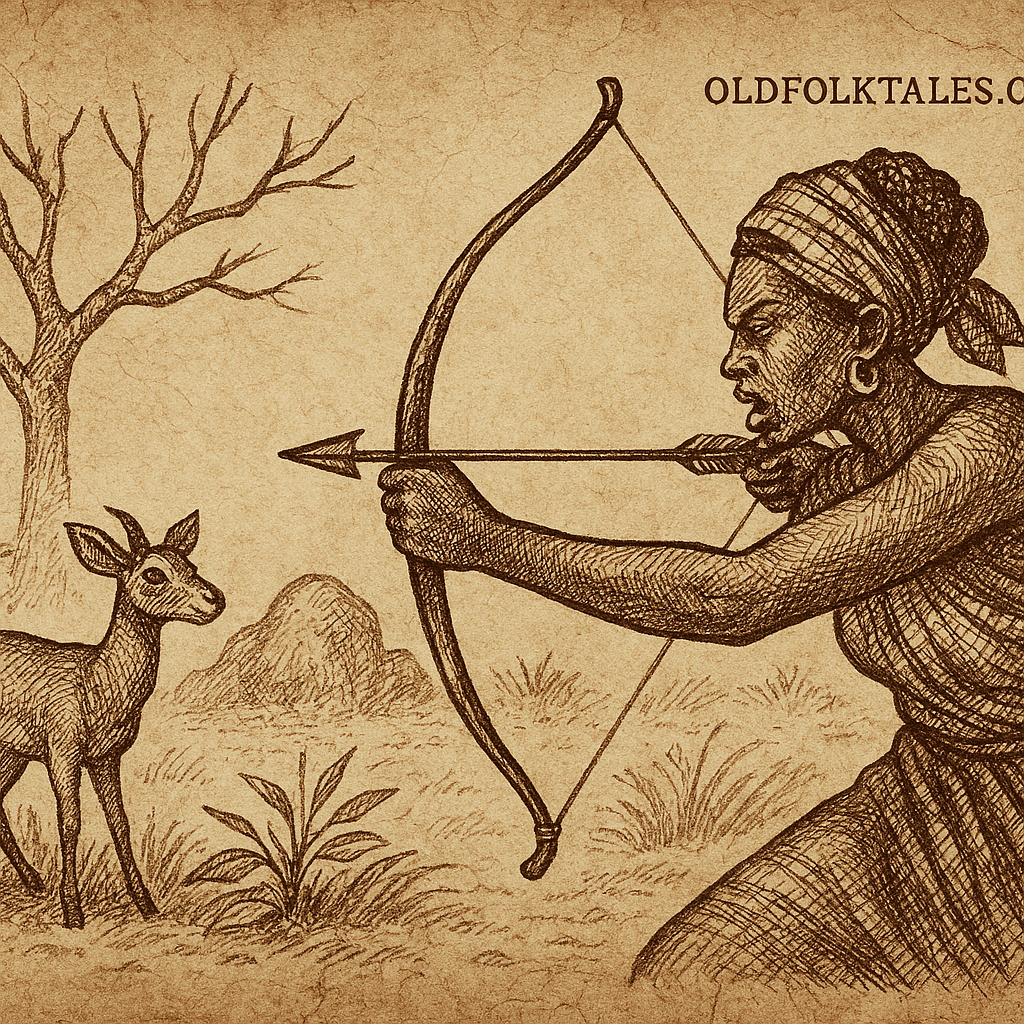
In a time when the boundary between human and animal was as thin as morning mist, there lived a woman possessed of extraordinary and mystical powers. She dwelt in a simple compound with her three beloved children, two daughters whose eyes sparkled with youth and innocence, and one son whose spirit burned with fierce independence. To the outside world, she appeared as any other village mother, tending to her children’s needs with the devotion that marked all good mothers throughout the land.
But when darkness fell and the children’s breathing grew deep with sleep, this woman would undergo a transformation that spoke to the ancient magic still flowing through the veins of the earth. Her human form would shimmer and change, reshaping itself into the body of whatever creature best suited her nocturnal purpose. Some nights she became a swift antelope, bounding through moonlit forests with silent grace. Other evenings found her prowling as a leopard, her spotted coat blending with shadows as she pursued her prey through dense undergrowth.
This supernatural ability was not mere magic for its own sake, it was how she provided for her family, using her shape-shifting powers to hunt the animals that would fill their cooking pot and keep hunger from their door. Night after night, she would kiss her sleeping children’s foreheads, step into the cool air beyond their compound, and surrender her human form to become the perfect predator.
Also read: The Vengeful Friends
One particular evening, as the sun painted the sky in shades of amber and crimson, the woman prepared for what would become a hunt unlike any other. But before she departed, a strange impulse seized her perhaps born from some premonition that whispered through her supernatural senses, or maybe from a mother’s deep need to test the bonds that tied her children to her heart.
She gathered her three children around her, their young faces turned upward in the flickering light of their evening fire, and posed a question that would echo through their lives forever: “If you don’t see me today, what will you do?”
Without hesitation, the children responded in unison, their voices carrying the certainty of youth and the depth of their love: “Today, if you do not return, we will mourn you.”
Satisfied with their answer or perhaps driven by forces she herself did not fully understand the woman handed them a large akekeh lah, a ceremonial bowl that would soon carry more weight than any of them could imagine. With this simple vessel in their possession, she transformed herself into her hunting form and disappeared into the forest darkness, leaving behind the familiar sounds of home for the wild symphony of night hunters.
But unlike every other hunt that had preceded this one, the woman deliberately extended her absence. Hours stretched into days as she remained deep in the forest, testing her children’s devotion through the cruel medium of prolonged separation. The children waited with growing anxiety, their eyes constantly turned toward the paths that led to their home, their ears straining for any sound that might herald their mother’s return.
As hope gradually transformed into despair, the oldest daughter took up the akekeh lah her mother had given them and began to weep. Her tears fell like rain into the bowl as her voice rose in a lament that seemed to capture all the sorrow in the world:
Anga nele o ki ya eh
Has a woman ever delivered a child of hers and killed it?
What will I do, hyraxes?
Her grief was so profound, so pure in its expression of loss, that the bowl filled completely with her tears. When she could weep no more, she passed the vessel to her younger sister, who took it with trembling hands and added her own sorrow to its contents. The second daughter’s tears flowed just as freely, her young heart breaking under the weight of their mother’s absence until she too had no more grief to give.
When the bowl came to their brother, however, something different occurred. Instead of adding his tears to those of his sisters, the boy’s sorrow transformed into anger a fierce, protective rage that burned away his capacity for the mourning his mother had requested. His voice rang out sharp and clear, cutting through his sisters’ gentle sobs with words that would seal his fate
“If our mother has transformed herself and gone to hunt rock-hyraxes, let them kill her! If Mother-Mine has transformed herself and gone to hunt rock-hyraxes, let ndafo carry her away! If our mother has transformed herself and gone to trap nenaa, let those civet cats tear her to pieces! Mourn your mother if you wish, I will not weep for her!”
His sisters stared at him in shock, their tear-stained faces reflecting horror at his harsh words. In their culture, to speak of death and destruction upon one’s own mother was to invite the very calamities one named. Yet their brother stood firm in his defiance, his young heart too proud to bend even in the face of such loss.
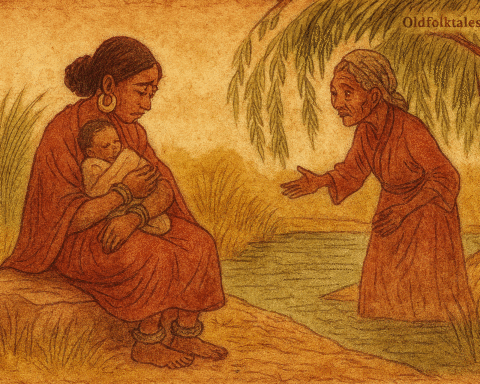
After several days that felt like lifetimes to the anxious children, their mother finally returned from her extended hunt. Her human form materialized from the forest depths as dawn painted the sky in gentle pastels, and her first question revealed the true purpose behind her prolonged absence.
“Did you mourn for me as I requested?” she asked, her supernatural senses already detecting the complex emotions that had swirled through her compound during her absence.
“Yes, Mother, we did,” the girls answered quickly, their voices united in protective harmony as they concealed their brother’s rebellious response.
But their mother’s otherworldly powers allowed her to sense deception as easily as most people detected smoke. “If that is true,” she said, her voice carrying an edge of command that brooked no argument, “then you should demonstrate this mourning now, so I can witness it with my own eyes.”
She retrieved the akekeh lah and handed it to her eldest daughter, who immediately began to weep as she had before, her tears falling freely into the ceremonial bowl. The vessel passed to the second daughter, who similarly filled it with her sorrowful tears, demonstrating the depth of her love and the sincerity of her grief.
But when the bowl reached the boy, his defiance blazed even brighter than before. Instead of tears, curses poured from his lips: “If our mother went to hunt rock-hyraxes, they should kill her! Tigers should tear her to pieces! Civet cats should carry her away!”
The woman’s supernatural nature flared at these words, her maternal instincts warring with her mystical powers. “What kind of child are you?” she demanded, her voice carrying undertones that seemed to echo from otherworldly realms. “You refuse to do what I ask of you?”
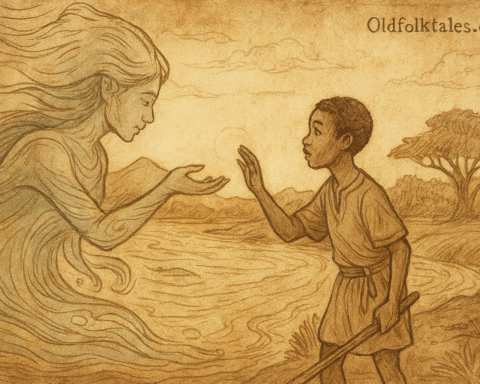
When she struck him in her anger and frustration, the boy’s proud spirit finally broke not into submission, but into flight. He fled from their compound, his sobs echoing behind him as he ran toward the hills that surrounded their home. Only then, when it was too late for reconciliation, did his tears finally flow.
The mother, her supernatural heart torn between anger and love, followed the sound of his weeping. Her voice rose in the same lament her daughters had sung, but now it carried the weight of maternal regret:
Anga nele o ki ya eh
Has a woman ever delivered a child of hers and killed it?
What will I do, hyraxes?
The boy’s flight took him up one hill and down another, his young legs carrying him farther from home with each passing moment. His mother followed desperately, calling his name into the wind, but her son’s anger gave him speed that even her supernatural powers could not match.
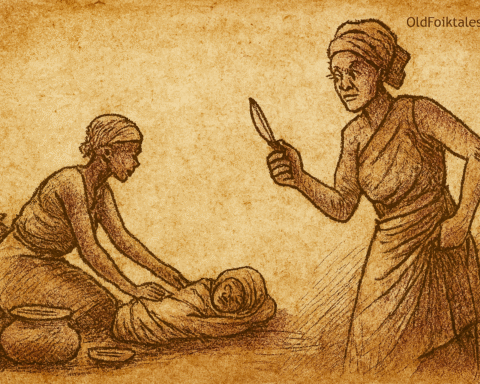
Finally, exhausted and lost, the boy stumbled into a village farm where fate awaited him in the form of a man called Nanga Batebe, a figure whose pleasant demeanor concealed the darkest of intentions. This seemingly ordinary farmer captured the fleeing child and, with casual cruelty that spoke to evils far older than memory, ended the boy’s young life.
When the mother crested the final hill, her supernatural senses suddenly registered a terrible silence. The sound of her son’s weeping, which had guided her pursuit, vanished into the wind like smoke. “Why do I always taunt my children with death?” she whispered to herself, her words carrying the weight of prophecy fulfilled.
Her search led her inevitably to Nanga Batebe’s compound, where the man greeted her with the false warmth of practiced deception.
“Father,” she asked, her voice tight with growing dread, “as you were sitting here, did you see a child come this way? A little boy?”
“No,” Nanga Batebe replied smoothly, his lies flowing like honey from his tongue. “I heard some children playing in the palm bush, some running down by the stream. I don’t know if your child was among them. Please, come in and share a meal with me.”
Desperate for any connection to her lost son and weakened by her long pursuit, the woman accepted his hospitality. Nanga Batebe served her plantain and meat, and she followed proper custom by offering a portion to the ancestors before beginning to eat. But as the first piece of meat touched her lips, a bird’s voice rang out from somewhere above:
“You’re eating the flesh of your child’s body!”
The woman’s supernatural senses recoiled in horror as she threw down the meat and reached for plantain instead. But again the bird’s voice pierced the air: “You are eating plantains prepared with your child’s body!”
Terror gripped her heart as she realized the true source of this meal. The voice seemed to come from everywhere and nowhere, from the trees, from the roof, from the very air around her. She searched frantically for the bird, her eyes scanning every branch and shadow, but her supernatural sight could detect no physical source for the accusations that tormented her.
“Where is this bird hiding?” she whispered, her voice breaking with the weight of growing understanding.
Nanga Batebe’s soothing words attempted to calm her fears: “Do not worry about our birds. You are a hunter, you know they are harmless creatures. If you listen to everything they say, you will never eat a thing in this village. Our birds have always been troublesome chatterers.”
But the woman’s supernatural nature could not be deceived by such simple lies. Each time she attempted to eat, the bird’s voice would ring out with its terrible truth, until she could no longer bear the confirmation of her worst fears.
As she leaped up to flee from this place of horror, Nanga Batebe revealed his true nature with swift, brutal efficiency. One powerful blow separated her head from her body, the head rolling outside into the nsaa while her body collapsed within his house.
“My meat has returned to me,” he chuckled with satisfied evil. “So the other one was indeed her child?”
But even Nanga Batebe’s practiced cruelty could not account for the supernatural forces still at work. A bird, perhaps the same voice that had tormented the woman, swooped down and seized her severed head, carrying it away on wings that never seemed to tire. Over hills and through forests the bird flew, finally delivering its precious burden to the two daughters who waited at home.
The girls maintained their vigil over their mother’s head through the long night, their tears mixing grief for their lost brother with desperate hope for some miracle that might restore their family. Only when exhaustion finally claimed them and they fell into troubled sleep did the magic complete its work.
The severed head transformed back into their mother’s complete human form, but she was forever changed by the night’s terrible events. The woman who had once prowled the forests in animal form, who had commanded the ancient powers of transformation, never again assumed her hunting shapes. The price of her test had been too high, the lesson too terrible to ignore.
Moral Lesson
This haunting folktale warns against testing the love of those closest to us and the dangers of pride that prevents reconciliation. The mother’s deliberate absence to test her children’s devotion led to tragic consequences, while her son’s pride and angry words created a chasm that could not be bridged. The story teaches that love should be nurtured, not tested, and that harsh words spoken in anger can have consequences far beyond what we imagine. It also emphasizes that supernatural gifts come with great responsibility, and that the bonds of family are both precious and fragile.
Knowledge Check
Q1: What supernatural ability did the huntress possess in this African folktale? A1: The huntress could transform herself into different animals at night to hunt for food for her family, demonstrating the shape-shifting powers found in many African supernatural traditions.
Q2: What was the significance of the akekeh lah bowl in the story? A2: The akekeh lah was a ceremonial bowl used to collect tears of mourning, serving as a test of the children’s love and devotion to their mother, and later becoming a symbol of genuine versus false grief.
Q3: Who was Nanga Batebe and what role did he play in this folktale? A3: Nanga Batebe was an evil character who captured and killed the fleeing boy, then served his flesh to the unknowing mother, representing the dangers that await those who wander away from home and family protection.
Q4: What is the symbolic meaning of the bird’s voice in the story? A4: The bird’s voice represents spiritual truth and justice, revealing hidden crimes and protecting the innocent by exposing Nanga Batebe’s evil deeds to the supernatural mother.
Q5: How does this tale reflect African beliefs about transformation and supernatural powers? A5: The story reflects African spiritual traditions where humans can possess shape-shifting abilities, the boundary between physical and spiritual realms is fluid, and supernatural powers come with moral responsibilities.
Q6: What does the ending teach about the consequences of testing family bonds? A6: The ending shows that testing love through deliberate absence and trials can destroy the very relationships we seek to validate, and that some losses cannot be undone even by supernatural powers.
Source: The sacred door and other stories: Cameroon folktales of the Beba (1st ed.). Ohio University Press.