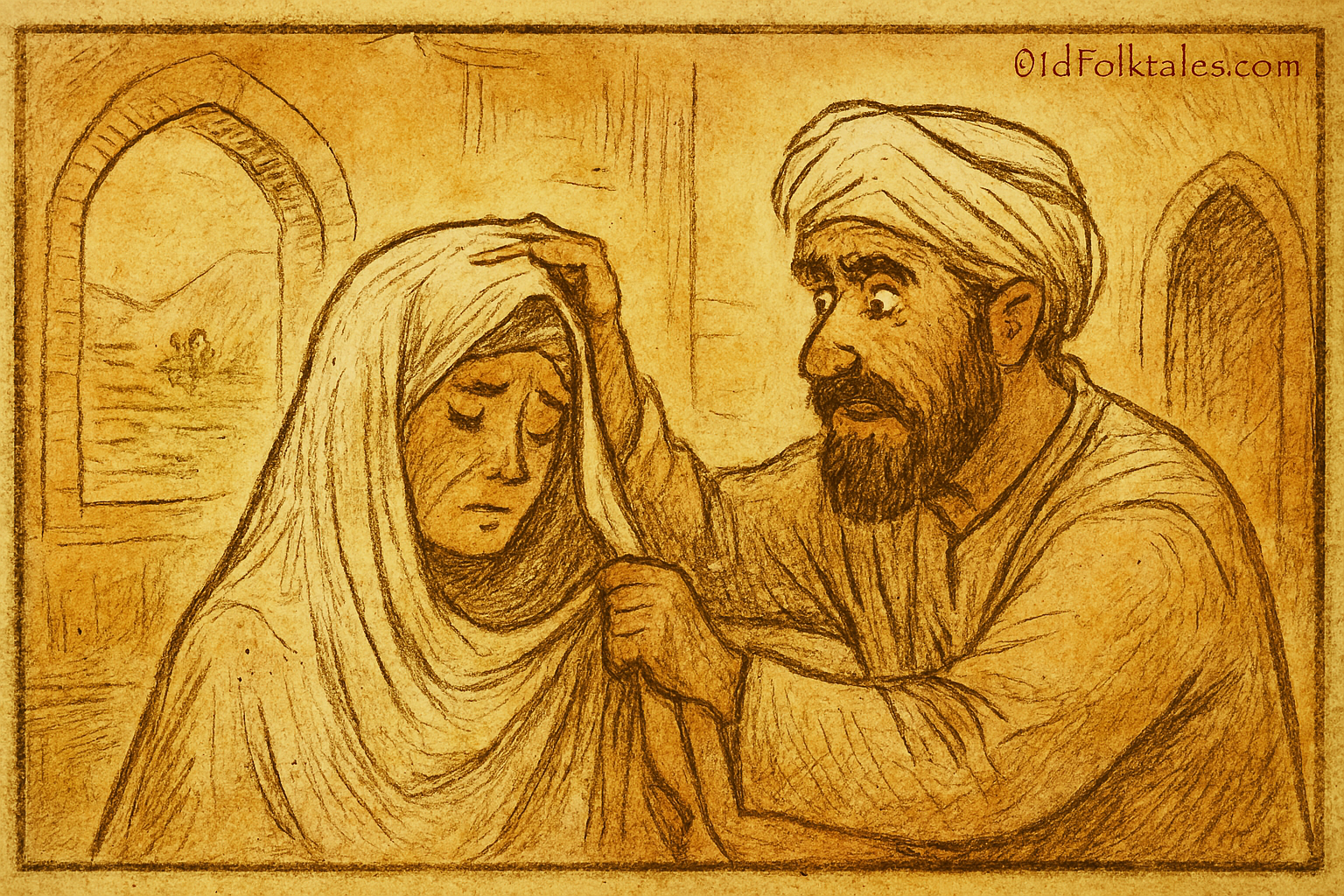
In a bustling Somali town where merchants called out their wares and the scent of spices filled the marketplace air, there lived a woman named Amina and her daughter, Jamila. They were known throughout the community as respectable, intelligent women who carried themselves with quiet dignity. Amina was a widow who had raised Jamila alone, teaching her daughter not only the domestic arts but also wisdom, wit, and the value of standing up for what is right.
One bright morning, as Amina made her way through the crowded streets toward the market, her basket swinging at her side, she passed the shop of Osman, a prosperous merchant known throughout the town. But on this particular day, something in his shop window stopped her in her tracks. There, displayed prominently for all to see, hung a bold sign that read: “Men are created smarter than women.”
Amina’s eyes widened with disbelief, then narrowed with anger. How dare he display such an insulting message! Her hands trembled slightly as she pushed open the door to Osman’s shop, the small bell above the entrance announcing her arrival.
Looking for more? Explore the magic of East African folktales here
“Excuse me,” she said, her voice controlled but firm, “but surely you know that sign is not true!”
Osman looked up from his ledger with an expression of supreme confidence, almost amusement. “Oh yes, it is indeed true,” he replied dismissively, waving his hand as if brushing away her concern. “Men are smarter than women. You women are good at having children, but please, leave the important matters to us men.”
Amina felt her blood boil, but she maintained her composure. “If you don’t take down that sign by tomorrow,” she warned, her voice steady and cold, “you’ll be very sorry.”
“Ha ha ha!” Osman laughed loudly, slapping his counter with glee. “What could you possibly do? You’re just a woman!”
Amina’s eyes flashed with determination. “You’ll see just how smart we women are!” she promised, and with that, she turned on her heel and left the shop.
As she walked home, her mind raced with possibilities. How could she teach this arrogant fool a lesson he would never forget? She passed the magnificent palace of King Hassan, its white walls gleaming in the sunlight, its gardens lush and well-tended. Suddenly, inspiration struck like lightning. A brilliant, daring plan formed in her mind. She quickened her pace, eager to share her scheme with Jamila.
The next day, the plan was set in motion. Jamila, already blessed with beauty and grace, dressed in her finest clothes and applied her most exquisite perfume. She arranged her headscarf elegantly and walked with purpose toward Osman’s shop. When she entered, Osman, who had never met Jamila,looked up and found himself mesmerized by this mysterious, beautiful woman.
Jamila purchased a few small items, engaging Osman in polite, charming conversation before departing. She returned the following day, and then the day after that, each time lingering a little longer, her conversations with Osman growing warmer and more personal. By her third visit, Osman could no longer contain his curiosity.
“Forgive me for asking,” he ventured, his voice hopeful, “but who are you? I don’t believe I’ve seen you in town before.”
“I am Sulekha,” Jamila announced with practiced elegance, “daughter of King Hassan.”
Osman’s jaw dropped. “Impossible! Everyone knows the King’s daughter is paralyzed and never leaves the palace!”
“That,” Jamila said with a conspiratorial smile, “is exactly what my father wants everyone in the kingdom to believe. He invented this story to protect me from fortune hunters, men who would pursue me only for my beauty and wealth rather than for who I truly am.”
Osman’s heart raced with possibility. “I would want to marry you for who you are, Sulekha,” he said earnestly. “Is such a thing possible?”
“Oh yes, it is possible,” Jamila assured him, “but you must follow my instructions very carefully.”
“Anything for you, Sulekha,” Osman promised without hesitation.
Jamila explained her conditions: When Osman went to the palace to ask for her hand, he must pretend to believe she was paralyzed. Only by showing he wanted her despite this “condition” would he prove to the King that his love was genuine.
The very next day, Osman rushed to the palace and requested an audience with King Hassan. After waiting anxiously in the grand corridors, he was finally ushered into the King’s presence.
“Your Highness,” Osman began with rehearsed humility, “it is with the greatest respect that I come to ask for your daughter’s hand in marriage.”
King Hassan studied him carefully. “Are you willing to marry my daughter, even with her condition?” the King asked, his voice serious.
“Yes, Your Majesty. I will care for her and provide everything she needs,” Osman vowed.
“Very well,” the King agreed. “The wedding ceremony will take place in one week’s time.”
Osman spent the next seven days in a frenzy of preparation. He purchased expensive silks and fabrics, fine furniture and luxurious decorations. In his eagerness to welcome his royal bride, he ordered his first wife to move into the smaller room with their children. He even suggested she might want to stay with her mother for a while.
After the elaborate wedding ceremony, Osman was led to the princess’s chamber where his bride awaited him. He saw her sitting on the bed, draped in a beautiful wedding veil. His hands trembled with anticipation as he lifted the delicate fabric. But instead of Jamila’s face, he found himself staring at a woman he had never seen before, a woman who was indeed paralyzed, her body rigid, her expression confused and frightened.
“Who are you? Where is Sulekha?” Osman shouted in horror.
“What are you talking about?” cried the princess, tears streaming down her face. “I am Sulekha!”
The terrible truth crashed down upon Osman. He had been deceived, tricked, completely fooled. And now he was married to the real princess, trapped in a situation he couldn’t escape. He couldn’t ask the King for a divorce—such an insult might land him in prison or worse. Mumbling excuses about preparing his house, Osman fled the palace and rushed home, his mind spinning with panic.
That evening, a knock came at his door. When he opened it, there stood Amina and Jamila, their expressions triumphant.
“How could you do something like this to me?” Osman cried in anguish.
“I warned you about taking down that sign,” Amina replied calmly. “You ignored me.”
“You have to get me out of this marriage!” Osman demanded desperately.
Amina smiled knowingly. “If men are so much smarter than women, then why are you asking me for help?”
But Osman’s pride remained stubborn. He refused to admit he was wrong. So Amina and Jamila left, leaving him to stew in his predicament. He sought advice from his male friends, but none could devise a solution. Days passed, and his situation grew more desperate.
Finally, when Osman encountered Amina and Jamila in the town center, he threw himself at their mercy, begging for help.
“Before we help you,” Amina stated firmly, “you must permanently remove your insulting sign. And for one full week, you must replace it with a new sign that reads: ‘Women are smarter than men.'”
“Anything! I’ll do anything!” Osman pleaded.
Following Amina’s clever instructions, Osman transformed part of his shop into a barbershop for men. Word quickly reached King Hassan that his son-in-law had become a common haircutter. The King summoned Osman immediately.
“I thought you owned a respectable shop?” the King asked, his voice filled with disappointment.
“I do, Your Majesty, but I have decided to become a haircutter.”
The King’s face darkened. “You cannot be a mere haircutter and be married to my daughter. I command you to divorce her at once!”
In an instant, Osman was free. He removed his sign and never again doubted the intelligence of women.
The Moral Lesson
This Somali folktale delivers a powerful message about the dangers of arrogance, prejudice, and underestimating others based on gender. Osman’s pride and his dismissive attitude toward women’s intelligence led directly to his downfall. Amina and Jamila demonstrated that wisdom, cunning, and careful planning can overcome brute force and social privilege. The story teaches that intelligence is not determined by gender, and those who judge others unfairly will ultimately face consequences. True wisdom requires humility and respect for all people, regardless of their gender or social position.
Knowledge Check
Q1: Who are the main characters in this Somali folktale?
A1: The main characters are Amina (a wise mother), her daughter Jamila (a clever young woman), Osman (an arrogant shopkeeper), King Hassan (the ruler), and the real Princess Sulekha (the King’s paralyzed daughter). Amina and Jamila work together to teach Osman a lesson about respecting women’s intelligence.
Q2: What insulting action did Osman take that sparked the conflict?
A2: Osman displayed a sign in his shop window that read “Men are created smarter than women.” When Amina confronted him about it, he dismissed her concerns, laughed at her, and insisted that women should leave important matters to men, which motivated her to teach him a lesson.
Q3: How did Jamila deceive Osman into marrying the wrong woman?
A3: Jamila disguised herself as “Sulekha,” claiming to be King Hassan’s daughter. She told Osman that the King pretended his daughter was paralyzed to protect her from fortune hunters. She instructed Osman to act as if he believed she was paralyzed when asking for her hand, which led him to unknowingly marry the real paralyzed princess.
Q4: Why couldn’t Osman simply divorce the princess after discovering the deception?
A4: Osman couldn’t divorce the princess because doing so would insult King Hassan, which could result in imprisonment or worse punishment. In the cultural context, divorcing a royal daughter without the King’s permission would be seen as a grave offense, leaving Osman trapped in the marriage.
Q5: How did Amina ultimately help Osman escape his marriage?
A5: Amina advised Osman to open a barbershop in his store and become a haircutter. When King Hassan learned that his son-in-law had taken up this lowly profession, he was so disappointed that he commanded Osman to divorce his daughter immediately, as a common barber was not suitable to be married to a princess.
Q6: What cultural values and gender themes are explored in this Somali tale?
A6: This folktale challenges traditional gender stereotypes prevalent in many cultures, including Somali society. It emphasizes that intelligence and cunning are not determined by gender, and that women deserve respect and recognition for their capabilities. The story also reflects the importance of humility and the consequences of arrogance, while showcasing the strategic thinking required to navigate strict social hierarchies and royal protocol.
Source: Somali folktale (East Africa)