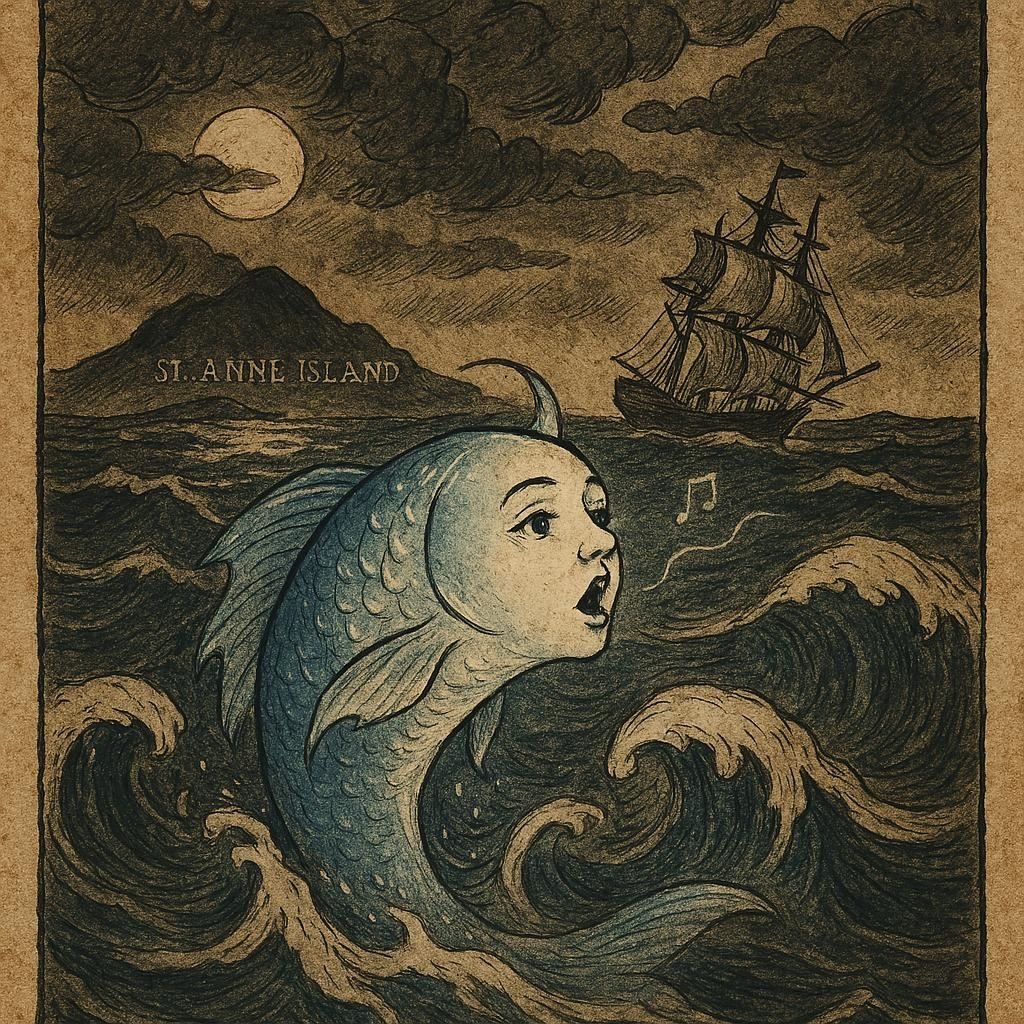
Long ago on the tranquil island of Mahé, where the sea sparkled like melted glass and the winds whispered through the palm trees, there lived a group of fishermen who sailed the waters near Saint Anne. These men were known for their bravery, for the sea could turn from calm to cruel in a single breath. Yet among all the stories that passed through the fishing villages, none was as mysterious as the tale of the Singing Fish of Saint Anne.
It was said that deep in the coral caverns near the island lived a shimmering fish unlike any other. Her scales shone in hues of silver and blue, and when the moonlight touched her fins, she glowed softly like a lantern beneath the waves. But the most remarkable thing about this fish was her voice. On certain nights, when the wind was still and the sea lay quiet, her song would rise through the water, a haunting human voice that warned sailors of storms yet to come.
Continue your journey: Read more East African folktales
The elders believed the Singing Fish was the spirit of a drowned maiden, blessed by the ocean to protect others from her fate. The fishermen listened whenever her voice rose from the depths, and they would pull their boats to shore, offering small gifts of seashells and palm wine to the waves in gratitude. The sea, it seemed, was kind to those who respected her.
One season, a new captain arrived from another island. His name was Captain Lormier, a proud man with a heart as restless as the wind. He had heard tales of the Singing Fish but laughed them off as island superstition. “Fish do not sing,” he said. “And if one does, it will sing for me alone.” His men, though uneasy, followed him because he was bold and skilled, and his boat, La Sirène, was the finest on the coast.
One late afternoon, the sky glowed red with the coming sunset. The fishermen of Mahé were returning to shore when the air grew heavy and still. From the deep came the faintest sound, a voice rising and falling like the rhythm of a lullaby. It was sorrowful yet beautiful, and every fisherman recognised it. The Singing Fish was calling. They quickly lowered their sails, whispering prayers to the sea.
But Captain Lormier only smiled. “It is nothing but wind in the reeds,” he said. “We sail tonight, for fortune favours the fearless.” His crew begged him to wait, yet he stood firm. The men feared to disobey and so they raised the sails once more, though their hearts trembled as the last light faded from the horizon.
As night descended, the ocean turned dark and glassy. The song returned, clearer now, echoing across the waves. “Turn back, sailors,” it cried, “the sea is rising with sorrow.” But Captain Lormier steered forward, his eyes fixed on the stars. “No spirit commands me,” he shouted into the wind. “I am the master of these waters.”
Moments later, a gust roared through the air. The waves lifted and crashed like furious beasts, tossing the ship from side to side. The sailors clung to the ropes as lightning cracked across the sky. Rain poured in torrents, and through the blinding storm they saw the silver glow of the Singing Fish circling the boat. Her voice pierced the thunder, a final mournful warning, but the captain’s pride was too great. He would not turn back.
Then came the great wave. It rose taller than a palm tree and fell with the roar of a thousand drums. The boat shattered, its pieces scattered across the raging sea. When dawn came, the villagers found the wreckage near the reefs of Saint Anne. Every sailor was gone except one, a young boy who clung to a piece of driftwood.
The boy said that as the storm took them, he saw the Singing Fish rise above the waves. Her eyes glistened with tears as she whispered, “Those who mock the sea will sleep beneath her forever.” When she vanished, the waters calmed and the clouds began to clear.
The people of Mahé built a small shrine near the shore, where fishermen still leave flowers and seashells for the spirit of the Singing Fish. When a storm threatens the island, the elders say her voice can still be heard, soft and distant, reminding all who listen that the sea has a soul and that pride can sink even the strongest ship.
Moral Lesson
The tale of The Singing Fish of Saint Anne teaches that pride blinds people to wisdom and that nature must be treated with respect and humility. Those who listen to the voice of warning find safety, while those who mock the forces of the world invite their own downfall.
Knowledge Check
What warning did the Singing Fish of Saint Anne give to the sailors before the storm?
The Singing Fish warned them that the sea was rising with sorrow and urged them to turn back before the storm arrived.Why did Captain Lormier ignore the voice of the Singing Fish?
Captain Lormier was too proud to believe in island legends and thought the voice was nothing more than the sound of the wind.What happened to the captain and his crew during the storm?
The ship was destroyed by a massive wave, and only one young boy survived by clinging to driftwood.How did the villagers of Mahé honour the Singing Fish after the tragedy?
They built a small shrine by the sea and left flowers and seashells to thank and remember the spirit of the Singing Fish.What message does the story of The Singing Fish of Saint Anne give about human pride?
The story shows that human pride leads to ruin when people refuse to listen to nature’s wisdom and warnings.What connection does the story make between the sea and human behaviour?
It teaches that the sea has a soul, and just as the sea rewards respect, it punishes arrogance and carelessness.
Source: Creole sea legend from Mahé, Seychelles. Transcribed by J. P. Desaubin in Legends of the Outer Isles (1936).