In the dusty lands of Algeria, where the desert winds carry ancient stories across endless dunes, there once lived a man blessed with abundance yet cursed with emptiness. He possessed seven wives and seven magnificent mares, but his household echoed with silence. No children’s laughter filled his courtyards, and no foals galloped in his pastures.
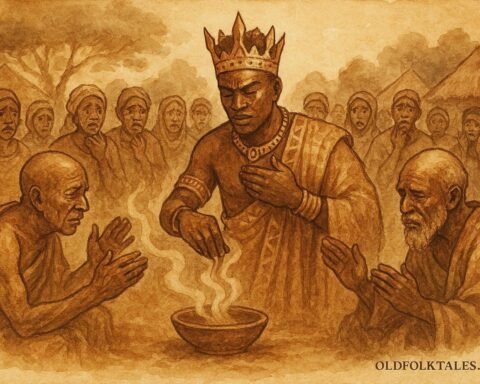
Desperate for counsel, the man sought out a wise elder known throughout the region for his profound understanding of life’s mysteries. The sage stroked his beard thoughtfully before speaking: “Journey to the ancient forest and gather seven sturdy sticks. Break one stick upon each mare’s back. Then visit the marketplace and purchase seven perfect apples, giving one to each of your wives.”
The man followed this peculiar advice with unwavering faith. As if touched by magic itself, the seven mares soon bore healthy foals, and his seven wives each delivered children. Five wives blessed him with noble sons, strong and handsome. One bore a daughter, beautiful but blind from birth. The seventh wife gave birth to a boy whose dark skin marked him as different. This negro child would face constant rejection in a household where he was seen as inferior.
As the years passed, the six brothers grew into young men who rode together through the winding streets of their town. Yet their unity was poisoned by prejudice. The five noble sons consistently schemed to abandon their dark skinned brother, turning him away with cruel words that sent him home weeping to his father’s arms.
One fateful day, the blind sister called her brothers to her side, her sightless eyes reflecting a desperate hope. “My dear brothers,” she pleaded, her voice trembling with longing, “I have heard tales of miraculous soap possessed by the daughter of the Chief of the Christians. If one among you could journey to her distant castle and bring me this precious soap, I might wash my eyes and finally see the world that has remained hidden from me.”
Without hesitation, all six brothers declared themselves ready for this perilous quest. They set out together, their horses’ hooves drumming against the hard-packed earth, but once again, the five noble sons revealed their cruel hearts. When they reached a massive stone where the road split into two paths, they struck their negro brother viciously, intending to abandon him forever.
The beaten brother, though hurt deeply by their rejection, showed wisdom beyond his years. “I will place this feather beneath this stone,” he declared, producing a delicate plume from his robes. “When any of us returns by this road, let him retrieve the feather and burn it as a sign.” The five chose the well traveled path, while the negro brother took the lonely, dangerous route alone.
The five noble brothers rode confidently until they discovered an imposing castle rising from the landscape like a mirage. Exhausted from their journey, they entered seeking shelter for the night. Beautiful women welcomed them with honeyed words and seductive smiles, explaining their sinister custom: “Each of you must choose a companion. If at dawn she sleeps upon your lap, you shall marry her. But if you fall asleep upon hers, she will claim all your possessions.”
Each brother selected a woman, but as night deepened, their chosen companions excused themselves one by one. “To change clothes,” said one. “To apply kohl to my eyes,” said another. Different women took their places. Confused and weary, the brothers gradually succumbed to sleep. When morning broke, they found themselves stripped of everything they owned, cast out naked into the wilderness.
Wandering desperately, they encountered a Mozabite charcoal burner and became his servants, their faces blackened with soot, their noble bearing reduced to common labor.
Meanwhile, the negro brother faced far greater perils along his solitary path. Coming upon a cornfield, he allowed his hungry horse to graze, only to be confronted by a fearsome ghoul who emerged from the earth like a creature from nightmares. But the young man’s courage proved stronger than fear. He fought the monster fiercely and emerged victorious, cutting flesh from the ghoul’s carcass for his journey ahead.
Further along his path, he discovered a massive vulture, blind and ancient, surrounded by seven offspring who searched constantly for food to satisfy their father’s endless hunger but never succeeded. The negro brother offered the ghoul’s flesh to the great bird, finally providing the satisfaction the vulture had long craved.
“What do you desire in return for this kindness?” the grateful vulture asked, his voice like wind through canyon walls.
“I must cross the great sea and return safely,” the young man replied.
The vulture called to his children, and when all seven had returned from their hunting, he announced: “Choose among yourselves who is strongest and swiftest to carry this noble youth across the waters and back again.” Each young vulture boasted of their abilities, but the youngest declared confidently: “I will take him across in the morning and return him by afternoon.”
As they soared across the endless blue waters, the negro brother fed pieces of ghoul flesh to his winged companion whenever the great bird’s strength began to wane. Thus they crossed the sea safely.
Upon reaching the distant Christian lands, the young man sought out a skilled Jewish craftsman. “Fashion me a golden cock,” he requested, “hollow inside so I might hide within it, yet able to walk by itself.” The artisan created this marvel, and the negro brother concealed himself inside the mechanical bird.
The golden cock walked directly to the palace of the Chief of the Christians, where his daughter lay in her chamber, deep in enchanted sleep. This princess possessed a peculiar nature. She slumbered for a full month, then remained awake for a month in endless cycle. While she slept, the hidden youth carefully exchanged his ring for hers and took her miraculous soap, leaving his own in its place.
Returning to the vulture, he flew back across the sea to find his horse grown fat and healthy from grazing in the rich pastures. Mounting his steed, he rode swiftly to the stone marker, where the feather remained untouched. This was proof that his brothers had not yet returned.
“The road that devoured my brothers shall devour me as well,” he declared with grim determination, and set off along their path. Following smoke rising in the distance, he discovered his brothers laboring as charcoal burners, their faces so blackened with soot that they didn’t recognize him, though he knew them instantly.
When they asked what he sought, he replied simply: “My brothers.” Only then did they weep and embrace him, revealing their shameful fate. The negro brother confronted the Mozabite master, threatening death unless his brothers were freed immediately. The frightened man released them at once.
Together, the six brothers returned to the castle of the treacherous women. But this time, the negro brother’s wisdom and magical soap protected them. The women who had robbed his brothers met their doom, and the brothers reclaimed their possessions.
When they finally returned home, the blind sister washed her eyes with the Christian princess’s soap and immediately received perfect sight. Her joy filled the household with celebration, but their happiness was short-lived. The daughter of the Chief of the Christians had awakened to discover the ring exchange and, through its magic, learned exactly who had visited her chamber.
Enraged by this intrusion, she arrived at their city with a great army, demanding the return of her property. When the sultan tried to protect the negro brother, she threatened to execute his entire family unless the young man was surrendered within three days.
Rather than allow bloodshed, the negro brother presented himself to the princess. To his amazement, instead of punishment, she gazed upon him with newfound respect and admiration. “You will come with me,” she declared, “but first, you must have the ground from here to my palace covered entirely with silk, so your horse may walk upon it as befits a hero.”
Thus the despised brother, rejected by his own family, became the husband of a powerful princess and lived prosperously in her father’s kingdom, honored for his courage and wisdom.
The Moral Lesson
This Algerian folktale teaches us that true worth lies not in appearance or social status, but in character, courage, and wisdom. The brother who was rejected and scorned proved himself the most capable and noble, while those who considered themselves superior failed when tested. The story reminds us never to judge others by their outward appearance and that often, those we underestimate possess the greatest strength and virtue.
Knowledge Check
Q1: What advice did the wise man give to help the childless man with seven wives and seven mares? A1: The wise man advised him to go to the forest, get seven sticks and break one on each mare’s back, then buy seven apples from the market and give one to each wife. This magical remedy resulted in foals and children being born.
Q2: How many children were born and what made each unique in this Algerian folktale? A2: Seven children were born: five noble sons, one blind daughter, and one negro boy. The blind sister needed magical soap to gain sight, while the negro brother faced constant rejection from his siblings due to his appearance.
Q3: What quest did the blind sister ask her brothers to undertake? A3: She asked them to travel to the house of the daughter of the Chief of the Christians and bring back her special soap, believing it would restore her sight when she washed her eyes with it.
Q4: How did the five noble brothers fail in their quest while the negro brother succeeded? A4: The five brothers were deceived by cunning women in a castle who stole all their possessions while they slept, forcing them to become charcoal burners. The negro brother succeeded through courage, defeating a ghoul and befriending a giant vulture to cross the sea.
Q5: What magical elements appear in this North African legend? A5: The story features magical soap that can restore sight, a golden mechanical cock that walks by itself, an enchanted princess who sleeps for months at a time, and a giant vulture family that can carry people across seas.
Q6: What does this Algerian folktale teach about prejudice and true heroism? A6: The tale demonstrates that those who are rejected or underestimated often possess the greatest courage and wisdom. The negro brother, scorned by his family, proves to be the true hero while his “noble” brothers fail, teaching us not to judge people by their appearance or status.