Long ago, Lisa, the great creator, had a daughter named Maho. One day Lisa gave her a new name: Gbemende, meaning “she who overcomes all obstacles.”
But Segbo, a powerful figure who ruled over many wives, overheard this. With a sly smile he said, “We shall see.” He demanded Maho for himself, and Lisa gave her to him.
Segbo already had twelve wives. One day, he gathered them all together. Handing each of his first twelve wives some millet, he instructed them to brew millet beer, warning: “She who fails to make good beer will die.” To Maho, however, he gave not millet, but okra.
Maho wept bitterly. She cried until Lisa heard her. Explaining her plight, she said, “Segbo gave me okra instead of millet, and I will surely die.”
Lisa comforted her: “That is nothing.” That night, a great wind rose, whistling through the land. By morning, Maho’s okra had transformed into excellent beer, while the other wives’ brews had turned into bowls of okra. Segbo frowned. “That is Lisa’s doing,” he muttered. “But we shall see.”
Time passed, and Segbo’s twelve wives became pregnant again. It was their custom to all give birth on the same day. Segbo declared, “In two days, your children will be born.”
Maho was not even pregnant. She cried and cried until Lisa heard her once more. When she explained her doom, Lisa reassured her: “Sleep. When the others give birth, strike the earth three times with your foot if you want a son, or three times with your head if you want a daughter.”
When Maho heard the cries of labor, she struck her foot three times. Immediately, a son appeared, handsome, strong, and radiant. When Segbo inspected him, he saw the boy was finer than any other child. Again, he grumbled: “Lisa has bested me. But we shall see.”
Segbo had a secret medicine that made ten-day-old infants walk and talk. He gave this to the other twelve sons but withheld it from Maho’s boy. “In twelve days,” he announced, “all sons must walk and speak. Any who fail will be killed, along with their mother.”
Maho cried again. Lisa told her calmly, “When the others walk and talk, tap your son’s head seven times.” On the eleventh day, as the other children began to walk, Maho tapped her son’s head. Instantly, he rose, taller, stronger, and livelier than all the rest. Segbo could not hide his anger.
Next, Segbo tested the children in a race. He gave twelve horses to his other sons and only a sheep to Maho’s child, now named Agbagugu. “Take this corn to the field. The last to arrive will be killed,” he said.
Maho despaired again, but Lisa gave her a white powder for the sheep to inhale. The moment it did, the sheep became a magnificent horse. Agbagugu sped faster than all the others, returning first to Segbo. Once again, Lisa had triumphed.
Furious, Segbo set a deadly task: “Bring me Death’s scythe.” Everyone knew no man could face Death and return alive.
Maho wept until Lisa gave Agbagugu seven peppers. “Break one at each step of the journey,” Lisa instructed.
Agbagugu obeyed. With each pepper broken, obstacles fell away: a crowd dispersed, dogs guarding a door fell asleep, bees circling Death vanished into a tree, and even Death himself sank into slumber. Agbagugu took the scythe and returned home safely.
When Death awoke and found his weapon missing, he shook the world with his fury. Segbo, seeing the scythe in Agbagugu’s hand, scowled: “Lisa has tricked me again.” He ordered Agbagugu to return it.
Lisa once more gave him seven peppers. This time Agbagugu retraced his steps, and instead of stealing the scythe, he placed it back in Death’s hands. He returned alive. Segbo finally admitted, “The boy is invincible. Lisa named him well.”
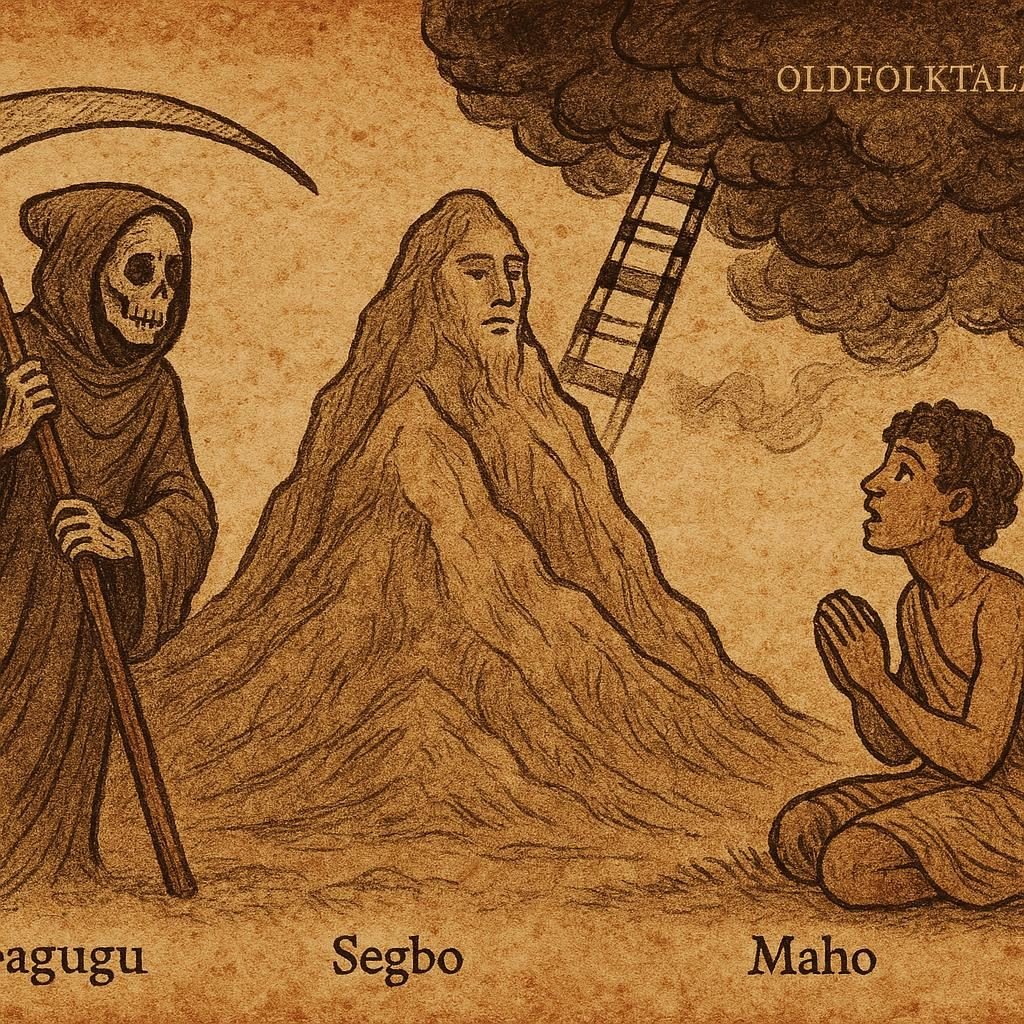
He promised Maho and her son the world, declaring he would turn into sand so his body could form humankind. But by night, Segbo plotted murder. Lisa struck him down with a mere finger, and Segbo transformed into a mountain.
Agbagugu inherited all of Segbo’s possessions. Twisting white and black thread together, he made a ladder and climbed into the sky with his mother, his brothers, and his father’s wives.
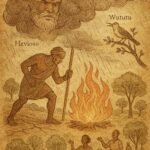
In the heavens, Agbagugu became Sogbo, or Hevioso, the god of thunder. When thunder cracks, it is his voice, fierce and vengeful. The faint rumble afterward is his mother’s gentle reminder: “Careful, careful. He is your father.”
In time, Lisa gave him the whole domain, which he shared among his twelve brothers. Yet it is said that at night, Hevioso slips down to earth with the dew, to visit the wife of the King of the Earth, whom he loves.
Moral of the Story
This tale teaches that true strength comes from wisdom, resilience, and the guidance of ancestors. With perseverance and faith, even impossible obstacles can be overcome.
Knowledge Check
Q1: Who was Maho renamed by Lisa, and what did her new name mean?
Maho was renamed Gbemende, meaning “she who overcomes all obstacles.”
Q2: Why did Segbo give Maho okra instead of millet?
He sought to trick her so she could not brew beer and be condemned to death.
Q3: How did Maho’s son, Agbagugu, grow stronger than the other children?
Lisa guided Maho to tap his head seven times, making him taller and livelier than the rest.
Q4: What task proved Agbagugu’s bravery against Death?
He retrieved and later returned Death’s scythe using the magical peppers given by Lisa.
Q5: Why is thunder followed by a faint rumble in this tale?
Thunder is Hevioso’s furious voice, while the rumble is his mother calming him down.
Q6: What culture does this folktale come from?
It is a Dahomey (Fon) folktale from present-day Benin.
Source: Beninese Folktale