In the days when the boundaries between the human world and the animal kingdom were not as clearly drawn as they are today, there lived a man whose life became intertwined with two very different creatures. This was a time when animals could speak their minds with eloquence, when wisdom was measured not by size or strength, but by the depth of one’s reasoning and the validity of one’s claims.
The man had lived a prosperous life, accumulating wealth and property through years of hard work and careful planning. His compound was well-built, his granaries were full, and his name was spoken with respect throughout the region. But as fate would have it, the time came when death claimed him, leaving behind all his earthly possessions without a clear heir to inherit them.
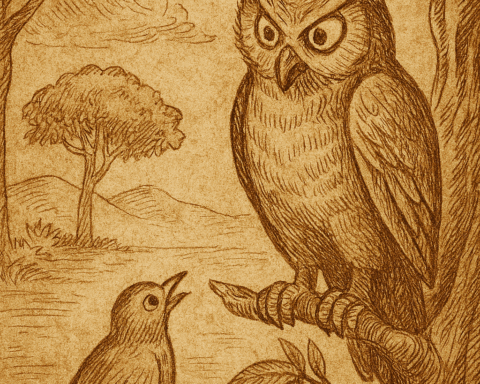
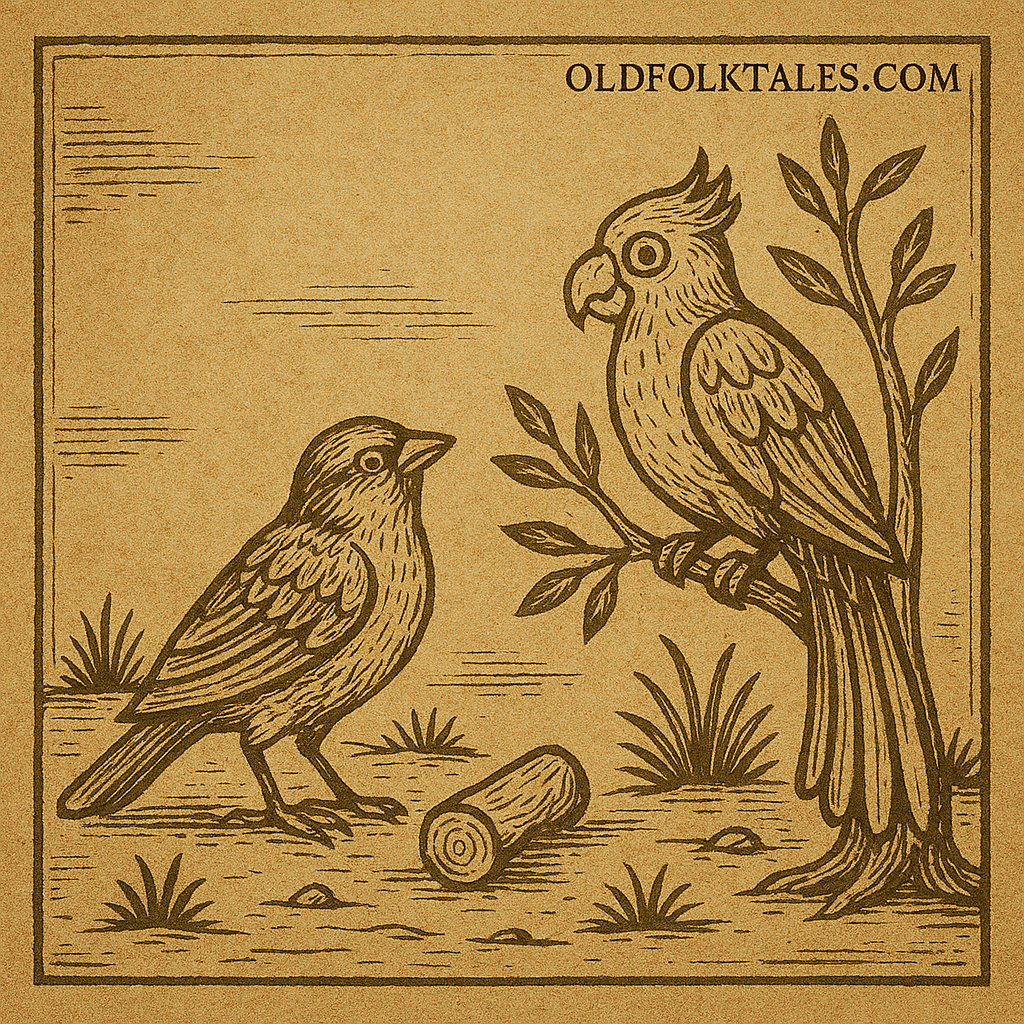
When news of the man’s passing spread throughout the community, an unexpected dispute arose. Two creatures who had shared different aspects of the man’s life stepped forward, each claiming the right to inherit his entire estate. The first was Utati-Mboka, a small but spirited sparrow who had been the man’s constant companion. The second was Koho, a magnificent parrot whose colorful plumage had once adorned the man’s head in ceremonial dress.
Also read: Tortoise Covers His Ignorance
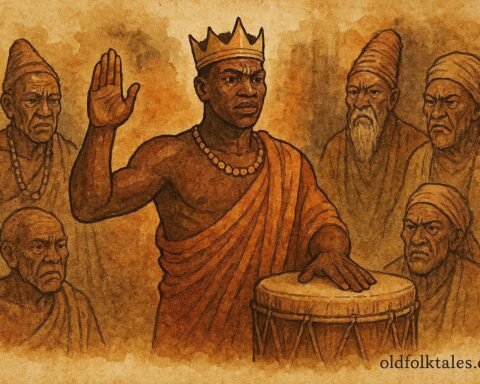
The community elders gathered under the great baobab tree where such matters of importance were traditionally decided. The warm afternoon sun filtered through the ancient leaves as people from neighboring villages came to witness what promised to be an intriguing legal dispute. The two claimants perched on opposite branches, each preparing to present their case with the gravity and formality that such proceedings demanded.
Utati-Mboka, the sparrow, spoke first. Despite his small size, his voice carried clearly across the assembled crowd, filled with conviction and the confidence of one who believed wholeheartedly in the righteousness of his cause.
“Honorable elders and respected members of this community,” the sparrow began, his tiny chest puffed out with pride, “I stand before you today to claim what is rightfully mine through the sacred bonds of companionship and shared destiny. This man and I were more than mere acquaintances, we were true companions whose lives were woven together like threads in the same cloth.”
The sparrow hopped along his branch, his keen eyes sweeping across the faces of his audience as he continued his impassioned plea. “From the earliest days of our association, the man and I lived in the same town, breathed the same air, and shared the same experiences. When circumstances required him to move to new places, I did not hesitate to follow. My loyalty was unwavering, my presence constant. At whatever place he chose to make his home, there also I could be found, standing proudly in the street, sharing in both his joys and his sorrows.”
The crowd listened attentively as the sparrow painted a picture of devoted companionship. “Our interests were not merely similar – they were identical. When he prospered, I celebrated. When he faced challenges, I remained by his side. We shared the same community, participated in the same social fabric, and built our lives in parallel harmony. If this is not grounds for inheritance, then what meaning do loyalty and companionship hold in our society?”
When the sparrow finished his presentation, a murmur of appreciation rippled through the crowd. His argument was compelling, built on the foundation of faithful friendship and shared experience that many in the audience could understand and respect.
Then it was Koho’s turn to speak. The parrot’s magnificent feathers caught the sunlight as he positioned himself prominently on his branch, his bearing regal and his manner confident. Unlike the sparrow’s appeal to emotional bonds, the parrot prepared to present a case based on economic contribution and causal responsibility.
“Distinguished elders and fellow community members,” Koho began, his voice rich and melodious, carrying the authority of one accustomed to commanding attention, “while I respect the sparrow’s claims of companionship, I must present to you a different perspective, one based not on sentiment, but on concrete contribution and undeniable causation.”
The parrot’s eyes gleamed with intelligence as he methodically built his argument. “I was born in the tree-tops, living freely in the natural world according to the ancient ways of my kind. But fate decreed that this man should discover me and choose to take me into his household. This was not a casual adoption, but the beginning of a relationship that would prove fundamental to his eventual prosperity.”
Koho spread his magnificent tail feathers, displaying the iridescent colors that shimmered like jewels in the afternoon light. “When I reached maturity and my tail began to grow into its full splendor, the man and his people recognized the extraordinary value of my plumage. With great care, they harvested my beautiful feathers, not once, but repeatedly, as they continued to grow and renew themselves.”
The crowd leaned forward, captivated by the parrot’s logical progression. “With these feathers, they crafted handsome head-dresses of exceptional beauty and quality. These ornate creations were not merely decorative items, but valuable trade goods that commanded high prices in the marketplace. The proceeds from selling these head-dresses brought the man considerable wealth.”
Koho’s voice grew stronger as he reached the climax of his argument. “But the story does not end there. With the money earned from my feathers, the man was able to purchase a wife, a woman who brought him not only companionship but the promise of future generations. That woman bore him daughters, and these daughters, when they came of age, were married for substantial bride-prices that further increased the family’s wealth and social standing.”
The parrot paused dramatically, allowing his words to sink in before delivering his final point. “And these daughters, in turn, bore children of their own, continuing the cycle of family growth and prosperity. Therefore, I declare before this assembled community that I was the original source, the fundamental cause, the very foundation upon which all this man’s wealth and family legacy was built. Without my contribution, none of his prosperity would have existed.”
The crowd fell silent as they contemplated the two very different but equally compelling arguments. The elders withdrew to deliberate, weighing the claims of loyal companionship against those of economic causation and foundational contribution.
After much discussion and careful consideration of both presentations, the elders returned with their decision. The wisdom of their years and their experience in resolving complex disputes had led them to a conclusion that recognized the fundamental importance of productive contribution over emotional attachment.
“We have heard both arguments with great attention,” the chief elder announced solemnly. “While we acknowledge the value of the sparrow’s faithful companionship, we find that Koho the parrot’s claim demonstrates a more direct and measurable contribution to the deceased man’s prosperity. The parrot was indeed the source of the wealth, the originator of the economic chain that led to the man’s success.”
And so it was decided. The parrot was granted the right to inherit the man’s estate, his claim validated by the community’s recognition of his role as the foundation of the man’s material success.
Moral Lesson
This folktale teaches us that while loyalty and companionship are valuable qualities, substantive contribution and productive effort often carry greater weight in matters of justice and reward. It reminds us that true worth is measured not only by emotional bonds but by the tangible impact we have on others’ lives and prosperity.
Knowledge Check
Q1: Who were the two main claimants in this African inheritance dispute? A: The two claimants were Utati-Mboka (a sparrow) who claimed inheritance based on loyal companionship, and Koho (a parrot) who claimed it based on being the foundation of the man’s wealth through his valuable feathers.
Q2: What was the basis of the sparrow’s inheritance claim? A: The sparrow based his claim on companionship and shared community interests, arguing that he had lived with the man throughout his life, moving wherever the man moved and sharing the same experiences and loyalty.
Q3: How did the parrot argue that he was the source of the man’s wealth? A: The parrot explained that his beautiful tail feathers were harvested to make valuable head-dresses, which were sold for money that allowed the man to buy a wife, whose daughters were later married for bride-prices, creating ongoing wealth and family legacy.
Q4: What cultural values does this folktale represent about property inheritance? A: The story reflects traditional African legal principles that prioritize substantive contribution and economic causation over emotional bonds when determining inheritance rights, showing how communities valued productive impact over sentiment.
Q5: Why did the elders rule in favor of the parrot’s inheritance claim? A: The elders determined that the parrot’s contribution was more fundamental and measurable, he was the original source of the economic chain that led to the man’s prosperity, making his claim stronger than the sparrow’s companionship argument.
Q6: What does this folktale teach about the difference between emotional and economic contributions? A: The story illustrates that while emotional bonds and loyalty are valuable, tangible contributions that create lasting economic impact often carry greater weight in legal and inheritance decisions within traditional African society.