In the time when kings ruled with absolute power and magic still danced through the world, there lived a curious monarch who loved to walk among his people under the cover of darkness. One evening, accompanied by his trusted vizier, the king ventured into the sleeping city, seeking to understand the hearts of his subjects.
As they wandered through the winding streets, a warm golden light caught their attention, spilling from the window of a modest dwelling. Drawing closer, they heard the voices of three women engaged in animated conversation, each making bold declarations that would change their lives forever.
The first woman spoke with confidence that made her companions lean forward. “If I were to marry the king,” she declared, “I would bake him a pancake so enormous that it could feed his entire army!” Her eyes sparkled with the certainty of her culinary prowess.
Read: Udea and Her Seven Brothers
Not to be outdone, the second woman raised her voice proudly. “And I,” she announced, “would weave a tent so magnificent and vast that it could shelter the king and all his soldiers beneath its protective embrace!”
But it was the third woman whose words carried a magic that made even the night air seem to shimmer. “I would bear the king twins,” she whispered, her voice filled with mysterious promise, “a boy and a girl whose hair would shine with alternating strands of gold and hyacinth. When they laugh, the sun and moon would appear in the sky, and when they weep, thunder would roar and rain would fall from the heavens.”
The king, deeply intrigued by these extraordinary promises, revealed himself and summoned all three women to the palace the next day. True to his royal word, he married each of them in turn, eager to see which promises would prove true.
The first two wives, when their time came, failed utterly to deliver on their grand boasts. Their pancakes were ordinary, their weaving unremarkable. But when the third wife gave birth, she indeed delivered twins exactly as prophesied, a son and daughter with the most beautiful hair anyone had ever seen, strands of gold and hyacinth intertwined like precious threads.
However, jealousy is a poison that corrupts even the most sacred moments. The two unsuccessful wives, consumed with envy and rage, hatched a cruel plot. They bribed the midwife to replace the miraculous twins with two blind puppies, instructing her to cast the real children into the river in a wooden box.
When the king beheld the blind puppies instead of the promised magical children, his fury knew no bounds. Feeling deceived and humiliated, he ordered his third wife to be chained to the palace stairs, covered with pitch, and subjected to the spitting and mockery of all who passed by.
But destiny has a way of protecting the innocent. The wooden box carrying the twins floated downstream until it reached an island where a kind fisherman lived with his wife. The couple, blessed with generous hearts but no children of their own, rescued the babies and raised them as their beloved son and daughter. They named the boy Muhammed, and he grew into a clever, resourceful young man.
Years passed peacefully on the island until one fateful market day. The fisherman took young Muhammed to sell their catch in the city. As they displayed their fish in the bustling marketplace, the king happened to pass by. The moment his eyes fell upon Muhammed, an inexplicable connection stirred in his heart. Something about the boy’s bearing, his unusual beauty, called to him irresistibly.
The king paid for all the fish and brought Muhammed to the palace, treating him with unexpected kindness before eventually sending him back to the fisherman. But this brief encounter had tragic consequences the jealous queen recognized the boy as one of the children who should have perished years ago.
Panic seized the wicked wives and the corrupted midwife. The midwife, desperate to complete her evil work, devised a new plan. She visited the fisherman’s island and found Muhammed’s sister alone. With honeyed words and cunning manipulation, she convinced the innocent girl that her brother should seek out a legendary treasure, the singing rose belonging to the mysterious maiden Arab-Zandiq.
Muhammed, devoted to his sister’s happiness, embarked on this perilous quest. His journey led him to the dwelling of a fearsome ogress. Following ancient customs of respect, he approached her humbly, suckled at her breasts, and offered proper greeting. This act of reverence earned him the ogress’s favor and protection.
“The singing rose you seek,” the ogress told him, her voice like grinding stone, “grows in an enchanted garden. You must exchange the fodder of the goat and lion you will find there, then enter when the gate opens. Take only the rose and flee immediately, or you will turn to stone forever.”
Muhammed followed these instructions precisely, retrieving the magical rose that sang with unearthly beauty. But the midwife’s wickedness knew no limits. When she learned of his success, she returned to convince his sister that the rose would not sing properly without its companion, a magical mirror.
Once again, Muhammed sought the ogress’s wisdom. She directed him beyond the garden to a staircase leading to a chamber where the mirror waited. He successfully completed this second quest, bringing the mirror home to join the singing rose.
The midwife’s final and most dangerous manipulation followed swiftly. She convinced Muhammed’s sister that they needed Arab-Zandiq herself to complete the magic. Despite the ogress’s warnings that many had attempted this feat and been turned to stone, Muhammed’s love for his sister compelled him to try.
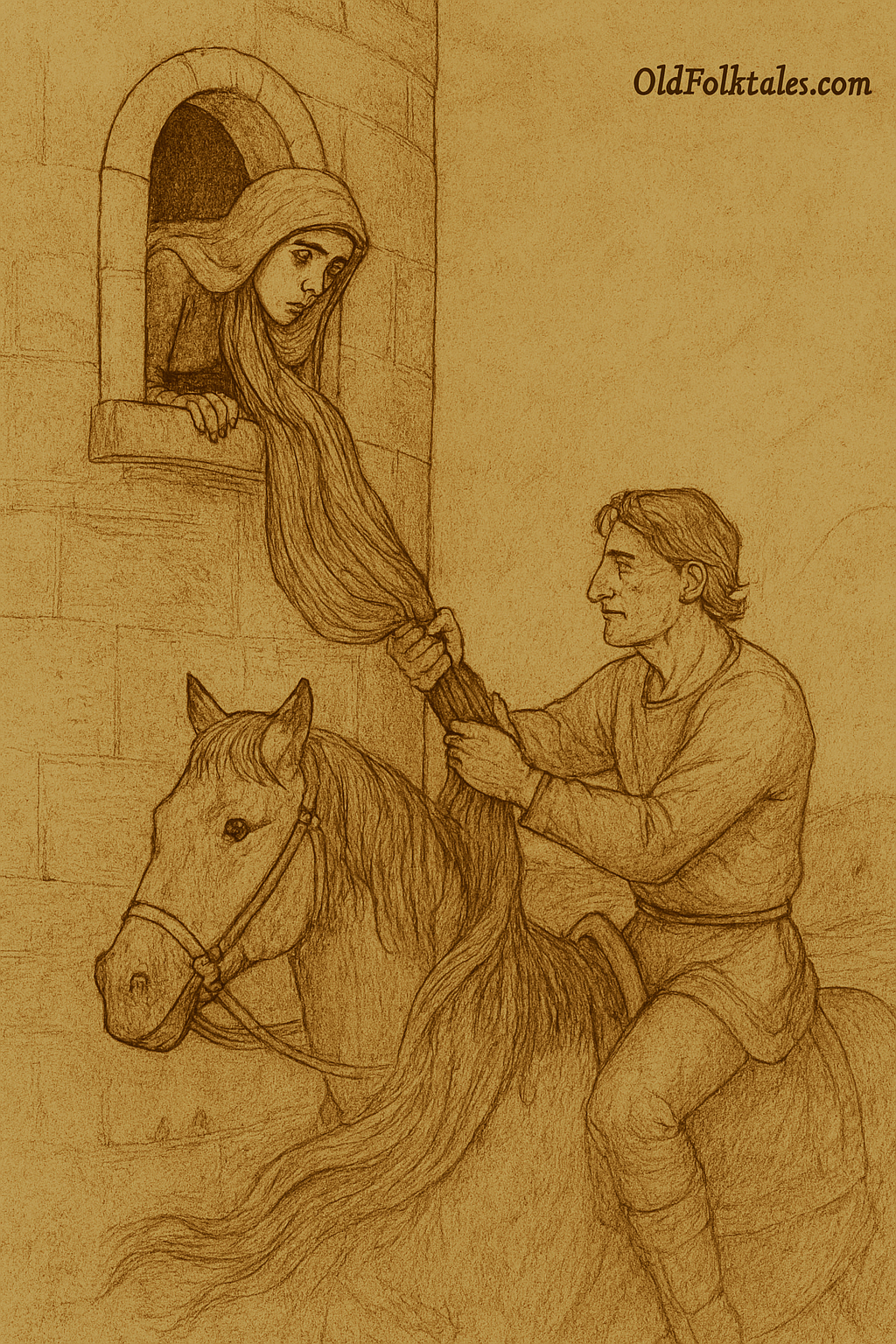
He rode to Arab-Zandiq’s palace and pressed his horse’s head against her tower wall, calling for her to appear at her window. The maiden, possessing terrible powers, began slowly turning both horse and rider to stone. But as Muhammed called out the third time, Arab-Zandiq leaned from her window, her magnificent hair cascading all the way to the ground.
Seizing this crucial moment, Muhammed grabbed her flowing locks and pulled her from the tower. Defeated by his clever courage, Arab-Zandiq revealed that destiny had bound them together. She used her powers to restore all the stones in her palace back to their original human forms, victims of her previous encounters.
Arab-Zandiq accompanied Muhammed to the fisherman’s island, where she commanded her servants to build a magnificent palace. She then instructed Muhammed to invite the king to their wedding celebration. The king, amazed by the splendid palace and the remarkable young man who had built it, invited Muhammed, Arab-Zandiq, and his sister to the royal palace in return.
When they arrived at the palace, Arab-Zandiq’s compassionate heart was moved by the sight of a wretched woman chained to the stairs, covered in pitch and filth. Without hesitation, she covered the suffering woman with her own shawl. When the king’s servants questioned this act of kindness, Arab-Zandiq ordered them to bathe the woman, cleanse her thoroughly, and clothe her in fine garments.
During the grand banquet that followed, the fisherman told his story of finding the box in the river and raising the twins as his own children. The newly cleaned woman, brought to join the feast, looked upon Muhammed and his sister with growing recognition. Her heart knew them immediately, their hair of gold and hyacinth strands was exactly as she remembered from their birth.
The king, though deeply moved, still required proof of this miraculous reunion. “If you are truly my children,” he declared, “show me the powers that were promised at your birth.”
The twins began to weep, and instantly thunder rolled across the clear sky while rain began to fall. Then they laughed together, and the sun and moon appeared simultaneously in the heavens, just as had been foretold so many years before.
Overwhelmed with joy at recovering his lost family, the king ordered a great celebration. Justice was finally served as he commanded that his jealous wives and the corrupt midwife be burned for their terrible crimes. The royal family was reunited at last, and Muhammed’s marriage to Arab-Zandiq was celebrated throughout the kingdom.
The Moral of the Story
This tale teaches us that jealousy and deception may temporarily triumph, but truth and destiny cannot be permanently thwarted. The story emphasizes that acts of kindness and respect, whether shown to an ogress, a suffering stranger, or magical beings are always rewarded. Most importantly, it demonstrates that family bonds, even when severed by cruel betrayal, possess the strength to overcome any obstacle when guided by love, courage, and divine providence.
Knowledge Check
Q1: Who is Arab-Zandiq in this Middle Eastern folktale? A: Arab-Zandiq is a magical maiden who possesses the power to turn people to stone and owns enchanted objects like a singing rose and magical mirror. She becomes Muhammed’s destined bride and helps reunite the royal family through her compassion and magical abilities.
Q2: What special powers do the royal twins possess in the story? A: The twins have hair with alternating strands of gold and hyacinth. When they laugh, the sun and moon appear in the sky simultaneously, and when they weep, thunder roars and rain falls from the heavens. These powers were prophesied before their birth and prove their royal identity.
Q3: How does the midwife’s betrayal drive the plot of this folktale? A: The midwife, bribed by the jealous queens, replaces the newborn twins with blind puppies and casts the real children into the river. Later, she manipulates the sister into sending Muhammed on dangerous quests to obtain Arab-Zandiq’s magical objects and eventually Arab-Zandiq herself, hoping to destroy him.
Q4: What role does the ogress play in Muhammed’s quests? A: The ogress serves as a wise guide and protector for Muhammed. When he shows proper respect by following ancient customs (suckling her breasts and greeting her), she provides crucial advice for obtaining the singing rose, magical mirror, and reaching Arab-Zandiq safely.
Q5: What cultural values are emphasized in this Middle Eastern tale? A: The story emphasizes respect for elders and magical beings, the importance of family loyalty, the power of compassion (shown when Arab-Zandiq helps the chained woman), and the belief that destiny and divine justice ultimately prevail over human jealousy and deception.
Q6: How does the theme of disguised identity function in the story? A: The twins’ true royal identity is hidden for years while they live as fisherman’s children. The story explores how true nobility reveals itself through character and magical abilities rather than social position, ultimately leading to the restoration of their rightful place in the royal family.