In the ancient city of Tripoli, where the Mediterranean waters kissed the edge of the vast Sahara Desert, there ruled a sultan whose heart carried a deep sorrow. Despite all his wealth and power, he had been denied the greatest treasure any ruler could desire, children to carry on his legacy and bring joy to his palace halls.
The weight of this emptiness pressed heavily upon the sultan’s spirit until he could bear the isolation of royal life no longer. One evening, he summoned his most trusted minister and shared a plan born of desperation and hope. “Tonight,” he declared, “we shall disguise ourselves as common men and walk among our people. Perhaps in hearing their honest words, we might find wisdom that the palace walls have hidden from us.”
As darkness settled over Tripoli like a velvet cloak, the two men shed their royal garments and ventured into the narrow streets of the city. They wandered through the maze of alleyways, past sleeping merchants’ stalls and silent fountains, until they found themselves at the very edge of the desert where the last houses stood against the endless dunes.
There, glowing like a beacon in the darkness, they discovered a humble dwelling with warm light spilling from its windows. The sight of this single illuminated house in the vast emptiness drew them closer, their curiosity overcoming their caution.
Through the latticed windows, they could see three sisters gathered together, their hands busy with their evening work. The soft clicking of their needles and the gentle murmur of their conversation created an atmosphere of contentment that the sultan had not experienced in his own palace for many years.
The eldest sister, her voice carrying the weariness of someone who had worked hard all her life, spoke first. “If fortune were to smile upon me,” she mused, “I would wish to marry the sultan’s doughnut maker. To spend my days beside the palace ovens, creating sweet treats for the royal household, would be happiness beyond my dreams.”
The middle sister looked up from her needlework, her eyes bright with her own aspirations. “My heart yearns for something different,” she said with a gentle laugh. “I would choose to marry the sultan’s cook, to work in the grand kitchens where the finest dishes in all the land are prepared for royal feasts.”
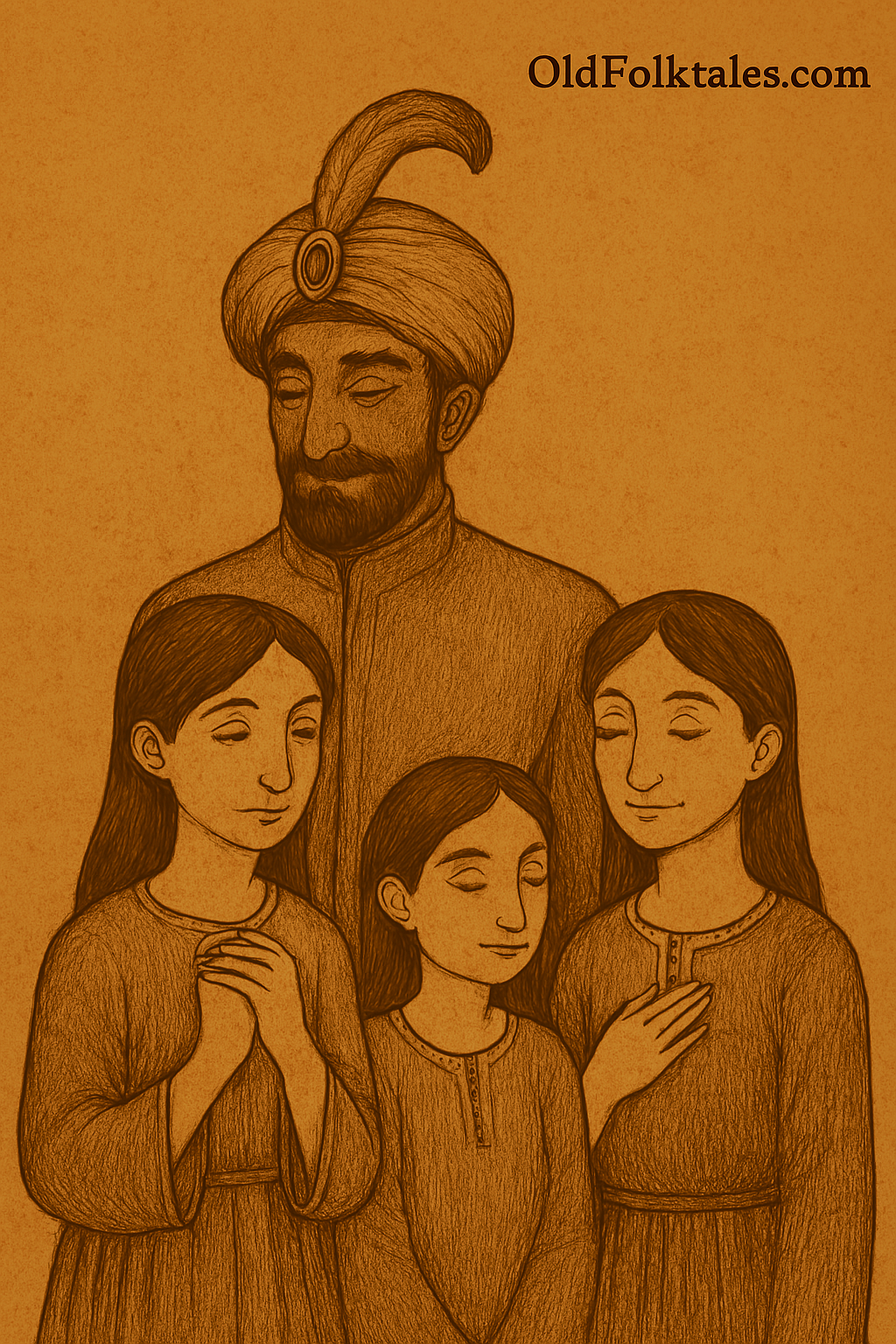
But it was the youngest sister whose words would change the course of all their lives. Setting down her needle, she gazed toward the palace that gleamed in the distance like a jewel against the desert sky. “My dreams reach higher still,” she whispered, her voice trembling with both hope and audacity. “I would marry the sultan himself, for I know I could bear him three children in three consecutive years: two sons and a daughter who would bring him the joy he has so long been denied.”
The sultan’s heart leaped at these words, as if the youngest sister had spoken directly to the deepest longing of his soul. Here was someone who understood his pain and offered not just companionship, but the promise of the family he had always craved.
When dawn broke over the desert, painting the sky in shades of gold and crimson, the sultan wasted no time in summoning the three sisters to his palace. To their amazement and delight, he granted each woman exactly what she had wished for: the eldest married the royal doughnut maker, the middle sister wed the palace cook, and the youngest became his beloved queen.
The two elder sisters initially rejoiced in their good fortune, but as time passed and they witnessed their younger sister’s elevation to the throne, jealousy began to poison their hearts like a slow-acting venom. When the young queen announced her first pregnancy, their envy transformed into something far more sinister.
True to her promise, the queen gave birth to her first child in the palace chambers filled with celebration and hope. But the elder sisters, consumed with jealousy, had corrupted the midwife with promises of gold and threats of ruin. Each time the queen delivered one of her promised children over the three consecutive years, the treacherous midwife replaced the royal babies with puppies, spiriting the real children away to what everyone believed would be certain death.
The sultan, seeing puppies instead of the children he had been promised, felt his heart break with disappointment and rage. He believed his young wife had deceived him with impossible boasts, never suspecting the cruel plot that had robbed him of his true heirs.
But destiny protects the innocent, and the three royal children survived their abandonment. Through a series of miraculous events and the kindness of strangers, they found their way into the world, growing up far from the palace that should have been their home, unaware of their true heritage.
Years passed like pages turning in an ancient book, and the children grew into remarkable young people, their royal blood manifesting in their intelligence, beauty, and natural nobility. They lived simply but happily, until the day when fate decided it was time for their story to unfold.
One of their aunts, the same women who had once worked at her loom in that humble house by the desert, came to visit them. Her words carried the weight of destiny as she spoke of a legendary treasure that had captured the imagination of heroes and adventurers for generations.
“There exists,” she told them, her voice dropping to a whisper that made them lean closer, “a shirt that sings with the voice of angels, and whose sleeves respond to its melodies with movements as graceful as a dancer’s arms. This magical garment is said to bring great fortune to whoever possesses it, but the quest to find it is perilous beyond imagination.”
The aunt’s words planted a seed in the children’s hearts that quickly grew into an overwhelming desire for adventure. The girl, moved by her aunt’s description, convinced her brothers that they must seek this wondrous shirt, not knowing that this quest would lead them back to their true destiny and the revelation of their royal heritage.
The Moral of the Story
This tale teaches us that jealousy and deception may temporarily triumph over truth, but justice and family bonds ultimately prevail. The story emphasizes that promises made in good faith, even when they seem impossible, often contain deeper truths than we realize. It also shows us that children, even when separated from their rightful place by cruel circumstances, will find their way back to their true destiny through courage, love, and the mysterious workings of fate.
Knowledge Check
Q1: Who are the main characters in this Judeo Tripolitanian folktale from Libya? A: The main characters are a childless sultan, his minister, three sisters from Tripoli, and the royal children (two sons and a daughter) who survive betrayal. The youngest sister becomes the sultan’s queen and bears the promised children despite her sisters’ jealous interference.
Q2: What promises do the three sisters make in this Libyan legend? A: The eldest sister promises to marry the sultan’s doughnut maker, the middle sister wants to marry his cook, and the youngest promises to marry the sultan himself and bear him three children in consecutive years: two boys and a girl who would bring him great joy.
Q3: How do jealousy and deception drive the plot of this Tripolitanian tale? A: The elder sisters’ jealousy leads them to bribe the midwife to replace each royal baby with a puppy over three consecutive years. This deception makes the sultan believe his wife lied about her promises, while the real children survive and grow up unaware of their royal heritage.
Q4: What is the significance of the magical singing shirt in this Libyan folklore? A: The singing shirt with responsive sleeves represents a legendary treasure that calls the royal children toward their destiny. The aunt’s mention of this magical garment sets up the quest that will eventually lead the children back to their true identity and rightful place in the palace.
Q5: What cultural elements from Tripoli and Libya are reflected in this folktale? A: The story reflects Judeo Tripolitanian culture with its desert setting, palace life, traditional crafts (weaving, cooking, doughnut making), and the custom of rulers disguising themselves to observe their subjects. The tale also incorporates Middle Eastern storytelling elements of magical objects and divine justice.
Q6: How does this Libyan myth explore themes of identity and belonging? A: The story shows how true identity cannot be erased by deception, the royal children survive despite attempts to destroy them and are eventually drawn back to their rightful heritage. Their quest for magical treasures becomes a journey toward discovering who they really are and reclaiming their place in the royal family.