Long ago, when the boundary between earth and sky was as thin as morning mist, our people understood that the Sun’s burning rays and hidden warmth were both blessing and burden. We complained when his heat scorched our skin, yet mourned when clouds concealed his life-giving light. Perhaps this is why the Sun chose to marry one of our daughters to understand the hearts of those who both needed and resented his power.
The story begins during planting season, when groups of women would trek to their hillside farms to prepare the rich earth for crops. Among them walked Majieno, whose lazy spirit would soon set in motion events that would echo between heaven and earth. While her companions diligently cleared weeds and tilled soil with calloused hands, preparing to sow precious pumpkin seeds, Majieno had other plans entirely.
As the other women bent their backs under the climbing sun, carefully placing each seed with hopes for abundant harvest, Majieno found a shady spot and began roasting her pumpkin seeds over a small fire. The aromatic smell filled the air as she cracked shell after shell, consuming what should have been her future crop. She thought herself clever, satisfying her immediate hunger while others toiled, but she failed to notice Mashii-the-Bird watching from the branches above.
Also read: The Outcast Who Saved a Village
This wise bird, seeing Majieno’s wasteful behavior, quietly gathered the scattered shells and properly planted them in neat rows where they would receive morning sun and evening dew. The seasons turned, and the rains came and went, nurturing the secret garden that grew from Mashii’s industrious work.
When the time for “tasting of the pumpkins” arrived that joyful tradition when women sample their first harvest, the group set out with hearts full of anticipation. Their laughter rang across the valleys as they shared stories and jokes, but Majieno walked in worried silence, knowing her deception would soon be revealed.
“Aweh, why are you so quiet?” her friends teased, poking her ribs with gentle concern. “Why aren’t you chatting and laughing with us?”
“I am not feeling fine,” Majieno lied, her stomach churning with anxiety.
As they climbed the final hill and reached the flat summit where they could survey their farms spread across the valley below, Majieno’s heart nearly stopped. Her plot was magnificulous with full, golden pumpkins gleaming in the afternoon sunlight. Suddenly, she whistled and laughed with genuine delight.
“Why the sudden outburst?” her puzzled friends inquired, noticing the dramatic change in her demeanor.
“The sun has touched my face at the top of this hill and I am feeling much better,” she lied again, relief flooding through her.
But when the women descended to their individual farms and began harvesting, Majieno discovered that appearances could be deceiving. Each time she plucked a pumpkin and placed it in her woven neshre basket, Mashii appeared with a commanding song:
Tinke bo’ Tinke bo’ Tinke tinke bo’ Back to the stem, pumpkin Back to the stem, pumpkin Back to the back to the stem, pumpkin
The pumpkin would tumble from her basket as if pushed by invisible hands, rolling back to reattach itself firmly to its vine. This magical frustration continued throughout the long day, leaving Majieno empty-handed while her friends’ baskets overflowed.
When her companions prepared to return home, Majieno called them over with embarrassment weighing her voice. “There’s a bird here,” she explained. “When I pick a pumpkin, Mashii says, ‘Back to your stem,’ and the pumpkin returns to its vine. All my harvest hangs exactly where I first picked it.”
The generous women quickly shared their abundance with their distressed friend, ensuring she wouldn’t return home empty-handed. That evening, Majieno confessed everything to her mother, who proposed joining her the next day to solve this mystery.
Instead of harvesting, they spent the day weeding, and when mealtime arrived, Mashii descended from his perch to share their simple feast of cocoyam and soup. The bird’s beak moved rhythmically from vegetable to broth, and when only one piece remained, they invited him to finish it. As Mashii flew into the basket to claim the last morsel, Majieno’s mother swiftly flipped the container, trapping the magical bird inside.
“Don’t kill me,” Mashii pleaded desperately. “I will provide oil and salt for you whenever you need them.”
“We won’t harm you,” they assured him, carrying their precious captive home.
True to his word, Mashii became their household miracle, producing cooking oil and salt on command. But one morning, when Majieno left for the farm and asked her young daughter to request provisions for their meal, disaster struck. The girl struggled to hold both Mashii and a bowl, and when she adjusted her grip to be more gentle, the clever bird escaped through her open palm.
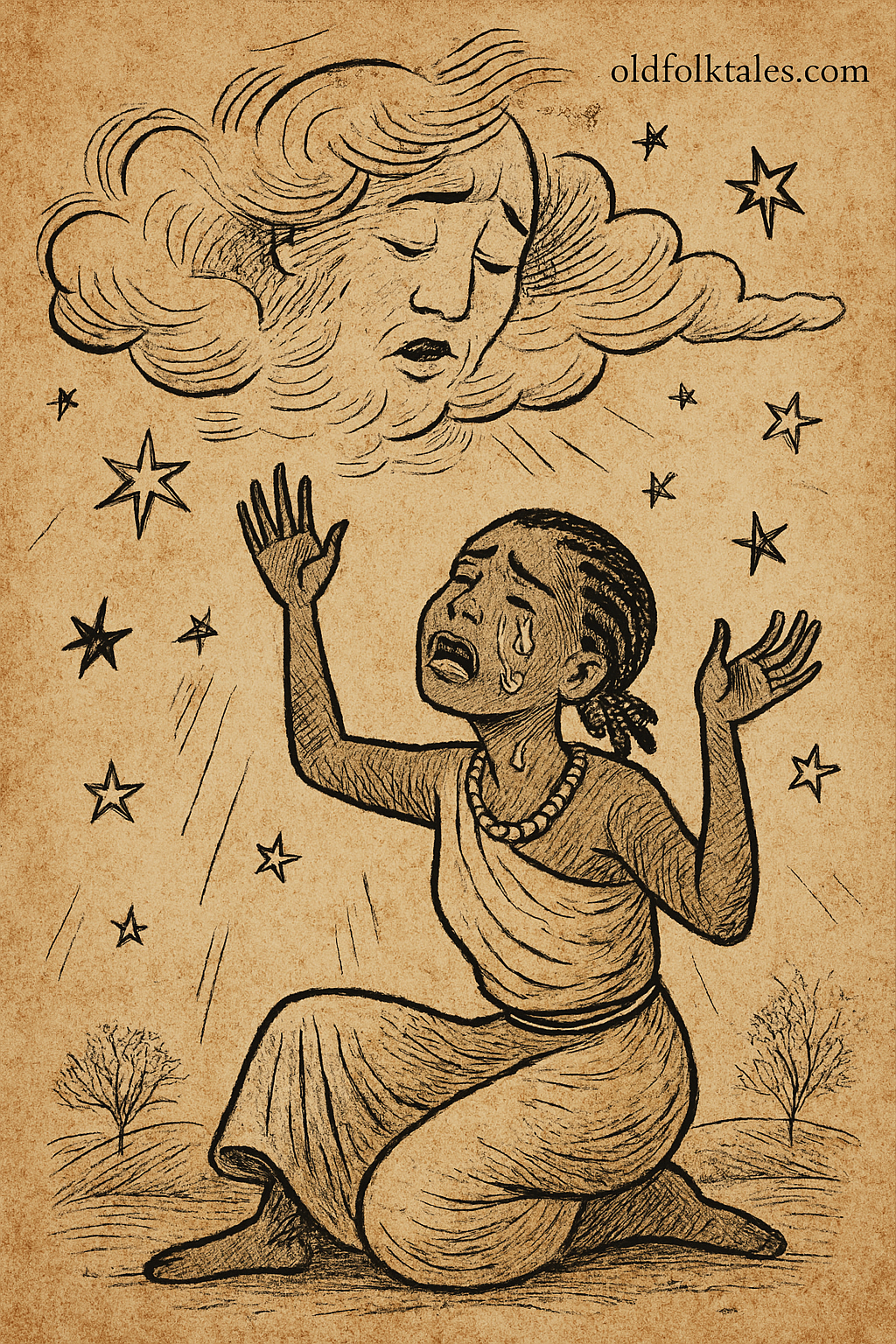
Though she chased him all day, the exhausted girl could only catch an ordinary bird as replacement. When evening came and Majieno asked for oil and salt, this imposter produced only grains of worthless sand. Enraged by her daughter’s carelessness, Majieno delivered a harsh beating that sent the heartbroken child outside to weep beneath the stars.
As tears streamed down her face, the girl’s anguish poured forth in a desperate song:
O sky, come down and take me O earth, come up and take me O sky, fall down and take me O earth, rise up and take me
The very heavens trembled at her call. Sky and Earth both responded to her plea, but Sky moved faster, swooping down to claim the girl before Earth could rise up to embrace her. Up, up, up she soared through the clouds until she reached the celestial realm where she met and married the Sun himself.
Years passed in the sky kingdom, and the girl adapted to her divine life. But when she accompanied her mother-in-law on a crab-fishing expedition, darker impulses emerged. Mother Sun revealed the secret of the magical stone, the ndeb netswegh, that could transport her back to Earth. At the river’s edge, when the girl lifted a heavy stone to reveal scurrying crabs, she called her mother-in-law closer. The moment Mother Sun approached, the girl released her grip, letting the crushing weight fall upon her husband’s mother.
Returning home, she sat by the fireside grinding corn while singing a chilling song:
Bekee bekee be kro ato ndeh neneb Bekee bekee be kro ato ndeh neneb Crabs crabs are eating Sun’s mother’s head Crabs crabs are eating Sun’s mother’s head
Meanwhile, on Earth, Majieno mourned her lost daughter with the devastating grief that only mothers know. She sat with legs stretched before her, tears flowing freely as she blamed herself for driving her child away. Ntifekwu-the-Spider witnessed her suffering and offered help in exchange for a goat’s meat. After feasting, the spider spun a magnificent web reaching to the heavens, guiding the grieving mother up to her daughter.
The reunion brought immense joy, but when it came time for Majieno’s departure, Sun insisted on escorting his mother-in-law personally. Along the path, he dug a pit filled with vicious neyibobo ants and buried her up to her neck. These weren’t harmless insects their stings inflamed skin and poisoned blood, causing excruciating torment.
When Sun returned home chortling with cruel satisfaction, his wife suspected treachery. She traced his steps, found her suffering mother, and carefully extracted every ant from her hair and body. “Return to Earth,” she told Majieno. “I’ll follow soon.”
Back at her celestial hearth, the girl resumed grinding corn and singing her ominous song. When she finished her work, she placed the flour by the fireside, lifted the ndeb netswegh, and descended back to Earth, abandoning her divine husband forever.
Moral Lesson
This tale warns against the consequences of laziness, deception, and betrayal in relationships both earthly and divine. Majieno’s initial dishonesty set events in motion that led to tragic separation from her daughter. The story teaches that breaking faith whether through lies, carelessness, or cruel revenge creates ripples that affect entire communities, even causing celestial powers to withdraw their blessings and inflict droughts upon the land.
Knowledge Check
Q1: What role does Mashii-the-Bird play in this Cameroon folktale? A1: Mashii-the-Bird serves as both a helper and teacher, planting pumpkins for the lazy Majieno, then becoming a magical provider of oil and salt while demonstrating the importance of honesty and proper gratitude.
Q2: What is the significance of the ndeb netswegh stone in the story? A2: The ndeb netswegh is a magical stone that allows travel between Earth and the celestial realm, symbolizing the connection between human and divine worlds and the power to cross boundaries between them.
Q3: Why did the Sun marry the human girl in this African folktale? A3: The Sun married the girl after she called upon sky and earth in her despair, representing how divine powers sometimes intervene in human suffering, though such unions often end tragically due to fundamental differences.
Q4: What does Ntifekwu-the-Spider symbolize in this Cameroon legend? A4: Ntifekwu-the-Spider represents wisdom and the power to bridge different worlds, using her web-spinning abilities to reconnect the grieving mother with her daughter in the celestial realm.
Q5: How does this folktale explain natural phenomena like droughts? A5: The story suggests that droughts occur because the Sun, abandoned by his human wife, expresses his anger and disappointment by “towering over Earth and bullying us with droughts and hunger.”
Q6: What cultural lesson does this tale teach about family relationships? A6: The story emphasizes that harsh punishment and lack of forgiveness can drive family members away permanently, and that revenge and betrayal create cycles of suffering that affect entire communities.
Source: The sacred door and other stories, Cameroon folktales of the Beba,” Ohio University Press.