
In a time when the bonds between mothers and sons were considered sacred above all earthly relationships, there lived a woman blessed with three devoted sons. These young men possessed hearts so filled with love for their mother that her happiness became their primary concern in life. They competed gently with one another to bring her joy, each seeking to prove the depth of his affection through acts of kindness and service.
As the years passed like seasons in an endless cycle, their beloved mother grew increasingly frail. Her once strong hands trembled like leaves in the wind, her voice became soft as a whisper, and her steps grew uncertain. Seeing her decline, the three sons gathered in solemn council to discuss how they might honor her when her time on earth came to an end.
The eldest son, whose practical nature had always guided his decisions, made the first promise: “When our dear mother passes from this world, I will carve the finest sepulchre from solid stone, a monument that will stand forever as testimony to her virtue and our love.”
The second son, gifted with skilled hands and an artist’s eye, added his own vow: “I will craft the most beautiful coffin ever seen, adorned with intricate designs that reflect the beauty of her soul and the elegance with which she lived her life.”
The youngest son, whose heart burned with the intensity that comes with being the baby of the family, made a promise that caused his brothers to gasp in amazement: “I will journey to find the tail of the princess elephant and place it in the coffin with her, so that she may rest with the most precious treasure in all the animal kingdom.”
This final promise was by far the most dangerous and difficult to fulfill, for the princess elephant was legendary, a creature of immense power and magical abilities, protected by all the elephants in the world.
Soon after these solemn vows were made, their mother’s gentle spirit departed this earth, leaving behind three grieving sons determined to honor their promises. While his older brothers began their work with stone and wood, the youngest son, whose name was Kwesi, immediately set forth on his perilous quest. He had no map, no guide, and no clear destination, only the burning determination to fulfill his sacred vow.
For three long weeks, Kwesi traveled through unfamiliar territories, crossing rivers, climbing mountains, and traversing dense forests. His feet grew sore, his provisions dwindled, and doubt began to creep into his heart like morning shadows. Just when despair threatened to overwhelm him, he arrived at a small village unlike any he had ever seen.
There he encountered an elderly woman whose eyes widened with shock at his appearance. “Never before has a human being set foot in this place,” she whispered, her voice trembling with amazement. “You have wandered into the secret home of all the elephants in the world, this is where they come to rest each night, and where the princess elephant herself sleeps.”
When Kwesi explained his quest, the old woman’s expression shifted from surprise to deep concern. “Young man,” she warned, “if these magnificent creatures discover your presence, they will surely kill you without hesitation. However, your love for your mother touches my heart, and I will help you.” She led him to an enormous pile of firewood, carefully concealing him within its depths.
“Listen carefully,” she instructed in hushed tones. “When all the elephants have fallen into deep sleep, you must rise and walk boldly, not stealthily, to the eastern corner where the princess rests. Cut off her tail with swift precision, then return the same way you came. Remember, you must walk with confidence, for if you attempt to sneak, they will sense your presence and awaken.”
As darkness descended like a heavy blanket over the village, the ground began to tremble with the approach of countless elephants. The air filled with their trumpeting calls and the thunderous sound of their massive feet. Upon entering the village, their sensitive trunks immediately detected an unfamiliar scent.
“I smell a human,” declared one of the great beasts, his voice rumbling like distant thunder.
The old woman, with remarkable composure, assured them they were mistaken. “You detect nothing more than the lingering scents of the forest,” she said calmly. Hungry from their day’s journey, the elephants accepted her explanation and settled down to their evening meal before seeking their rest.
In the deepest part of the night, when even the most vigilant creatures had surrendered to sleep, Kwesi emerged from his hiding place. His heart pounded like a war drum as he walked with forced confidence across the open ground toward the eastern corner. There, bathed in moonlight, lay the princess elephant, more magnificent than anything he had ever imagined. Her skin gleamed like polished obsidian, and her presence radiated an otherworldly power.
With trembling but determined hands, Kwesi used his sharpest knife to sever the princess’s tail. The deed accomplished, he retraced his steps with the same bold stride, clutching the precious tail against his chest. As soon as he was safely away from the village, he began his long journey home.
When the first rays of dawn broke across the elephant village, several of the creatures stirred uneasily. One elderly bull announced, “I dreamed that our princess’s tail was stolen.” His companions, dismissing this as mere nightmare, beat him for suggesting such a terrible possibility. A second elephant reported the identical dream and received similar treatment.
Finally, the wisest among them suggested they verify the truth of these troubling visions. Upon examining their sleeping princess, they discovered to their horror that the dreams were reality, her tail was indeed gone. They awakened the princess, who was initially unaware of her loss. Once informed, her rage was terrible to behold.
The entire herd set out in furious pursuit, their massive legs covering ground with frightening speed. Within hours, they spotted Kwesi in the distance, still carrying his precious burden. Seeing his pursuers approaching like a living avalanche, Kwesi cried out in desperation to his protective spirit: “O my juju Depor! What shall I do?”
His juju, a powerful idol he always carried hidden in his hair, immediately responded: “Throw a tree branch over your shoulder.” The moment Kwesi complied, the branch grew into an enormous tree that completely blocked the path. The elephants were forced to eat their way through the massive obstacle, buying Kwesi precious time.
When they resumed their chase, Kwesi again called upon his juju for aid. This time, the spirit instructed him to throw a corn cob behind him. The small object instantly transformed into a vast field of maize that the elephants had to consume before continuing their pursuit.
By the time they had eaten through this second barrier, Kwesi had safely reached his village. The frustrated elephants had no choice but to abandon their chase and return home, all except the princess, whose anger burned like an unquenchable fire.
“I will not return,” she declared with terrible resolve, “until I have punished this impudent thief.”
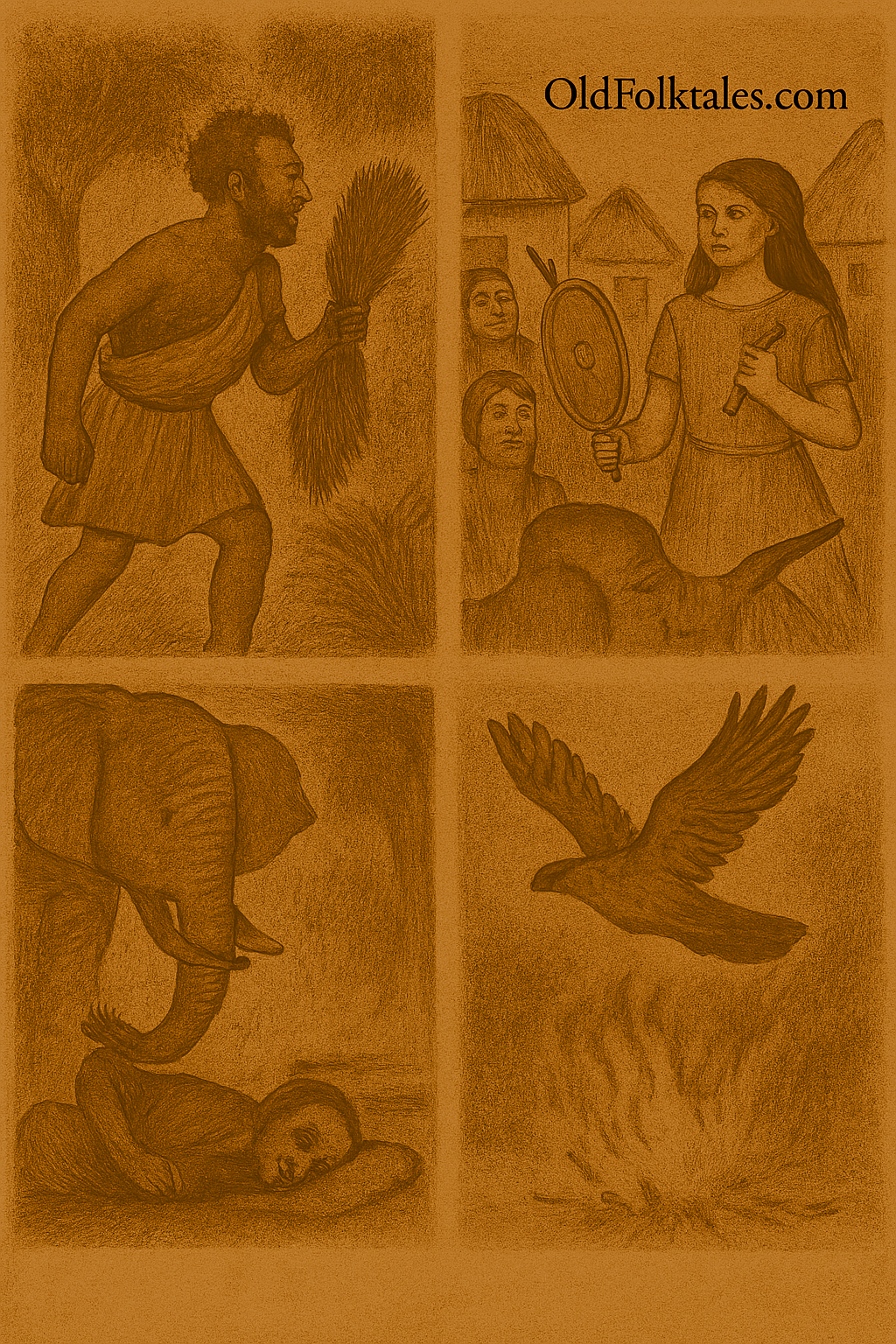
Using her magical powers, the princess transformed herself into the most beautiful maiden anyone had ever seen. Taking a calabash cymbal in her delicate hands, she approached Kwesi’s village, where her stunning appearance immediately drew crowds of admiring villagers.
She proclaimed throughout the community that whoever could successfully shoot an arrow at her cymbal would win her hand in marriage. Young men from across the region attempted the challenge, but all failed to hit the target.
An elderly villager, observing the failed attempts, commented thoughtfully, “If only Kwesi were here, the brave young man who cut the princess elephant’s tail, he could surely hit that cymbal.”
The disguised princess’s eyes gleamed with satisfaction. “Then Kwesi is the man I will marry,” she declared, “whether he hits the cymbal or not.”
Kwesi was quickly summoned from the fields where he was plowing. When told of his supposed good fortune, he felt no joy, only deep suspicion. Something about this beautiful stranger troubled him, though he could not identify exactly what.
Nevertheless, he took up his bow and arrow. His shot struck the exact center of the cymbal with remarkable precision. The villagers cheered as the couple were declared married, but Kwesi’s unease only deepened as he observed his new bride’s strange, calculating smile.
On their wedding night, as Kwesi lay sleeping, the princess revealed her true nature. She transformed back into an enormous elephant and prepared to crush her sleeping husband. But Kwesi awakened just in time and cried out to his protective spirit: “O my juju Depor! Save me!”
Instantly, the juju transformed Kwesi into a simple grass mat lying on the bed. The princess elephant searched frantically but could not locate her prey. When morning came and she had resumed human form, she demanded to know where her husband had been during the night.
“While you were an elephant,” Kwesi replied calmly, “I was the mat you were lying upon.”
Enraged, the princess immediately gathered all the mats in the house and burned them to ashes.
The following night, the deadly game resumed. Again the princess became an elephant seeking to kill her husband, and again Kwesi called upon his juju for protection. This time, the spirit transformed him into a tiny needle, rendering him invisible to the princess’s searching eyes.
When she questioned him the next morning, Kwesi again revealed how his juju had saved him. The princess realized that as long as he possessed this protective spirit, her revenge would remain incomplete. She began planning how to destroy the source of his power.
The next day, Kwesi prepared to return to his farming duties. He asked his wife to bring food to his usual resting place in the fields. The princess agreed, her mind already formulating her final trap.
When she arrived with the meal, she behaved with such sweetness and affection that Kwesi’s suspicions were temporarily lulled. After he had eaten, she suggested tenderly, “Now lay your head in my lap and rest, my dear husband.”
Kwesi, forgetting in his moment of contentment that his juju was hidden in his hair, gratefully accepted her offer. As soon as he fell asleep, the princess carefully extracted the protective idol from its hiding place and cast it into a large fire she had secretly prepared.
When Kwesi awakened to find his wife transformed once again into a murderous elephant, he cried out in terror: “O my juju Depor! What am I to do?”
This time, the answer came not from the spirit itself, but from the flames consuming it: “I am burning, I am burning, I am burning!”
In desperation, Kwesi called again for help. With its dying power, the juju managed one final act of protection: “Lift up your arms as if you were flying.” The moment Kwesi raised his arms, his body transformed into that of a hawk, and he soared away from the elephant’s deadly reach.
Moral Lesson
This captivating African folktale teaches us about the unexpected consequences that can arise from acts of love and devotion. While Kwesi’s quest began as a noble gesture to honor his mother, his theft, regardless of its loving motivation, set in motion a chain of events that forever changed his nature. The story reminds us that even our most well intentioned actions can have far reaching consequences, and that sometimes the price of fulfilling our promises is higher than we could ever imagine.
Knowledge Check
Q1: What does Kwesi represent in this African transformation folktale? A: Kwesi represents devoted filial love and the willingness to undertake dangerous quests for family honor. His character demonstrates how love can drive someone to extraordinary acts, but also shows the unexpected consequences that can result from even well intentioned actions.
Q2: What role does the princess elephant play in this African magical tale? A: The princess elephant represents the power of nature to seek justice and revenge when wronged. As both a magical creature and a shape shifter, she embodies the principle that actions have consequences, and that even theft motivated by love cannot go unpunished.
Q3: What is the significance of the juju Depor in African spiritual traditions? A: The juju Depor represents protective spiritual power and the connection between humans and supernatural forces. In African folklore, such protective spirits often help worthy individuals but can be destroyed by cunning enemies, showing the fragile nature of spiritual protection.
Q4: How does this folktale explain the origin of hawk behavior? A: The story provides an origin myth explaining why hawks are often seen flying in smoke from fires, they are searching for their lost juju spirits. This transformation tale connects human experience with observed animal behavior, a common element in African folklore traditions.
Q5: What does the disguised princess’s marriage test symbolize in African culture? A: The cymbal shooting test represents the theme of fate and destiny in African storytelling. The princess’s declaration that she will marry Kwesi regardless of his performance shows how some encounters are predetermined, and how one cannot escape the consequences of past actions.
Q6: What cultural values does this African folktale promote regarding family obligations? A: The tale promotes deep respect for parents and the lengths to which children should go to honor them, even after death. However, it also warns that excessive devotion can lead to dangerous choices, showing the need for balance between love, duty, and wisdom in decision making.

