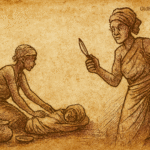
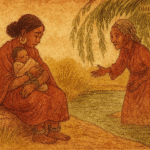
In a time when the Baobab trees were still considered sacred and the rivers sang songs only griots could understand, there lived a boy named Demba in the old Wolof lands of Senegal. His village, Koumbal, sat on the edge of the River Saloum, where mangroves spread their fingers into the land, and fishermen cast nets that shimmered like silver in the sun.
Demba was known not for his strength nor for clever tricks, but for his heart. He helped the elders, carried water for his neighbors, and played the talking drum better than anyone in Koumbal. The villagers said his fingers had the blessings of the ancestors. When he played, birds fell silent, and trees leaned slightly, listening.
His drum was a gift from his grandfather, who was once a great griot. It had carvings of crocodiles, suns, and moons etched with patient hands. “Play with truth in your heart,” his grandfather had told him. “And the ancestors will guide you.”
One dry season, a terrible silence came upon Koumbal. The river stopped singing, the drums refused to speak, and people’s laughter faded. Crops wilted early, and even the griots had no stories to tell. It was said that the Spirit Drummer, guardian of harmony, had vanished from the forest shrine.
According to legend, the Spirit Drummer lived beyond the river, deep within the Sacred Grove of Fadial, a realm only the pure of heart could enter. Every generation, one drummer would be chosen to learn the ancient rhythms that balanced the land and sky. But no one had been chosen in over fifty years.
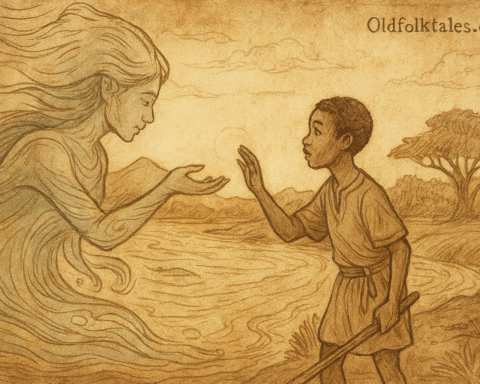
One night, Demba sat by the river, tapping rhythms with his fingers on the wooden dock. He wasn’t trying to call anyone, but his drumming carried into the forest. Leaves rustled where there was no wind. Frogs stopped croaking. Then came a voice, soft and low, like the hum of the Earth.
“Demba.”
He turned, startled. A man stood across the river, tall and cloaked in raffia, with eyes that gleamed like wet stones. He held a drum carved from black wood and skin that shimmered like moonlight.
“You called with your truth. The forest heard. Will you come?”
Demba’s heart pounded. “Where?”
“To the place where rhythm was born.”
Without thinking, Demba stepped into a canoe tied by the bank. As he rowed, mist rose from the river. The water no longer flowed — it shimmered like glass. Hours passed, or maybe minutes, before the boat touched the far shore. The cloaked figure waited, silent.
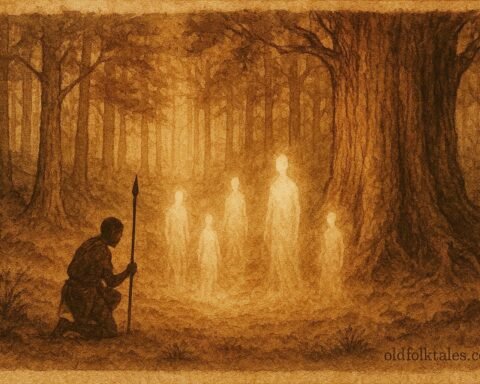
Demba followed him into the Sacred Grove. The trees there were older than time, their roots knotted like wise fingers. Sounds filled the air — soft whispers, gentle drumming, wind-song. At the center of the grove was a circle of stones, and on each stone sat a spirit, drumming. They had no faces, only masks carved of ebony, ash, and gold.
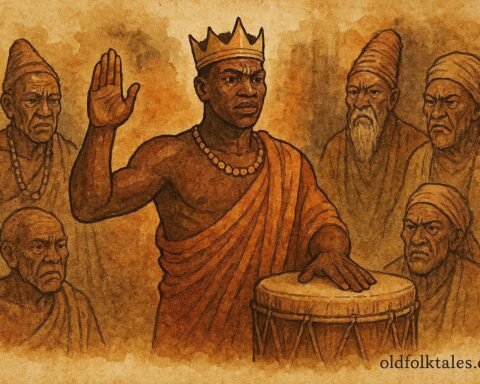
The cloaked man turned. “This is the Circle of Echoes. To join us, you must play. But your rhythm must not mimic, must not copy — it must be your soul.”
Demba swallowed. His hands trembled as he took out his grandfather’s drum. The spirits waited. He closed his eyes.
At first, he played the lullaby his mother used to hum when he was small. Then the rhythm of pounding millet. Then the heartbeat of the village. Slowly, his hands moved into a rhythm he had never played — a mix of sorrow and joy, of longing and hope. It came not from his mind, but from deep inside.
When he opened his eyes, the spirits were nodding. The cloaked figure smiled. “You have spoken with truth. You are the next Drummer of Balance.”
Suddenly, the grove vanished.
Demba woke at the riverbank, but something had changed. The silence was gone. Birds chirped, the wind whispered through grass, and somewhere, a talking drum sang.
He returned to Koumbal. People gathered, curious. He touched his drum, and with the first strike, laughter returned to the village. Children danced. Rain fell after a long drought. Old griots began to remember stories long forgotten.
But Demba never bragged, never claimed he was chosen. He played at festivals, ceremonies, and funerals, always with humility. And at night, he would go to the river’s edge, drumming softly to the trees, where sometimes, if you listened closely, you could hear the spirits playing along.
Years passed, and when Demba grew old, he disappeared one Harmattan morning. They say a single drumbeat echoed through the village that day — steady, warm, and final. His drum was found by the river, resting on a rock, waiting for the next soul of rhythm to rise.
✧ Commentary
This Senegalese folktale honors the sacred role of music and drumming in West African traditions. Demba’s story is one of humility, inner truth, and the spiritual connection between art and nature. The forest, spirits, and ancestral guidance reflect the animist beliefs embedded in Wolof and broader Senegambian culture. Rhythm isn’t just sound here — it’s a bridge between people, time, and the unseen world. Demba’s journey shows that true leadership and power lie in listening to one’s inner voice, not in seeking glory. The story is also a reminder that gifts from elders, when used with sincerity, can transform a community.
✧ Moral
The most powerful rhythms come from a pure heart. Speak truth through your gifts, and the world will find harmony.
✧ Questions & Answers
1. Q: Who was Demba, and what was his special gift? A: Demba was a humble boy from Koumbal known for his ability to play the talking drum with deep emotion and sincerity.
2. Q: What happened to Koumbal that led Demba to the forest? A: A strange silence fell over the village — crops failed, music stopped, and even the river ceased its song, signaling the loss of balance.
3. Q: Who called Demba into the Sacred Grove? A: A cloaked spirit drummer from the forest responded to Demba’s heartfelt rhythms and invited him into the Grove of Echoes.
4. Q: What did Demba have to do to be accepted by the spirit drummers? A:He had to play a rhythm that came entirely from his soul — not copied or rehearsed, but honest and true.
5. Q: What changed in the village after Demba returned? A: Harmony returned — rains fell, people rejoiced, and music filled the air once again. Demba restored the balance between humans and the spirit world.