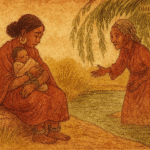
In a quiet village nestled along the banks of the River Gambia, there lived a young boy named Lamin. The village was small — just a cluster of clay huts, goats roaming freely, and laughter of children echoing between trees. Life here was simple, and people lived in harmony with the land and river. But for Lamin, simplicity was never enough.
He was different from other boys his age. While they raced goats or played drumming games, Lamin sat under the shade of the baobab tree, listening. His grandmother always said the baobab could speak — not with a voice, but with memories passed from root to leaf, trunk to sky.
“Baobabs are the ancestors’ ears,” she told him once, tapping her walking stick gently against its bark. “And if you’re quiet enough, they may whisper something back.”
Most children laughed at this, but not Lamin. He believed her.
One evening, after the elders had gathered beneath the grandest baobab to tell their nightly stories, Lamin stayed behind. The sky was dressed in deep indigo, pierced with stars. Crickets chirped. A hyena called in the distance.
Lamin leaned against the tree’s thick, knotted trunk, heart steady. He had questions—about life, the village, and his restless feeling. And then, as the wind moved through the leaves, a sound like a sigh drifted down.
“Lamin…”
His heart leapt.
He stood, trembling, searching for the voice.
“Lamin…” the whisper came again, soft and ancient.
“Yes?” he said, barely breathing.
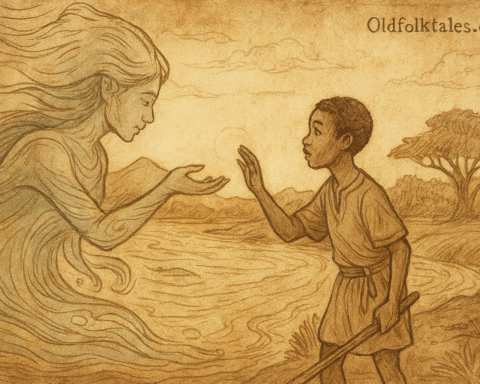
“I am the soul of this tree,” the baobab said. “I have seen your people rise and fall with the rains. You have a question in your heart.”
“I want to help my village,” Lamin said. “Our water is drying. The river grows shallower each season. Soon, the crops will fail.”
The baobab was silent for a long moment. Then: “There is a hidden spring, deep in the forest. It flows eternally. But it is guarded by the Leopard of Questions. Many have gone to seek it. Few return.”
“I will go,” said Lamin, without hesitation.
The baobab’s leaves rustled as if in approval. “Then listen well…”
At first light, Lamin packed millet bread, dried mango, and a waterskin. His grandmother, sensing something unspoken, said nothing but pressed a kola nut into his hand.
“For courage,” she whispered.
He set off toward the forest, beyond the fields, beyond where the goats wandered. The path quickly vanished into tall grass and thick underbrush. Birds called from the treetops, and the air buzzed with heat.
Lamin walked for hours. When the sun was highest, he rested beneath a cluster of palms, chewing his bread. The baobab’s voice echoed in his mind: “Follow the path only your heart can see.”
By nightfall, he reached the deep forest. Here, the trees grew so tall they blocked the stars. Shadows twisted. He heard the rustling of unseen creatures, but he pressed on, guided only by the flicker of hope.
On the second day, he met an old tortoise crossing his path slowly.
“Where are you going, child?” the tortoise rasped.
“To find the eternal spring,” Lamin said.
The tortoise blinked slowly. “The leopard waits for those who come with greed or fear. Go with a clean heart.”
Lamin nodded and thanked him.
On the third morning, Lamin heard the soft gurgle of water. He quickened his pace, pushing through thorns until he emerged into a sunlit clearing.
There it was—the spring.
The water shimmered in a pool surrounded by stones shaped like lion paws. But before he could move, a shadow fell over the clearing.
The leopard stood, golden fur glowing, green eyes sharp.
“I am the keeper of this spring,” he said, his voice deep as thunder. “Why do you come, child of the river?”
“To save my people,” Lamin replied, steady but respectful. “We are thirsty. Our crops are failing. I seek water not for myself, but for them.”
The leopard circled slowly. “Many say the same. But their hearts hide other truths.”
“Test me,” Lamin said.
The leopard stopped. “Three questions. Answer truly. Fail, and remain here forever.”
Lamin nodded.
The leopard’s first question: “What is stronger than the fiercest warrior, but can be broken by a whisper?”
Lamin thought. “Trust,” he said.
The leopard blinked. “Correct.”
“Next: What grows with giving, shrinks with greed, and dies when hoarded?”
“Kindness,” Lamin replied without pause.
A slow smile tugged at the leopard’s face. “Last question: What can cross time, outlive kings, and heal wounds words cannot?”
Lamin looked up at the sunlight dancing on the spring and said, “A story.”
The leopard bowed his head. “You have answered with truth and clarity. Take from the spring.”
Lamin filled his waterskin, but only halfway.
“Why not fill it all?” asked the leopard.
“To leave enough for others who may come,” Lamin answered.
The leopard nodded with deep respect. “Go. And carry the whispering wisdom with you.”
The journey back was lighter. Lamin’s feet barely felt the earth. When he returned, the village gathered. He poured the spring water into the well, and within days, it filled anew.
Crops revived. Rivers ran stronger. And at night, the baobab’s leaves rustled like applause.
Lamin was not just the boy who saved the village. He was the one who listened.
✧ Commentary
This powerful tale from The Gambia beautifully captures the balance between courage and humility. Lamin’s character shows us that leadership begins with listening, and that ancient wisdom like that of the baobab still speaks to those willing to hear. The leopard, a traditional guardian in many West African stories, doesn’t oppose Lamin but tests him, as life often does. It’s a story of bravery, not in fighting, but in walking with truth.
✧ Moral
Courage guided by wisdom and humility opens doors that force never can.
✧ Questions & Answers
1. Q: Why did Lamin leave his village? A: To find a hidden spring and bring water back to save his drought-stricken village.
2. Q: What did the baobab symbolize in the story? A: Ancestral wisdom and spiritual guidance.
3. Q: Who tested Lamin before he could access the spring? A: The Leopard of Questions.
4. Q: What kind of answers did Lamin give that impressed the leopard? A: He gave thoughtful answers rooted in values like trust, kindness, and storytelling.
5. Q: What deeper lesson does this story offer? A: That listening, humility, and selflessness are the marks of true leadership.