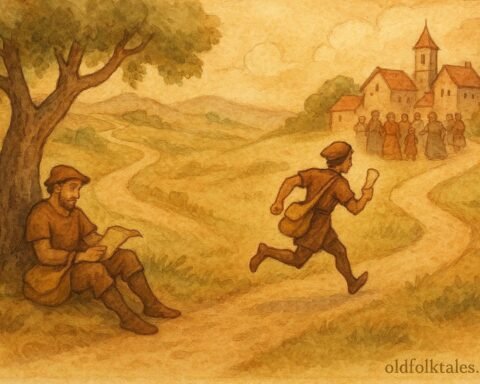
It once happened that a poor Akim-man set out from his quiet little village to Accra, a bustling coastal town. He had never traveled far before, and he spoke only the language of his people, a tongue not understood by the townsfolk. As he drew near the town, the sights around him filled him with both awe and wonder.
The first marvel he met was a vast herd of cows grazing in a field. Their number was so great that he stopped in his tracks, astonished. “To whom do all these cows belong?” he asked the herdsman. But the man, not understanding his language, simply replied, “Minū”, meaning, I do not understand.
The Akim-man, however, thought “Minū” was a name. “Ah,” he exclaimed with wide eyes, “this Mr. Minū must be very wealthy indeed!”
With that, he continued his journey and entered the busy town. Soon his eyes caught a magnificent building, large and beautifully designed. He wondered aloud, “Who owns such a grand house?” The person he asked shook his head and replied, “Minū.” Again the villager assumed it was the name of the owner. “Dear me! What a rich fellow Mr. Minū must be!”
READ THIS: How Jealousy and Selfishness Sread Across the World: Akan Folktale from Ghana
Not long after, he reached an even finer house, surrounded by gardens bursting with flowers. “Who owns this splendid place?” he inquired eagerly. The answer came the same: “Minū.” The villager clapped his hands in amazement. “This Mr. Minū is truly the richest man I have ever heard of!”
Still marveling, he strolled further until he reached the coast. There, at the beach, he beheld the greatest wonder of all: a massive steamer in the harbor, being loaded with cargo by many hands. He asked a bystander, “To whom does this fine vessel belong?” The man, as before, did not understand his words and replied, “Minū.”
The villager shook his head in disbelief. “So the Honourable Mr. Minū owns this ship as well? What wealth! What glory! Surely no man has ever been so fortunate.”
At last, after completing his small business in the city, the Akim-man turned toward home. But as he passed down one of the town’s streets, he encountered a solemn procession. Men were carrying a coffin, followed by mourners clad in black. Curious, he asked the name of the deceased. Once again, the answer came: “Minū.”
The villager stopped in his tracks, his eyes wide with sudden sorrow. “Oh, poor Mr. Minū!” he cried. “So he too must die like the rest of us? With all his cattle, his grand houses, his beautiful gardens, and his mighty steamer, he has gone into the grave as empty as the poorest man. Truly, wealth cannot save anyone from death.”
Shaking his head, he turned toward his village. By the time he reached his humble hut, his heart had settled. “In future,” he told himself, “I will be content with my tiny house and little money. For even the richest man, Mr. Minū himself, could not escape death.”
And so, pleased with his lot in life, the Akim-man lived contentedly in his modest home.
Moral Lesson
This tale teaches that wealth, power, and glory are fleeting. Even if one possessed cattle, fine houses, gardens, and ships, death comes for all. The Akim-man’s misunderstanding led him to an unexpected wisdom: contentment with what one has is a greater treasure than riches that cannot last.
Knowledge Check
Who was the main character in the story?
A poor Akim-man who traveled from his village to Accra.
What word did the Akim-man mistake for a person’s name?
He thought “Minū,” meaning I do not understand, was the name of a wealthy man.
What things did the Akim-man believe Mr. Minū owned?
A herd of cows, grand houses, beautiful gardens, and a large steamer.
What did the Akim-man see at the end of his journey?
A funeral procession carrying a coffin, which he believed to be for Mr. Minū.
What lesson did the Akim-man learn from his misunderstanding?
That wealth is meaningless in the face of death, and one should be content with what they have.
What is the cultural origin of this folktale?
Akan folktale from Ghana.
Source: Akan folktale, Ghana