The story is told of a day when kindness was weighed, not by words, but by action. It began when a stranger walked quietly into a village, carrying nothing but a staff and the dust of a long journey upon his feet. No one knew where he came from, yet his presence would soon reveal the true hearts of everyone who lived there.
The village itself was lively and full of movement. At dawn, farmers left their homes to tend to their fields, carrying tools over their shoulders as they spoke about the day’s work. Women gathered at the riverbank, their laughter echoing as they filled their clay pots with water. Traders arranged their goods carefully in the marketplace, calling out to attract buyers.
To any visitor, it seemed like a place of unity and shared purpose. But beneath that appearance, there were differences among the people. Some were known for their generosity, always ready to help others, while others guarded what they had, unwilling to give even when they had more than enough.
No one had ever truly tested the hearts of the villagers until that day.
Don’t miss out: Read more Southern African folktales
The stranger entered the marketplace first. His clothes were worn, and his face showed signs of fatigue. He moved slowly, observing the people as they went about their business. Then he approached a wealthy trader whose stall overflowed with yams, grains, and fine goods.
The stranger greeted him respectfully and asked for a small portion of food.
The trader frowned and looked him over from head to toe. Though his stall was full, he tightened his grip on his goods.
“I worked hard for what I have,” he said. “I cannot give it away to every traveler who comes asking.”
The stranger nodded quietly and moved on without argument.
Next, he approached a woman known for her skill in weaving baskets. She sat outside her home, her hands moving quickly as she worked.
The stranger greeted her and asked for a drink of water.
The woman paused and glanced at her water pot. Though it was not empty, she hesitated.
“If I give you water,” she said, “what will my children drink later?”
The stranger thanked her gently and continued on his way.
As the sun climbed higher in the sky, the stranger walked from one part of the village to another. He asked for help wherever he went. Some people ignored him completely, pretending not to hear his voice. Others spoke kindly but still refused to give anything, offering excuses instead of assistance.
Though their reasons were different, their actions were the same, they chose not to help.
The stranger did not argue or complain. He simply continued walking, observing, listening, and learning.
By the time the sun began to sink toward the horizon, the stranger reached the far edge of the village. There stood a small hut, simple and quiet, belonging to a young woman who lived alone. She was not wealthy, and her possessions were few. Yet she carried herself with a calm and gentle spirit.
When she saw the stranger, she did not turn away. Instead, she stood up and welcomed him.
“You look tired,” she said softly. “Please, come and rest.”
The stranger sat down, and after a moment, he asked for food and water.
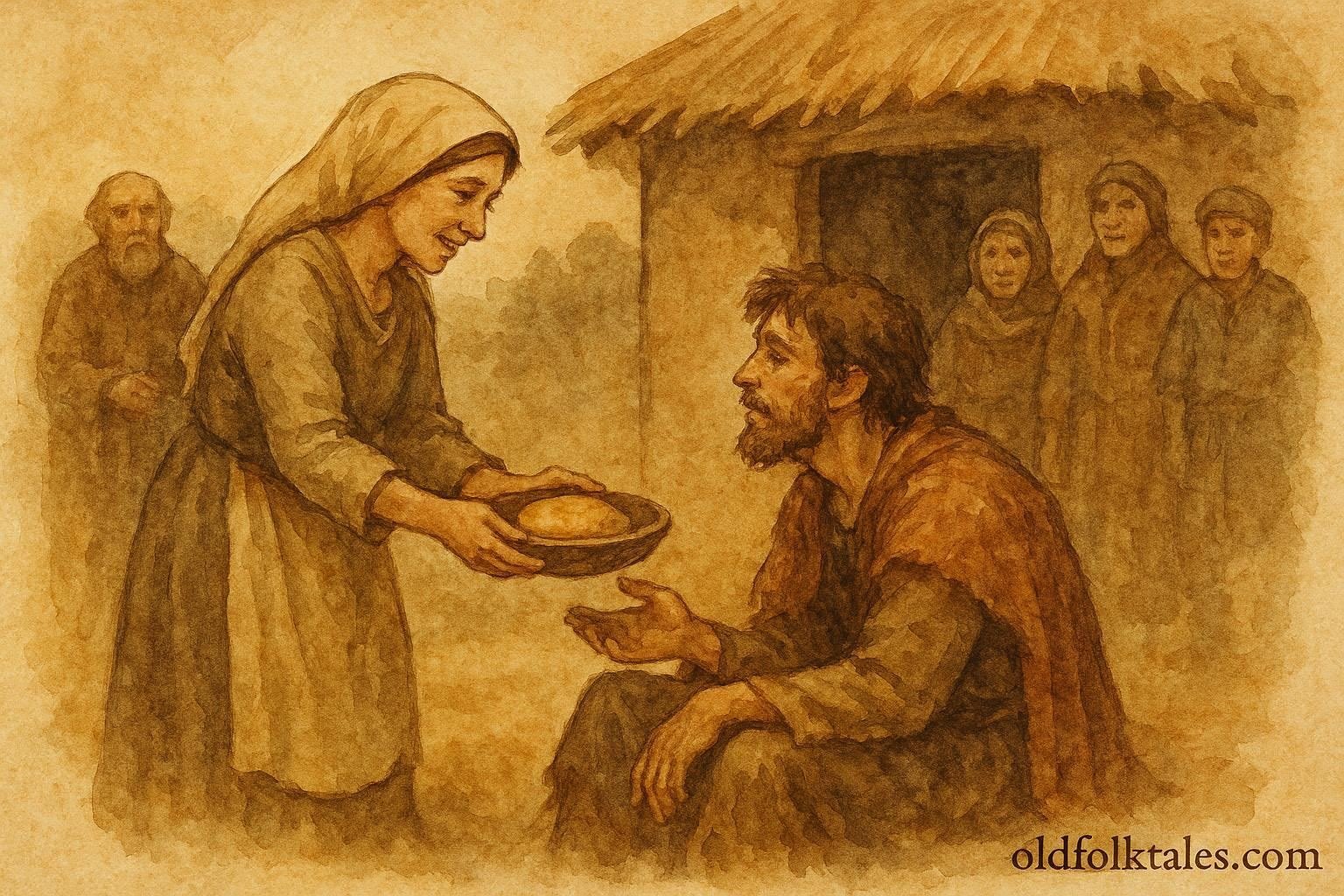
The young woman did not hesitate. She went inside her hut and brought out the small meal she had prepared for herself. She placed it before him and offered water from her pot.
“This is all I have,” she said, “but you are welcome to share it.”
The stranger looked at her carefully.
“You give without hesitation,” he said. “Yet you have so little. Why?”
The young woman smiled, her voice calm and sincere.
“Because if I have something, even if it is small, it can still help someone,” she replied. “Kindness is not about how much we give, but about being willing to give at all.”
The stranger ate the food and drank the water. When he finished, he sat quietly, as though considering her words.
Then he stood.
Something about him began to change. The weariness of his journey seemed to disappear, and a quiet light surrounded him. The young woman stepped back in surprise, realizing that she was not standing before an ordinary traveler.
“I came to this village to test its people,” he said. “Many had plenty but refused to give. You had little, yet you shared without fear.”
The young woman listened in silence.
“Because of your kindness,” he continued, “your home will never lack. What you give will always be returned to you.”
And with that, the stranger disappeared.
At first, the young woman wondered if what she had seen was real. But as the days passed, she began to notice something remarkable. Her food never seemed to run out. Her water pot remained full. Even when she shared with others, she always had enough.
Word of what had happened spread quickly throughout the village. People began to talk about the stranger and the test he had given. They remembered how they had refused him and how easily they had chosen to keep what they had.
The wealthy trader felt a deep sense of regret. The woman with the water pot lowered her head in shame. Others who had ignored the stranger began to reflect on their actions.
The elders of the village gathered everyone together and spoke with wisdom and authority.
“You have seen what has happened,” they said. “Generosity is not measured by wealth, but by the heart. Those who give only when it is easy have not truly learned kindness. But those who give even when it is difficult understand the true meaning of generosity.”
The villagers listened carefully, their hearts heavy with understanding.
From that day forward, the village began to change. People became more willing to help one another. They shared what they had, even if it was little. Strangers were welcomed with kindness, and no one was turned away without consideration.
The story of the stranger became a lesson that was told again and again, reminding everyone that true generosity is not about abundance, but about willingness.
And the young woman who had given freely continued to live a life of quiet kindness, her home always filled with enough, her heart always at peace.
If you enjoyed this story, explore our full West African folktales collection
Moral Lesson
True generosity comes from the heart, not from abundance. Those who give willingly, even when they have little, receive blessings beyond what they can see.
Knowledge Check
- Why did the stranger visit the village?
He came to test the generosity and kindness of the villagers. - Who passed the test of generosity?
A poor young woman who shared her food and water freely. - Why did others fail the test?
They were unwilling to give, even when they had enough. - What reward did the kind woman receive?
Her home was blessed with endless provision. - What lesson does the story teach?
Generosity is about willingness to give, not how much one has. - Where does this folktale originate from?
Benin, West Africa.
Source
West African folktale, Benin. Collected by Harold Courlander in A Treasury of African Folklore (1975).