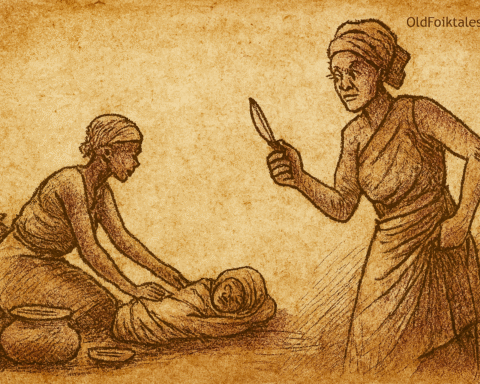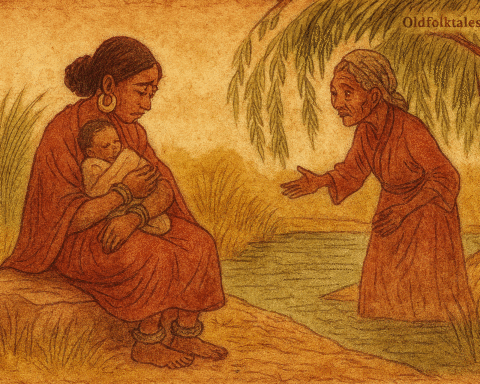
In a small village where the acacia trees cast long shadows and the red earth stretched endlessly toward distant mountains, there lived a woman whose spirit had been slowly crushed beneath the weight of her husband’s cruelty. Day after day, Amara endured his harsh words and violent hands, her body bearing the marks of his rage while her two young children cowered in the corners of their humble hut.
The breaking point came on a night when the moon hung like a silver coin in the star-scattered sky. As her husband raised his hand once more, something deep within Amara’s heart finally snapped, not in defeat, but in defiant strength. “No more,” she whispered, her voice trembling yet resolute. That very night, while her tormentor lay in drunken sleep, she gathered her precious children, little Kesi, barely four years old, and baby Jengo, still nursing at her breast, and slipped away into the darkness.
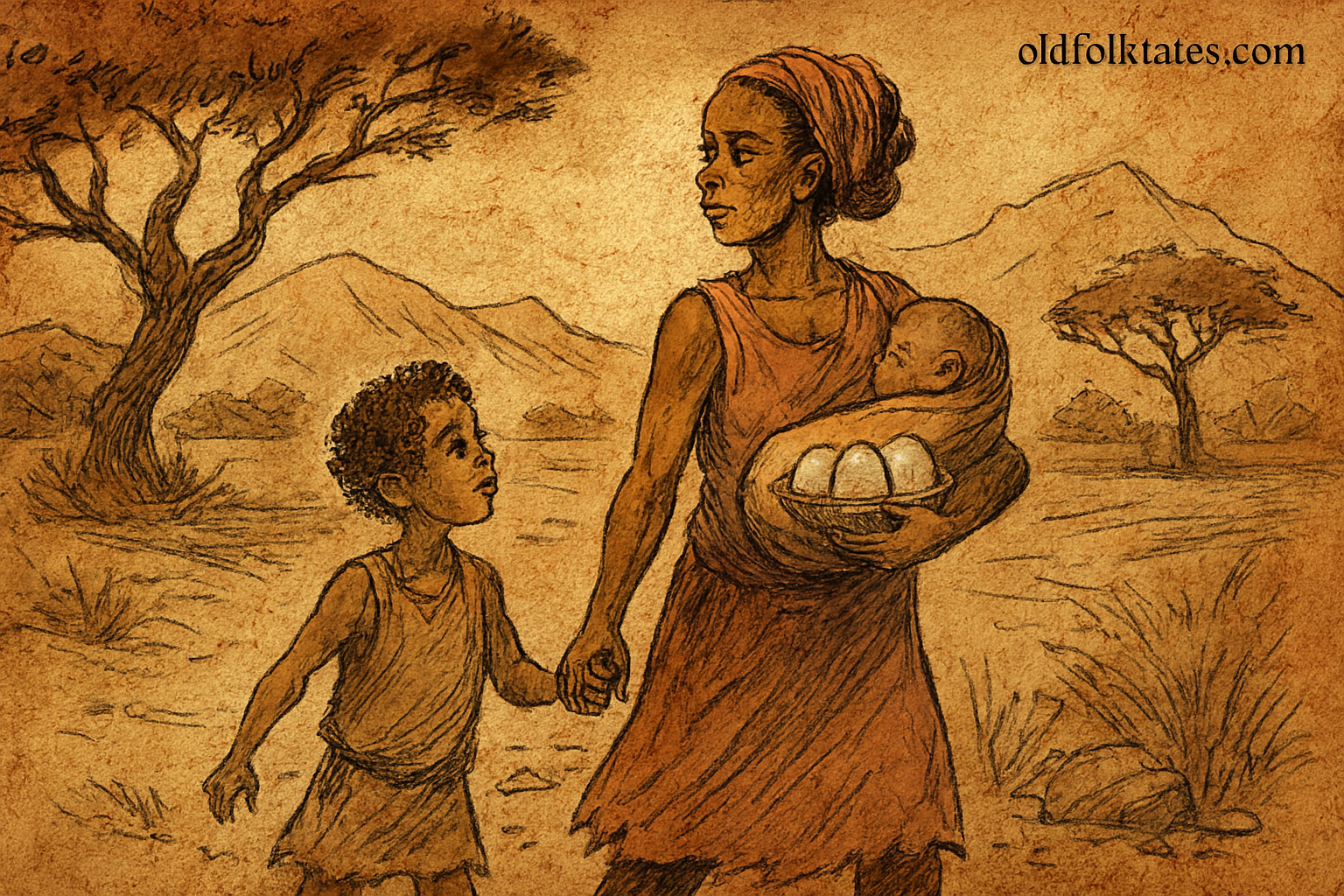
The wilderness beyond their village was vast and unforgiving, filled with thorns that tore at their simple clothes and rocks that bruised their bare feet. Amara’s heart pounded with fear and determination as she carried Jengo on her back while Kesi stumbled alongside, his small hand clutched tightly in hers. They had no food, no shelter, and no clear destination only the desperate hope that anywhere would be better than the hell they had left behind.
Also read: The Rabbit’s Missing Tail
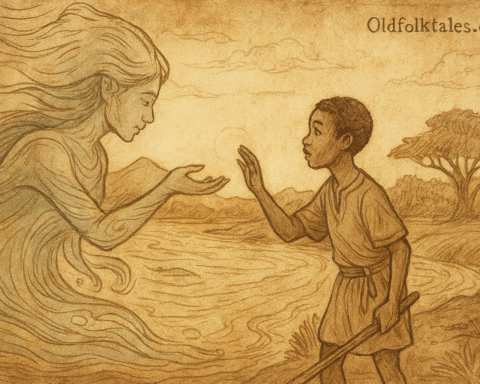
On their second day of wandering, when the sun beat down mercilessly and their throats were parched with thirst, they discovered a gentle river winding through a grove of fever trees. As Amara knelt to cup the cool water in her hands, Kesi’s excited voice called out, “Mama, look!” There, nestled in the roots of an ancient baobab tree beside the riverbank, was a small nest containing three pristine eggs, each one glowing with an otherworldly pearlescent sheen.
Something about these eggs seemed magical, almost sacred. With infinite care, Amara lifted the nest, cradling it against her chest. As they continued their journey, the most extraordinary thing began to happen the eggs started to whisper.
Their voices were soft as morning dew, wise as ancient spirits. “Turn left at the split in the path,” one would murmur. “Fresh water lies beyond those rocks,” another would counsel. “Shelter awaits in the cave ahead but beware the serpent that guards it.” The third egg remained silent, but Amara could sense its presence, warm and comforting against her heart.
Guided by these mystical voices, Amara navigated treacherous terrain and faced dangers that would have terrified seasoned warriors. When a massive hyena blocked their path, slavering and snarling, the eggs whispered ancient words of power that made the beast slink away into the shadows. When they encountered a river troll demanding payment for crossing his bridge, the eggs revealed the creature’s true weakness, his fear of children’s laughter and Kesi’s innocent giggles sent the monster fleeing.
Each trial tested Amara’s courage and motherly devotion. She fought off wild dogs with nothing but a broken branch, outsmarted cunning spirits who tried to lead them astray, and carried her children across raging torrents while the eggs whispered encouragement and guidance. Her body grew lean and strong, her eyes bright with newfound purpose. She was no longer the cowering woman who had fled in the night she was becoming something powerful, something magnificent.
After many weeks of wandering, they arrived at a kingdom shrouded in perpetual twilight. The people there moved like shadows, their faces etched with sorrow and despair. “A terrible curse has fallen upon our land,” explained an elderly woman. “Our beloved prince was transformed into an egg by a jealous witch, and until true love breaks the spell, our kingdom will know neither joy nor daylight.”
Understanding flooded through Amara like dawn breaking over mountains. The third egg the one that had remained silent throughout their journey pulsed with warm recognition against her chest. This was no ordinary egg, but the cursed prince himself.
With trembling hands, she lifted the egg and pressed it gently to her lips. “I have carried you through dangers and darkness,” she whispered. “I have protected you as I have protected my own children. If this is love, this fierce, protective devotion then let it break your chains.”
The egg cracked open like a flower blooming, and from it emerged not a bird, but a man of noble bearing with eyes that held the wisdom of one who had witnessed great suffering and greater courage. The curse shattered like glass, and golden sunlight flooded the kingdom for the first time in years.
The people, overjoyed by their liberation, proclaimed Amara their queen. She had proven herself through trials that tested not just her strength, but her character, her love, and her unwavering determination to protect those she cherished. The prince, transformed by his own journey of vulnerability and dependence, recognized in Amara a kindred spirit who had also been transformed by hardship into something greater.
Their love grew slowly, built on mutual respect and shared understanding of suffering overcome. Together, they ruled with wisdom and compassion, creating a kingdom where no woman would ever again face the violence that Amara had endured. Kesi and Jengo grew up as princes in this new realm, learning that true strength comes from protecting others, not from wielding power over them.
The Moral Lesson
This powerful tale teaches us that courage is not the absence of fear, but the determination to act despite it. Amara’s journey reminds us that even in our darkest moments, when we feel powerless and broken, we possess an inner strength capable of transforming not only our own lives but entire kingdoms. The story emphasizes that true love is not possession or domination, but protection, sacrifice, and the willingness to carry others through their most vulnerable moments.
Knowledge Check
Q1: Who is Amara and why does she flee her village? A: Amara is the protagonist, a woman suffering domestic abuse who courageously escapes with her two children, Kesi and Jengo, to protect them from her violent husband and seek a better life.
Q2: What is the significance of the three whispering eggs in the story? A: The three eggs serve as magical guides providing wisdom and protection during Amara’s journey. The third egg is revealed to be a cursed prince, symbolizing hidden potential and transformation through love and care.
Q3: How does Amara transform throughout her journey? A: Amara evolves from a victimized, cowering woman into a strong, courageous leader who faces monsters, overcomes obstacles, and ultimately becomes a queen through her demonstrated wisdom and protective love.
Q4: What curse affects the kingdom Amara discovers? A: The kingdom suffers under a curse cast by a jealous witch that transformed their prince into an egg and shrouded the land in perpetual twilight and sorrow until true love could break the spell.
Q5: What does breaking the prince’s curse teach about true love? A: The story reveals that true love is not romantic infatuation but protective devotion Amara’s willingness to carry and protect the egg-prince through danger demonstrates the nurturing, sacrificial nature of genuine love.
Q6: What is the cultural significance of this African folktale? A: This folktale reflects African storytelling traditions that use magical elements to convey moral lessons about courage, transformation, and the power of protective love to overcome adversity and create positive change in communities.
Source: The Multicolored Diary