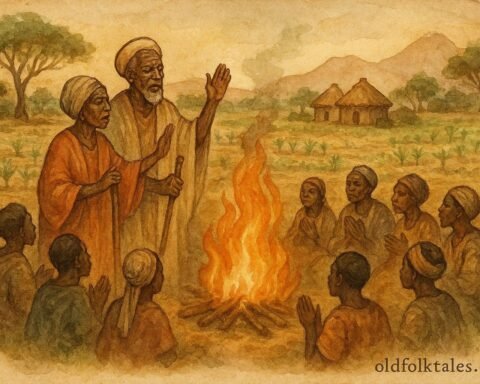
Listen, children of the red earth, gather close around the flickering fire. Listen to this tale of long, long ago, when the wind was young and the desert spirits still taught lessons to those with ears to hear. Listen well to the story of proud Ostrich and clever Jackal and learn why the wise ones say: “Pride walks on tall legs, but humility runs swift and sure across the sand.”
In those ancient days, when the Kalahari was still learning its songs and the baobab trees were counting their first hundred seasons, there lived an Ostrich—ah, such an Ostrich! Big and beautiful she was, with feathers black as the night sky and white as the foam where the great waters meet the shore. Her neck stretched tall, tall, tall toward the clouds, and her legs—hai!—her legs could carry her swift as the desert wind across the red dunes.
But this Ostrich, this beautiful one, she was proud, proud, proud. Every morning when the sun painted the eastern sky with fire, Ostrich would prance and strut before the water hole. “Look at me!” she would call to all who would listen. “See how graceful I am! Watch my magnificent dance! Is there any creature in all the Kalahari more beautiful, more elegant than I?”
The other animals would shake their heads and whisper among themselves. Springbok would leap away, embarrassed by such boasting. Gemsbok would lower their great horns and pretend not to hear. Even the dung beetles would roll their burdens faster, hurrying past Ostrich’s morning display.
But Jackal—eh, that cunning one!—Jackal watched and listened with his bright eyes gleaming. Silver-tongued Jackal, that trickster with the knowing smile, he saw how Ostrich’s pride made her foolish, foolish, foolish. And Jackal, being Jackal, he began to plan.
One morning, as the sun climbed higher and the heat began to shimmer on the red earth, Jackal came trotting to the water hole with his tail held high and his ears pricked forward with false excitement.
“Oh, magnificent Ostrich!” called Jackal in his sweetest voice. “I bring news, wonderful news from across the great desert!”
Ostrich stopped her preening and fixed Jackal with one large, curious eye. “What news, clever Jackal? Speak quickly—I have important dancing to do.”
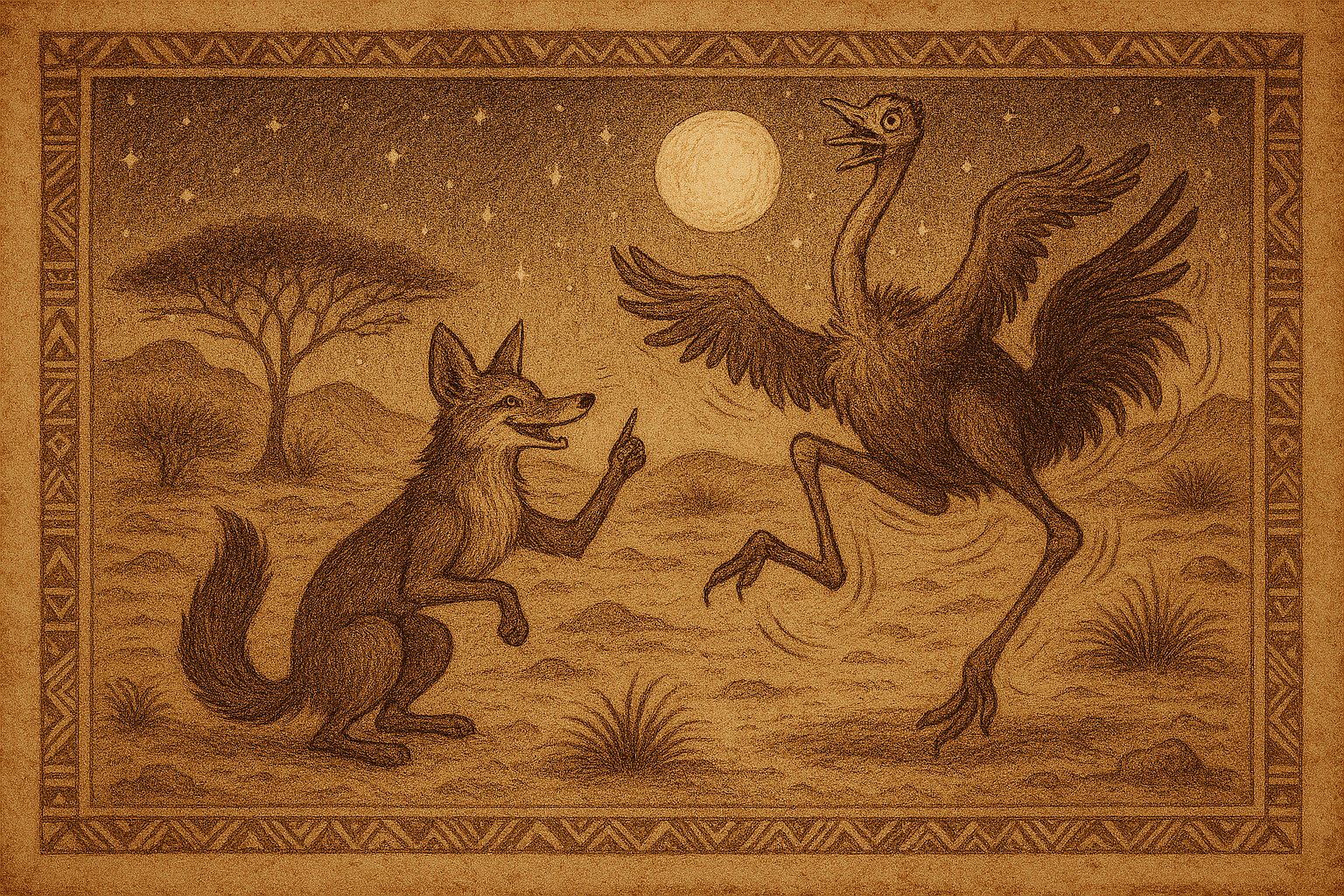
“Ai, yi, yi!” exclaimed Jackal, dancing on his hind legs with pretended joy. “The Great Dance Competition, Ostrich! The greatest dance contest in all the world is to be held today, right here by this water hole!”
“A dance competition?” Ostrich’s other eye swiveled to focus on Jackal. Her heart began to beat fast with excitement. “Tell me more, silver-tongued one!”
Jackal grinned his sly grin. “Animals are coming from every corner of the Kalahari to compete. Secretary Bird from the tall grass country, Flamingo from the salt pans, even Crowned Crane from the river lands far, far away. The winner will be declared the Greatest Dancer in All the World!”
Now Ostrich could barely contain herself. She began to hop from foot to foot, her great wings flapping with excitement. “When does it begin? I must prepare! I must practice! Surely no one can dance more beautifully than I!”
“Soon, soon,” said Jackal, trying not to laugh. “But first, you must warm up properly. The competition will be fierce, and you wouldn’t want to embarrass yourself by being unprepared.”
“Embarrass myself?” squawked Ostrich indignantly. “Impossible! But you are right, wise Jackal. I must practice until I am perfect.”
And so began the great deception. Under Jackal’s encouraging words, Ostrich began to dance. First she danced the Morning Sun Dance, stretching her long neck toward the sky and spreading her magnificent wings. Her powerful legs kicked up clouds of red dust as she spun and twirled.
“Beautiful! Beautiful!” cheered Jackal. “But I hear Secretary Bird does that dance even better. You must try harder!”
Ostrich’s pride flared hot as the noon sun. She danced faster, her neck swaying like a tall reed in the wind, her feet drumming a rapid rhythm on the hard earth. Thump-thump-thump, thump-thump-thump!
“Wonderful!” cried Jackal. “But wait—I just remembered that Crowned Crane includes leaping in her dance. Can you leap while you spin?”
“Of course I can!” puffed Ostrich, already beginning to tire but too proud to admit it. She began to leap and spin, leap and spin, sending showers of sand in all directions.
The sun climbed higher. The heat grew fierce. Still Ostrich danced, sweat beading on her long neck, her breath coming in short gasps. But every time she slowed, Jackal would mention another competitor, another dance move she simply must master.
“Ay, ay, ay!” called Jackal. “Flamingo can dance on one leg for hours! Surely the great Ostrich can do the same?”
So Ostrich danced on one leg, then the other, wobbling and swaying as exhaustion crept through her powerful body like the evening shadows creeping across the desert floor.
Other animals began to gather, drawn by the spectacle. Meerkat popped up from his burrow, chittering with amusement. Antelope paused in their grazing to watch. Even wise old Tortoise crept closer, shaking his ancient head.
The sun reached its highest point and began its journey toward the western horizon. Still Ostrich danced, no longer graceful, no longer beautiful. Her magnificent feathers were dusty and disheveled. Her proud neck drooped. Her strong legs trembled with fatigue.
“When… puff, puff… when do the other dancers arrive?” she gasped between spins.
“Any moment now!” called Jackal cheerfully. “But you’re slowing down, great Ostrich. Surely you’re not getting tired? The real competition hasn’t even begun!”
Pride gave Ostrich one last burst of energy. She danced and spun and leaped until finally—thud!—she collapsed in the dust beside the water hole, too exhausted to lift even her beautiful head.
“I… I cannot dance anymore,” she whispered. “Where are the other competitors? When does the judging begin?”
Jackal’s grin grew wide, wide, wide. “Oh, dear Ostrich, there is no competition. There are no other dancers coming. You have been dancing alone all day for nothing but your own pride.”
The watching animals gasped. Some laughed, but many felt sorry for the foolish, exhausted bird.
Ostrich lay in the dust, her pride crumbling like dried clay in the rain. “You tricked me, clever Jackal. You made me dance like a fool.”
“No, proud Ostrich,” said Jackal, his voice growing gentle. “Your own pride made you dance. I only gave it something to dance for. If you had been content with your natural grace instead of always boasting and showing off, you would not have been so eager to prove yourself the greatest dancer in the world.”
Old Tortoise crept forward on his stumpy legs. “Listen to the jackal’s words, young Ostrich. He speaks wisdom, though he learned it through trickery.”
As the sun set and the evening star appeared, Ostrich slowly struggled to her feet. Her magnificent feathers were dusty, her proud neck drooped with exhaustion and shame. But in her large eyes, something had changed. The fire of pride had dimmed, replaced by something softer, wiser.
“I have been foolish,” she admitted. “My dancing was beautiful, but my pride made it ugly. Thank you, trickster Jackal, for teaching me this hard lesson.”
From that day forward, Ostrich still danced—for dancing was her joy and her gift. But never again did she boast or demand that others watch and admire. She danced for the pure pleasure of movement, for the song of the wind through her feathers, for the rhythm of her feet upon the red earth.
And Jackal? That clever one learned something too. Though his trick had taught a valuable lesson, he saw how his deception had caused pain. From then on, he used his silver tongue to help rather than to harm, becoming a teacher of wisdom instead of merely a player of tricks.
The Wisdom of Humility
This ancient tale reminds us that true beauty and talent shine brightest when adorned with humility rather than pride. Ostrich’s magnificent abilities became foolish spectacle when driven by vanity and the need for constant admiration. Like the desert rose that blooms quietly among the thorns, genuine excellence needs no loud announcement—it speaks for itself through graceful action. The Kalahari teaches us that all creatures have gifts, but the wise ones share their talents to enrich the community rather than to elevate themselves above others. When we practice our skills with quiet dedication and offer them in service to others, we honor both the gifts we’ve been given and the interconnected web of life that sustains us all. Pride may make us dance frantically for applause, but humility allows us to dance with the eternal rhythm of the desert itself, finding joy in simply being part of the greater dance of existence.
Knowledge Check: Understanding San Trickster Tales
Q1: What role do trickster animals play in San Bushmen folklore? A1: Trickster animals in San folklore, particularly Jackal and Mantis, serve as complex characters who teach moral lessons through clever schemes. They represent both wisdom and foolishness, often solving problems while creating others. These trickster tales help San communities explore themes of intelligence, morality, and the consequences of actions within their desert environment.
Q2: How do San folktales use animal characters to teach human behavior lessons? A2: San folktales anthropomorphize Kalahari animals to reflect human traits and behaviors, making moral lessons accessible and memorable. Animals like proud Ostrich, clever Jackal, and wise Tortoise embody specific characteristics that mirror human strengths and weaknesses, allowing listeners to examine their own behavior through the safe distance of animal stories.
Q3: What traditional San storytelling techniques make these tales engaging for audiences? A3: San storytelling employs rhythmic language, repetitive phrases, onomatopoeia, and call-and-response elements to create engaging oral performances. Storytellers use vivid Kalahari imagery, dramatic pauses, sound effects like “thump-thump-thump,” and interactive elements that involve the audience in the narrative experience around communal fires.
Q4: Why are pride and humility common themes in San Bushmen stories? A4: Pride and humility themes in San stories reflect the community values essential for survival in the harsh Kalahari environment. These tales emphasize that individual boasting and arrogance can endanger group cohesion, while humility and cooperation ensure community survival. The stories teach that everyone has valuable skills but must contribute them modestly for collective benefit.
Q5: How do San animal tales reflect the hunter-gatherer lifestyle and values? A5: San animal tales mirror hunter-gatherer values of cooperation, resource sharing, environmental awareness, and community solidarity. The stories emphasize practical wisdom, understanding animal behavior for survival, respecting natural balances, and maintaining social harmony—all crucial elements for nomadic groups living in the challenging Kalahari Desert ecosystem.
Q6: What makes Jackal a particularly important character in San mythology? A6: Jackal holds special significance in San mythology as a primary trickster figure representing intelligence, adaptability, and survival skills. His silver tongue and cunning nature mirror qualities needed in the harsh desert environment, while his complex moral character teaches that cleverness must be balanced with wisdom and responsibility to the community.