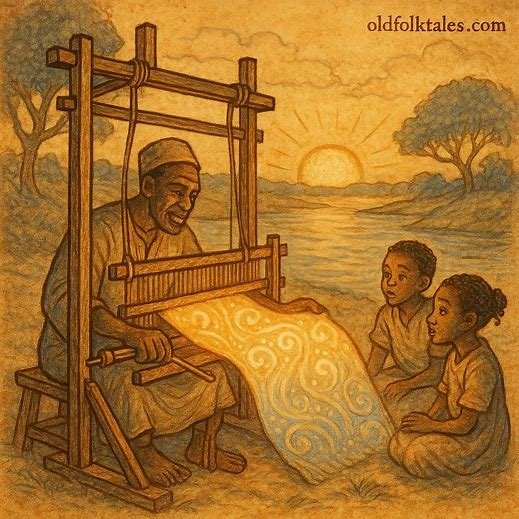
In a quiet village near the banks of the Senegal River lived a humble weaver named Lamine. His fingers were quick, his eyes gentle, and his loom sang from dawn until sunset. While others wove cloth of colour and pattern, Lamine’s work seemed to hold something deeper. The people said his fabric shimmered like moonlight on water, and that those who slept wrapped in it dreamed of the future.
No one knew how he did it. Some whispered that his grandmother had once been blessed by the spirits of the loom. Others said that the wind itself guided his hands. But Lamine only smiled and said, “A cloth is born from patience, not magic.”
Every morning he would greet his loom with a prayer. “May my hands be steady, may my heart be honest, and may every thread tell the truth.” Then he would weave until his hut filled with the soft rhythm of creation. Children often gathered at his doorway to watch the threads dance, and he would say, “Dreams are like fabric, my little ones. If you weave them with care, they will hold even when the storms come.”
Want more? Read more West African folktales now
One day, a merchant from a faraway town visited the village. His name was Boro, and his reputation was known even before his footsteps arrived. He was wealthy and proud, and his clothes sparkled with gold. When he saw Lamine’s cloth displayed in the market, he stopped in amazement. The fabric shimmered as though alive.
“Who made this?” Boro demanded.
“The weaver Lamine,” replied the market woman. “He works by the river.”
The merchant’s eyes gleamed. “I must have all his cloth, and his secret too.”
He went to Lamine’s hut and found the weaver bent over his loom. “Good man,” said Boro, pretending to smile, “your work is finer than anything I have ever seen. I will pay you handsomely. Tell me your secret, and I will make you rich.”
Lamine looked up calmly. “There is no secret, only love for the work. What the cloth gives comes from the heart of the weaver, not from gold.”
Boro’s smile faded. “If you will not tell me, then I will buy all your cloth instead. Name your price.”
“The cloth is not for greed,” said Lamine softly. “It must go to those who will dream kindly.”
The merchant left in anger, but greed is a restless fire. That night, under the cover of darkness, Boro crept back to the hut. He slipped inside and took one roll of the dream cloth, then hurried away, laughing to himself.
When he returned to his caravan, he ordered his servants to cut the fabric and make him a robe. “When I wear this, I will dream of gold and power,” he said.
But when he slept that night, he dreamed instead of all the people he had cheated. He saw the faces of traders he had tricked and families he had driven to poverty. The dreams grew darker until he woke trembling in fear.
“This cloth is cursed!” he cried, tearing it off.
The next morning, he marched back to the village, furious. “You have played a trick on me,” he shouted at Lamine. “Your cloth brings nightmares, not dreams!”
Lamine smiled gently. “Dreams tell what the heart hides. Perhaps the cloth did not curse you. Perhaps it only showed you the truth.”
The people gathered, whispering among themselves. The merchant’s anger burned hotter. “You will pay for this insult. I will take your loom and your hut as punishment.”
Lamine bowed his head. “If that is your wish, great merchant, come tomorrow at dawn. You may take whatever you think belongs to you.”
When the morning came, Boro arrived with his guards. But when they entered Lamine’s hut, the loom stood silent. The threads were gone, and only a single piece of cloth remained on the floor, shimmering faintly in the light. On it was woven the image of the entire village, the huts, the trees, even the people gathered in the market. And at the edge of the cloth stood Boro himself, clutching gold that turned into sand.
He stared in disbelief. “What is this trickery?”
Lamine appeared behind him, holding another piece of thread between his fingers. “It is no trick, only a reflection. You took from me what was not yours, and the cloth has remembered. Every dream woven in truth cannot be stolen. The loom keeps what belongs to it.”
Boro’s hands shook. He fell to his knees. “Forgive me, weaver. I have been blind with greed.”
Lamine lifted him up kindly. “The loom forgives all who listen. Take this cloth home and use it not for gain, but for good. Let it remind you that dreams are not treasures to steal but gifts to share.”
From that day, the merchant changed his ways. He traded fairly, helped the poor, and spoke often of the humble weaver by the river. As for Lamine, his fame grew, but he never sought riches. He continued to weave each morning, his loom singing softly as before.
It was said that when he finally grew old and his hands trembled, the loom wove by itself, as if guided by invisible hands. And when he passed, the people found one last piece of cloth lying across the loom bright with the colours of sunrise and the calm of the river.
Those who slept under it dreamed not of gold or sorrow, but of peace.
Moral Lesson
True creativity comes from honesty and kindness, not greed. What is made with a pure heart can never be stolen, for its power lives in the spirit of its maker.
Knowledge Check
Who is the main character in The Weaver Who Wove Dreams?
Lamine, the humble weaver whose cloth brings dreams to lifeWhat makes Lamine’s cloth special?
It allows those who sleep under it to dream truthfully, revealing what lies in their heartsWho tries to steal Lamine’s cloth?
A greedy merchant named Boro who desires the weaver’s secret for profitWhat happens when the merchant wears the stolen cloth?
He dreams of his own wrongdoings and feels the weight of his greedHow does Lamine teach the merchant a lesson?
Through his weaving, he shows that truth and kindness cannot be taken by forceWhat message does the story teach about creativity?
That true creation comes from sincerity, patience, and generosity, not wealth or pride
Source
Wolof folktale, Senegal. Compiled by Mariama Ba in Threads of Imagination: Senegalese Folktales (1995)