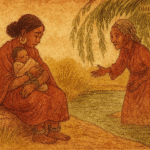
On the island of Santo Antão, where the green mountains tumble down to kiss the ocean, there once lived a humble weaver named Tiago. His hands worked the loom from sunrise to sunset, creating cloth so fine it shimmered like fish scales. But it was not Tiago who drew people’s attention , it was his daughter, Salina.
Salina was quiet, observant, with eyes the color of the deep sea after a storm. She often wandered the shore at dawn, gathering shells, listening to the tide, and sometimes , though she told no one, she sang to the waves.
People in the village said she was strange. They said the sea had claimed her mother, and that Salina had inherited the ocean’s wildness. Tiago never spoke of his late wife, and Salina never asked.
One evening, as Salina returned from the shore, her hair smelling of salt and wind, she found her father sitting silently at the loom. His hands were still.
“Papa?” she asked gently.
Tiago looked up, his face drawn. “The drought has dried the cotton fields. The traders have stopped coming. I have no work.”
Salina’s heart ached. She loved her father deeply. His loom had sung lullabies to her as a child. Now it stood quiet.
That night, as the island wind whispered through the cane grass, Salina dreamed. In her dream, the sea opened like a book, and a voice sang from within it.
“Daughter of wave and weft… come to me.”
When she awoke, the echo remained.
She returned to the shore that morning, barefoot on black volcanic sand. A storm cloud gathered on the horizon, but she did not turn back.
As she walked, she saw something strange. A silver fish, no larger than her palm, lay gasping in a tidepool. Its eyes shimmered like glass beads.
She gently placed it back into the water. As it swam off, a voice rose from the sea.
“You have returned kindness,” it said. “And so, I return a gift.”
The waves rolled back, revealing a path of wet stone. Salina stepped forward. Though her heart pounded, she felt no fear.
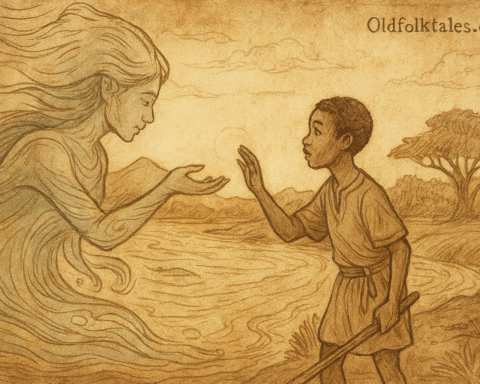
She walked until the sea closed behind her. The sky dimmed. Ahead, beneath the water, a light glowed. Then, rising from the deep, came a figure.
She was taller than any woman Salina had seen. Her skin gleamed like obsidian, her hair flowed like kelp, and around her neck hung a net of coral and pearl. Her voice echoed as if spoken through a conch shell.
“I am Morin, Guardian of the Tide.”
Salina bowed her head.
“You seek to help your father,” Morin said, her gaze steady. “But aid does not come freely. Will you weave a song into cloth, and carry it to the village?”
Salina was confused. “A song?”
Morin raised a hand, and from the water rose a skein of sea-silk, threads finer than any cotton. “Each night, sing your heart into these threads. When the cloth is ready, gift it, not sell it, to the one who needs it most.”
“Who is that?” Salina asked.
“You will know,” Morin said. “But be warned: if your gift is given from pride or greed, the sea will take it back.”
With that, the sea pushed Salina gently to shore. In her arms, she held the silk.
For seven nights, Salina wove. She sang softly as her fingers moved, songs of love for her father, of longing for her mother, and of the wind’s quiet sorrow. The loom, unused for weeks, found new life in her hands.
On the eighth day, the cloth was done, light as breeze, blue as tide, glowing faintly with every fold.
Tiago was amazed. “What is this, child?”
“A gift,” she said, wrapping it carefully. “But not for us.”
That day, she walked into the village square, where people gossiped and traded fish. She watched faces carefully until she saw her.
Old Dona Bela, who sat every day on a crate, ignored and alone. Once a master singer, she had lost her voice years ago and now spoke only in rasps.
Salina approached and laid the cloth in her lap.
Bela’s eyes widened. Her hands trembled as she touched it.
That night, when the village gathered for the full moon, Bela stood slowly and stepped forward. Then, without warning, her voice rose.
Clear. Strong. Like a bell over water.
The villagers gasped.
As Bela sang, the cloth glowed brighter, and those who listened found tears in their eyes , not from sorrow, but from something older. Something healing.
Salina slipped away quietly.
From that day, strange things began to happen.
The traders returned, asking about the magical cloth.
Flowers bloomed early. Wells filled with cool water. Fishermen found their nets full again.
Salina refused payment, though many offered. Instead, she returned to the shore, waiting.
One night, the sea whispered once more. Morin rose from the tide.
“You gave your gift freely,” she said. “And so the sea gives more.”
Salina bowed. “May I ask one thing?”
“Speak.”
“My mother — was she of the sea?”
Morin smiled softly. “She was of both sea and land. As are you.”
From that night on, Salina continued to weave, not for gold or praise, but to bring song back to a quiet world.
And sometimes, when the moon was high, people said they saw her walking the waves — a girl of weft and wave, singing the song of the sea.
✧ Commentary
This Cape Verdean folktale blends island tradition with deep symbolism. The sea, often central in Cape Verde’s culture, represents mystery, memory, and maternal legacy. Salina’s journey shows that true power lies not in wealth, but in generosity and creativity. Her bond with the sea speaks to Cape Verde’s unique blend of African roots and Atlantic rhythms.
✧ Moral
Gifts given from love and humility ripple outward, bringing healing far beyond what we see.
✧ Questions & Answers
1. Q: What problem did Salina and her father face? A: The drought ended Tiago’s weaving work and dried the cotton fields.
2. Q: Who did Salina meet in the sea? A: Morin, the Guardian of the Tide.
3. Q: What was Salina asked to do with the sea-silk? A: Weave her songs into it and gift it freely to the one who needed it most.
4. Q: Why did Salina choose Dona Bela? A: Because she sensed Bela’s hidden sorrow and forgotten gift — her voice.
5. Q: What lesson does this story teach? A: That selfless creativity and kindness can restore both people and community.