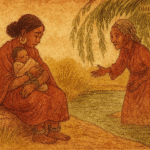
In a quiet village nestled beneath the wide skies of Benin, there stood a mighty baobab tree, its thick branches stretching like ancient arms toward the heavens. This baobab was no ordinary tree. The elders believed it was the resting place of the village’s ancestors, a silent guardian who watched over the people, whispering secrets carried by the wind.
Among the villagers lived a young girl named Adama. She was small in stature but possessed a heart larger than the tallest baobab. Adama was different from the other children; she listened more than she spoke, and when the wind rustled the baobab’s leaves, she could hear voices—soft whispers only she seemed to understand.
One evening, as the sun dipped low and painted the sky with hues of orange and pink, Adama sat beneath the baobab. The village buzzed softly with the sounds of families finishing their day’s work and the distant call of a nightbird. The air was cool and fragrant with the scent of earth and flowers.
Suddenly, the wind shifted, and the baobab’s leaves rustled urgently. The whispers grew clearer, almost like a voice calling her name.
“Adama… listen well… the river’s spirit stirs with unrest… danger flows near.”
Adama’s heart quickened. The river was the village’s lifeblood, the source of their water, their crops, and their fish. A warning from the river’s spirit was not to be taken lightly.
The next morning, Adama hurried to the village square where the elders gathered. The chief, Mansa, sat at the center, his silver beard flowing as he listened to the traders and farmers speak.
With determined steps, Adama approached. “Great Mansa,” she called, “the baobab has spoken. The river’s spirit is restless. We must prepare.”
The elders looked down at her, some with curiosity, others with doubt.
“Child,” Mansa said kindly but firmly, “the river flows as it always has. Your imagination weaves stories as the spider weaves webs.”
Adama’s cheeks flushed, but she stood her ground. “I hear the whispers. Please, we cannot ignore them.”
But her words were met with laughter from some villagers. “What can a child know of spirits and rivers?” one man sneered.
Undeterred, Adama made her way to the riverbank alone. The water, usually clear and calm, moved with an unusual force. Fish darted frantically as the current swirled dark and fast.
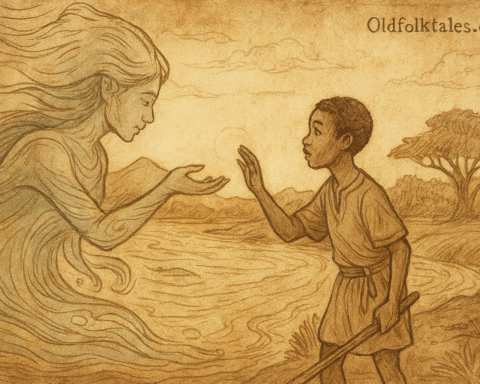
She knelt beside the river, whispering, “Spirit of the river, what troubles you?”
A gentle breeze carried a voice, barely audible, “The rains will come heavy and fierce. Prepare, or suffer the flood’s wrath.”
Adama raced back to the village, gathering her closest friends. “Help me warn the others,” she pleaded.
Together, they visited each home, telling the tale. Some listened, storing food and securing their belongings; others ignored them.
Days later, storm clouds gathered on the horizon, dark and menacing. The sky cracked with thunder, and rain poured like a waterfall from the heavens.
The river swelled, bursting its banks, flooding fields and homes. But thanks to Adama’s warning, many villagers had moved their food and valuables to higher ground.
When the storm passed and the skies cleared, the village counted their losses—and their blessings.
Mansa approached Adama, his eyes shining with respect. “You have the courage to listen to the unseen and the strength to act. You saved us.”
From that day, the baobab’s whispers were no longer ignored, and Adama’s name became a legend whispered with reverence, a symbol of bravery, wisdom, and respect for the voices of nature.
✧ Commentary
This rich tale from Benin teaches the importance of listening to the natural world and trusting one’s intuition, even when others doubt. Adama’s courage in standing by what she knows saves her community from disaster, highlighting how wisdom can come from unexpected places. The baobab tree represents ancestral guidance and the deep connection between people and nature.
✧ Moral
True bravery lies in listening, trusting your heart, and acting to protect your community.
✧ Questions & Answers
1. Q: What special ability did Adama have? A: She could hear the whispers of the baobab tree.
2. Q: What warning did Adama receive? A: The river’s spirit was restless, and heavy rains would cause flooding.
3. Q: How did the villagers initially react? A: Many doubted and laughed, but some listened and prepared.
4. Q: What happened when the floods came? A: Homes and fields were damaged, but many lives were saved thanks to the warnings.
5. Q: What does the baobab symbolize in the story? A: The baobab symbolizes ancestral wisdom and nature’s voice.