Long ago, in the pastoral lands of Somalia, where flocks of sheep grazed on sprawling grasslands beneath the endless African sky, there lived two men whose paths were about to cross in an unexpected and contentious way. The villages of Somalia had long depended on their livestock for survival, and sheep were treasured possessions, sources of wool, meat, milk, and wealth. Every shepherd knew his flock intimately, counting each animal as both property and responsibility.
Omar was a shepherd who tended his flock with diligence, leading them each day to graze on the land he had cultivated and protected. Mohamed, too, was a shepherd who had invested his hard-earned money in building his own flock, purchasing each sheep with careful consideration and feeding them with the best food he could afford. Both men took pride in their work and their animals, never imagining that a single wandering sheep would bring them into bitter conflict.
Continue your journey: Read more East African folktales
The Dispute Begins
The trouble started when one of Mohamed’s sheep, as sheep are prone to do, wandered away from its familiar flock. Perhaps it was drawn by the scent of particularly sweet grass, or perhaps it simply lost its way in the vast openness of the grazing lands. Whatever the reason, the sheep found itself among Omar’s flock, contentedly eating the grass on Omar’s land.
For three days, the lost sheep grazed alongside Omar’s animals, blending in with the flock as if it had always belonged there. Omar noticed the newcomer but, seeing it settle comfortably among his other sheep, began to consider it his own. After all, it was eating his grass, drinking from his water source, and moving with his flock. In his mind, the sheep had chosen to join him, and that choice gave him ownership.
Meanwhile, Mohamed had been frantically searching for his missing animal. He walked the grazing lands, calling out, squinting against the sun as he scanned every flock he encountered. His heart grew heavier with each passing day, knowing that he had paid good money for that sheep and had invested time and resources in feeding it well. That sheep represented more than just an animal, it was part of his livelihood, his family’s security.
On the third day, Mohamed’s persistence finally paid off. He spotted his sheep among Omar’s flock, recognizing it immediately. Relief flooded through him, followed quickly by determination. He approached Omar with the reasonable expectation that his sheep would be returned without question.
But Omar had other ideas entirely.
The Confrontation
“This sheep is mine,” Omar declared firmly, his voice rising with conviction. “He was eating on my land, and he has been with my other sheep for a few days. That makes him my sheep.”
Mohamed stared at Omar in disbelief, his face flushing with frustration and anger. “Just because he went to eat on your land doesn’t make him yours!” he protested, his voice sharp with indignation. “I paid good money for this sheep, and I fed him good food. Now you want to keep him? That isn’t fair!”
Omar’s face hardened with stubbornness. “Fair?” he shot back, his voice growing louder. “That sheep wandered over here on his own. He joined my flock and ate my food. This sheep is mine! Mine! Did you hear me? He is MINE!”
The two men stood facing each other, tension crackling in the air between them like lightning before a storm. Their voices carried across the grazing lands, disturbing the peaceful bleating of the sheep around them. What had started as a simple matter of a lost animal had escalated into something far more serious,a battle of pride, principle, and perceived rights.
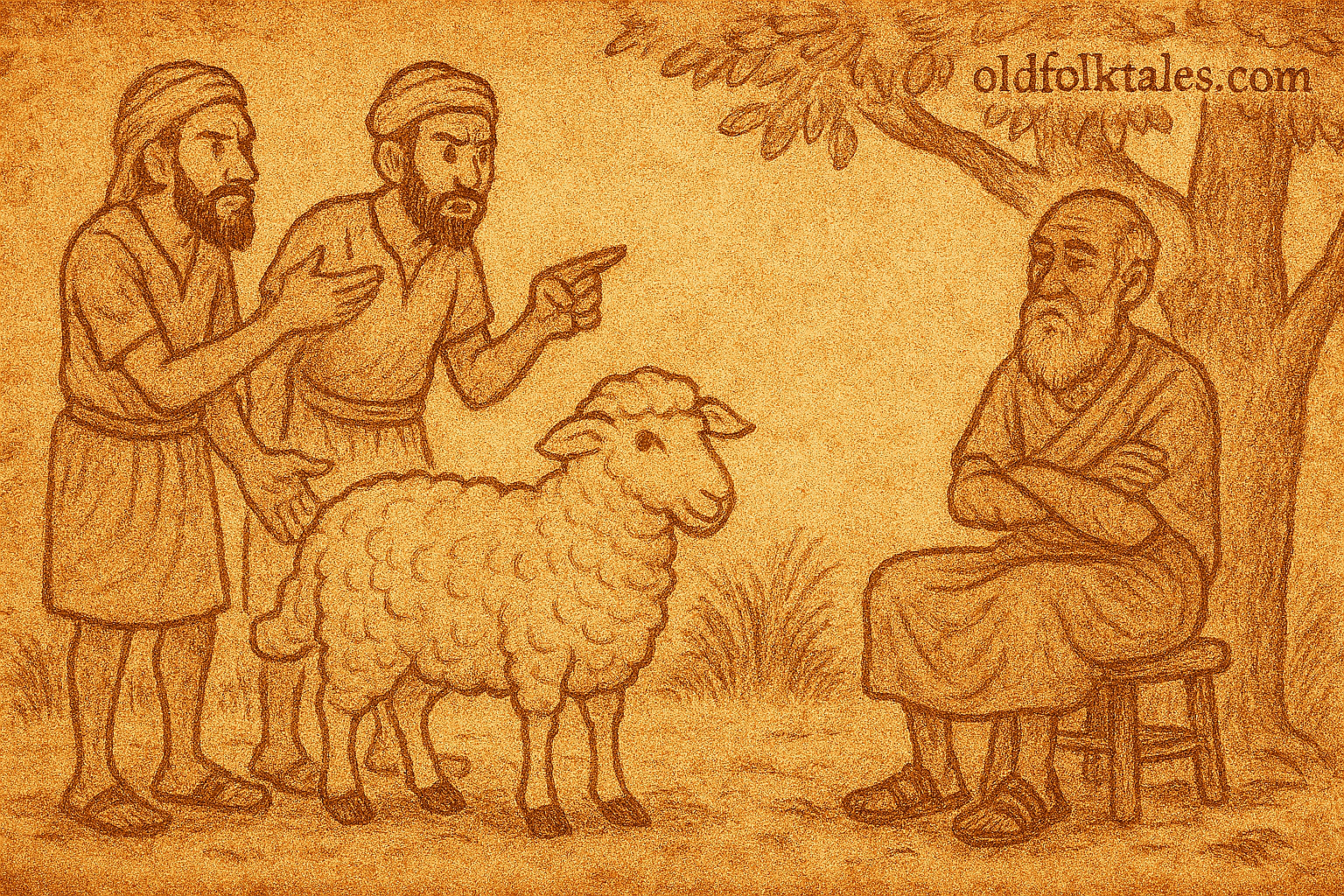
Mohamed took a deep breath, trying to rein in his anger. He knew that continuing to shout would solve nothing. “Are we going to keep fighting?” he asked, his voice still tight with emotion but more controlled now. “Anyone could tell that this sheep is mine. I’m not going to let you have the sheep unless someone that we both trust says you should have the sheep.”
Omar paused, recognizing the wisdom in this suggestion. Despite his stubbornness, he knew that their dispute needed resolution by someone impartial, someone whose judgment they both respected. “Yes,” he agreed, nodding slowly. “Let’s go to the wise man of the village. He will listen to both of us, and he will solve the problem.”
Seeking the Wise Man’s Counsel
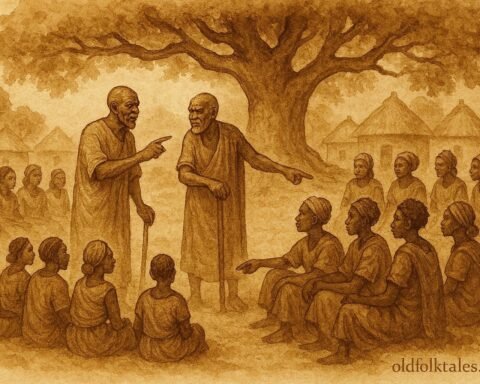
Together, though still bristling with resentment toward each other, Omar and Mohamed made their way to the dwelling of the village’s wise man. This elder was known throughout the region for his fairness, his ability to see through deception, and his gift for finding solutions that served justice rather than just pleasing one side or the other. People came from far and wide to seek his counsel on matters ranging from family disputes to questions of inheritance and property.
The wise man sat in the shade of an acacia tree, his weathered face reflecting decades of experience and observation. When he saw the two shepherds approaching, their faces clouded with anger and frustration, he knew immediately that a conflict had brought them to his door.
“Hello, Omar and Mohamed,” the wise man greeted them calmly, his voice carrying the gentle authority of age and wisdom. “What is your problem?”
Omar spoke first, his words tumbling out in a rush of justification. “One of Mohamed’s sheep wandered over to join my flock. It has been eating my grass for at least three days. Now that sheep is mine! I have been feeding it along with my other sheep.”
Mohamed shook his head vigorously, his voice rising in passionate disagreement. “No, my sheep simply got lost, as so many sheep do. I tried to find my sheep. Finally, after three days, I found my sheep with his flock. I asked him to return my sheep, but he wouldn’t. Now we’re here for you to settle the matter.”
The Judgment of Wisdom
The wise man sat in profound silence, his eyes moving thoughtfully from one man to the other. He studied their faces, reading the emotions written there, Omar’s defensive pride, Mohamed’s desperate sense of injustice. The moment stretched long, the only sounds being the distant bleating of sheep and the whisper of wind through the grass.
Finally, the wise man spoke, and his words carried the weight of undeniable truth.
“Omar,” he began, his gaze settling firmly on the stubborn shepherd, “you must return Mohamed’s sheep. Just because Mohamed’s sheep got lost doesn’t mean you can keep it.”
He paused, letting those words sink in before continuing with an illustration that would pierce through Omar’s rationalization like an arrow finding its mark.
“What if one of your family got lost?” the wise man asked, his voice gentle but penetrating. “Let’s say that Mohamed found them and gave them food and drink. Does that make them his family? Of course not!”
The simplicity and power of this comparison struck Omar like a physical blow. His face changed, the stubborn set of his jaw softening as understanding dawned in his eyes. The wise man had shown him the fundamental flaw in his reasoning, that providing temporary shelter or sustenance did not transfer ownership of something that rightfully belonged to another.
“Now,” the wise man concluded with quiet authority, “return the sheep to Mohamed at once.”
Omar stood silent for a moment, the last remnants of his defensiveness crumbling away. “Okay,” he said finally, his voice humble and sincere. “I understand now. I’ll return the sheep. I’m sorry, Mohamed.”
Mohamed’s face, which had been tight with anxiety and anger throughout the encounter, relaxed into an expression of relief and gratitude. “Thank you, Omar,” he responded warmly, extending his hand in a gesture of reconciliation. “I hope we can be friends.”
Both men turned to the wise elder, speaking in unison with genuine appreciation. “Thank you, wise man.”
“You’re welcome,” the wise man replied with a gentle smile, satisfied that justice had been served and that two members of his community had learned something valuable about fairness, property, and the bonds that should unite neighbors rather than divide them.
The Wisdom of the Tale
This powerful Somali folktale teaches us that finding something or temporarily caring for it does not grant us the right to claim ownership. True justice recognizes and protects the legitimate claims of rightful owners, even when those claims might inconvenience us. The wise man’s comparison brilliantly illustrates that the principles governing property and relationships are consistent, what we would never accept when applied to our loved ones, we should not attempt to apply to the possessions of others. Moreover, the story shows us the value of seeking impartial wisdom when conflicts arise, and the importance of humility in accepting just decisions even when they go against our desires. Through Omar’s willingness to acknowledge his error and Mohamed’s gracious acceptance of the apology, we see how justice combined with forgiveness can transform enemies into friends.
Knowledge Check
1. What caused the conflict between Omar and Mohamed in this Somali folktale?
The conflict arose when one of Mohamed’s sheep wandered away and joined Omar’s flock, grazing on Omar’s land for three days. When Mohamed finally found his lost sheep and asked for its return, Omar refused, claiming that because the sheep had been eating his grass and staying with his flock, it now belonged to him.
2. What was Omar’s reasoning for claiming ownership of Mohamed’s sheep?
Omar argued that the sheep had wandered to his land voluntarily and had been eating his grass and staying with his flock for at least three days. In his view, the fact that he had been feeding the sheep alongside his other animals for this period meant the sheep had become his property through this temporary care.
3. How did the two men decide to resolve their dispute?
After realizing that their arguing was getting them nowhere, Mohamed and Omar agreed to seek the counsel of the village’s wise man, someone they both trusted and respected. They decided that this impartial elder would listen to both sides of the dispute and provide a just solution that they would both accept.
4. What comparison did the wise man use to help Omar understand his error?
The wise man asked Omar to imagine if one of his own family members got lost and Mohamed found them and provided them with food and drink. He then posed the question: would that temporary care make them Mohamed’s family? This powerful analogy helped Omar recognize that providing temporary sustenance doesn’t transfer ownership of what rightfully belongs to another.
5. What does this Somali tale teach about property rights and justice?
The folktale teaches that temporarily caring for or finding something does not give us the right to claim ownership of it. True justice requires recognizing and respecting the legitimate claims of rightful owners, even when returning their property might inconvenience us or cost us something we’ve invested. The principle of rightful ownership supersedes the claim of temporary possession.
6. What cultural values does this story reflect about Somali society?
This tale reflects the importance of community wisdom and elder authority in traditional Somali culture, where respected elders serve as mediators and judges in disputes. It also emphasizes pastoral values surrounding livestock ownership, the communal responsibility to resolve conflicts peacefully, and the virtue of accepting correction with humility. The story shows how Somali culture values reconciliation and friendship over prolonged conflict.
Source: Traditional Somali folktale