In the fertile lands surrounding Calabar, where the forest met the farmland and the morning mist clung to towering trees, there lived a hardworking slave named Okun Archibong. He belonged to the powerful King Archibong and made his modest living as a hunter on a small farm carved from the wilderness. Day after day, Okun would venture deep into the dense forest with his bow and arrows, tracking bushbuck through tangled undergrowth and hunting the swift antelopes that bounded through sun-dappled clearings.
His skill as a hunter provided him with a steady, if humble, income. The pelts he carefully dried under the scorching African sun found eager buyers in the bustling market squares monkey skins transformed into resonant drums that echoed through village celebrations, while antelope hides became comfortable sitting mats for prosperous households. The meat, thoroughly smoked over fragrant wood fires until it turned dark and preserved, also brought in a few coins, though never quite enough to lift him from his modest circumstances.
Despite his limited means, Okun’s heart overflowed with joy when he married Nkoyo, a beautiful slave woman who belonged to the household of the influential Duke family. Though he could only afford a small dowry to secure her hand in marriage, his love for her burned as bright as the cooking fires that warmed their simple home. When Nkoyo bore him a son during the harsh dry season, Okun felt like the richest man in all of Calabar, holding his precious child with hands calloused from years of honest labor.
About four months after their baby’s birth, the demands of survival required both parents to work tirelessly. While Okun disappeared into the forest before dawn to hunt, Nkoyo would carry their infant son to the farm, where the back-breaking work of land preparation awaited. She would place the baby carefully in the cool shade of a massive tree, its broad canopy protecting the child from the relentless sun, while she bent her back to the arduous task of clearing ground for the yam planting that must be completed before the rains arrived.
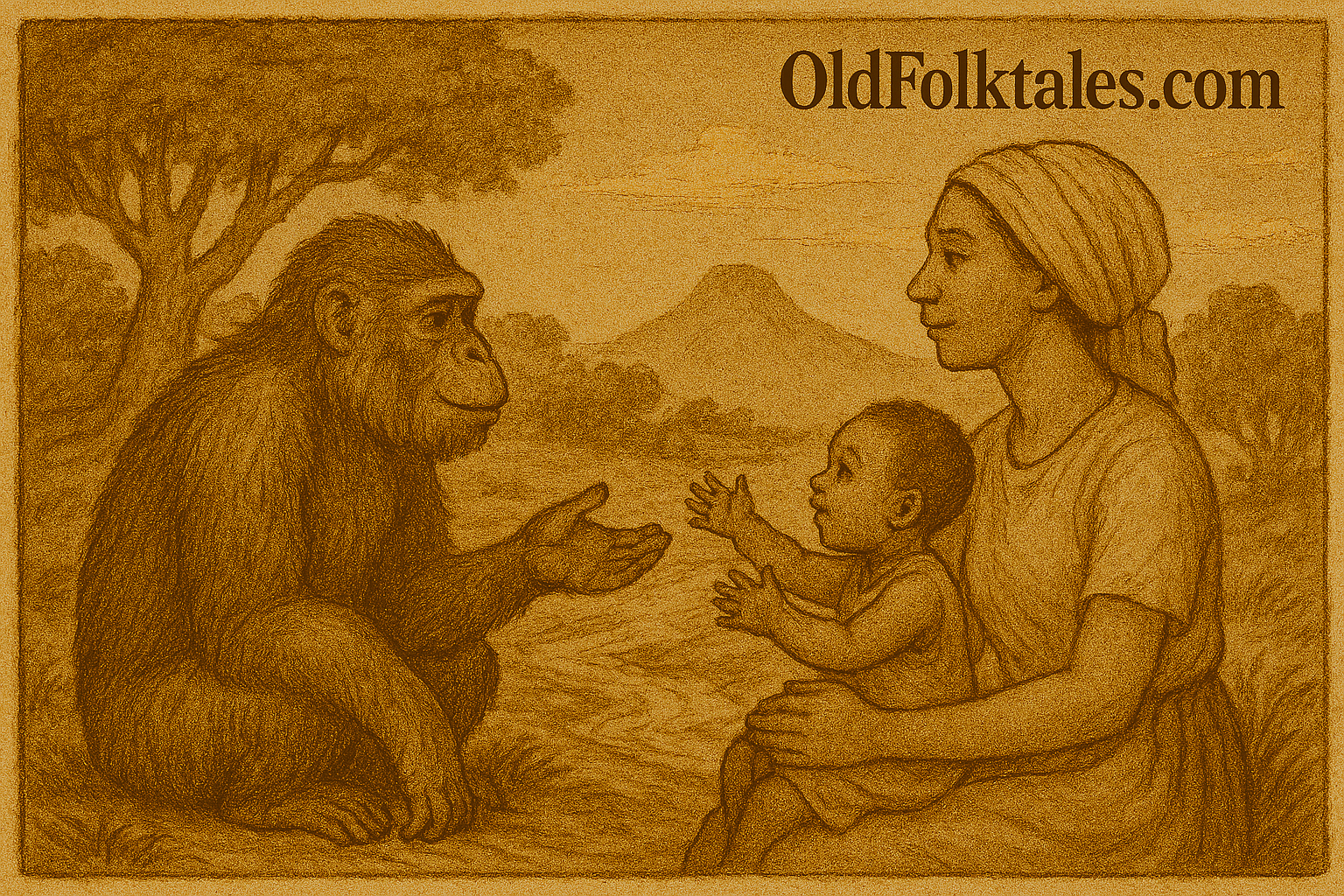
It was during these long working days that something remarkable began to happen. A large ape, magnificent in his strength and surprisingly gentle in his manner, emerged from the depths of the forest each morning. This majestic creature, with arms powerful enough to tear branches from trees, would approach the baby with extraordinary tenderness. He would cradle the child as carefully as any human mother, carrying him high into the treetops where cool breezes rustled through the leaves. There, among the swaying branches, the ape would play with the delighted infant, keeping him safe and entertained while his mother labored below.
When Nkoyo finished her exhausting work each evening, her unlikely helper would gently return the happy, unharmed child to her waiting arms. Day after day, this beautiful arrangement continued, with the forest creature serving as the most devoted and reliable caretaker any mother could wish for.
However, this peaceful routine caught the attention of Edem Effiong, a hunter whose heart harbored dark secrets. For many months, Effiong had pursued Nkoyo relentlessly, his desire for her growing more desperate with each rejection. Her unwavering loyalty to her husband had left Effiong consumed with jealousy that poisoned his thoughts and twisted his perception of innocent events.
When Effiong encountered Nkoyo working alone on the farm one fateful day, her baby nowhere to be seen, his jealous mind seized the opportunity to create trouble. “Where is your child?” he demanded with feigned concern. Nkoyo, trusting and naive, explained how the gentle ape cared for her son while she worked, carrying him safely in the treetops until her tasks were complete.
Effiong’s eyes gleamed with malicious opportunity. The very next day, he sought out Okun Archibong with venomous purpose, weaving his lies with careful precision. “I have seen something terrible,” he announced with false gravity. “Your wife has been meeting with a large ape in the forest. You must see this shameful behavior with your own eyes.”
At first, Okun’s love for his wife made him resist these poisonous suggestions. But Effiong’s persistent whispers eventually planted seeds of doubt that grew like weeds in the hunter’s mind. Torn between trust and suspicion, Okun finally agreed to accompany the lying hunter to witness whatever truth might be revealed.
Hidden among the forest shadows, Okun watched in horror as his innocent interpretation of events crumbled. There, high in the swaying branches, sat the massive ape cradling his precious son with obvious affection. To Okun’s jealousy-clouded vision, this beautiful act of interspecies compassion appeared as something sinister and shameful.
Rage consumed the heartbroken father as he raised his bow with trembling hands. His arrow flew true, striking the gentle giant who had done nothing but protect and care for an innocent child. But the wounded ape, driven mad with pain and confusion, reacted with the terrible strength of a dying wild creature. In its agony and fury, it tore the innocent baby apart before hurling the lifeless remains to the ground below.
Okun’s anguish transformed into uncontrollable fury. Seeing his beloved wife standing nearby, he held her responsible for this tragedy that his own actions had caused. His second arrow found its mark, and Nkoyo fell beside her destroyed child, becoming another victim of jealousy’s devastating power.
Consumed with grief and knowing that war would surely follow, Okun fled to King Archibong’s palace to confess his terrible deeds. The king, a warrior who had never backed down from any fight, immediately understood that King Duke would demand satisfaction for the death of his slave woman. Rather than surrender his subject, King Archibong summoned his fighting men and prepared for the inevitable conflict.
When Duke’s messenger arrived demanding Okun’s surrender for execution, King Archibong’s refusal rang out like a war drum. “I would rather fight than surrender one of my people,” he declared boldly.
The two kings met with their warriors in the bustling market square, transforming the place of peaceful commerce into a battlefield soaked with blood. Spears clashed against shields, war cries echoed off surrounding buildings, and brave men fell on both sides. Thirty of Duke’s warriors perished in the fierce fighting, while twenty of Archibong’s men joined them in death. Many more bore wounds that would mark them for life.
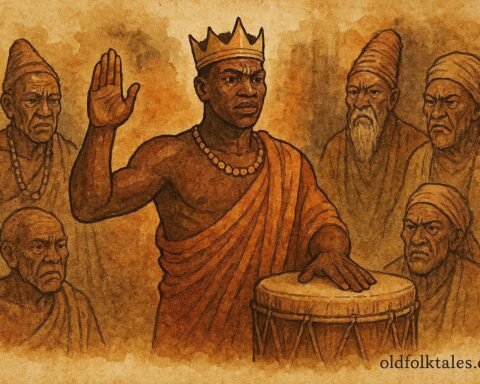
Though King Archibong initially held the advantage, driving Duke’s forces back through sheer ferocity, the other chiefs of the region intervened before complete devastation could occur. The Egbo men emerged with their sacred drums, their authority compelling both armies to lay down their weapons.
In the solemn atmosphere of the Egbo house, where justice was dispensed according to ancient laws, King Archibong faced trial for his role in the tragedy. The court found him guilty and ordered him to pay six thousand rods to King Duke as compensation for the loss of his slave woman.
“I will not pay Duke directly,” Archibong declared with stubborn pride, “but I will pay the town, since the Egbos have rendered judgment.” This defiant stance nearly reignited the war, but wiser voices prevailed when King Archibong revealed the truth that had been hidden beneath layers of bloodshed and grief.
“The real guilt lies not with my slave Okun,” he announced to the assembled crowd, “but with Edem Effiong, whose false accusations and jealous lies caused this entire tragedy.”
When this revelation reached King Duke’s ears, justice finally found its proper target. Edem Effiong was dragged before the judgment stone, where his lies were exposed and his guilt established beyond doubt. Two Egbo executioners emerged with cutting whips that tore his flesh with two hundred brutal lashes. Then, as the crowd watched in grim satisfaction, they severed his head and presented it to King Duke, who placed it before his sacred JuJu as an offering to the spirits of justice.
From that day forward, the natural world itself seemed to remember the tragedy that unfolded in the forest. All apes and monkeys developed an instinctive fear of human beings, even tiny children, as if the memory of betrayal and violence had been written into their very souls. The Egbo chiefs, determined to prevent similar tragedies, established a new law forbidding slaves of different houses from intermarrying, recognizing that such unions could easily become sources of conflict between powerful families.
Moral Lesson
This folktale warns against the destructive power of jealousy and false accusations, showing how one person’s lies can destroy innocent lives and spark conflicts that claim many victims. It teaches that truth must always be sought before judgment is passed, and that jealous hearts often create the very tragedies they claim to expose.
Knowledge Check
Q1: Who was Okun Archibong and what was his occupation in this Nigerian folktale? A1: Okun Archibong was a slave belonging to King Archibong who worked as a hunter on a farm near Calabar. He hunted bushbuck, antelopes, and monkeys, selling their dried skins and smoked meat in the local market to make a modest living.
Q2: How did the ape help care for Nkoyo’s baby in this Calabar folktale? A2: The large ape would emerge from the forest each day while Nkoyo worked on the farm, gently taking the baby up into the trees to play with and protect him from the sun, then returning the child safely to his mother when her work was finished.
Q3: What motivated Edem Effiong to make false accusations against Nkoyo? A3: Edem Effiong was consumed with jealousy because he had been pursuing Nkoyo romantically for a long time, but she had consistently rejected his advances due to her loyalty to her husband. His jealousy led him to spread lies about her innocent relationship with the helpful ape.
Q4: What tragic consequences resulted from Okun Archibong shooting the ape? A4: When Okun shot the ape based on Edem Effiong’s false accusations, the wounded animal became enraged and tore the innocent baby apart before throwing the remains to the ground. In his grief and anger, Okun then shot and killed his wife Nkoyo as well.
Q5: How was justice ultimately served in this Nigerian folktale? A5: After a war between the two kings and a trial in the Egbo house, the truth about Edem Effiong’s false accusations was revealed. He was found guilty, given 200 lashes with cutting whips, beheaded, and his head was presented to King Duke’s JuJu as justice for causing the tragedy.
Q6: What permanent changes occurred after this tragic event in Calabar culture? A6: The folktale explains that all apes and monkeys became permanently afraid of humans, even children, remembering the betrayal. The Egbo chiefs also established a law preventing slaves from different houses from marrying to avoid similar conflicts between powerful families.