The Chief’s Prayer Answered
Long ago, in the heart of the great lands of Zambia, there ruled a mighty chief who possessed everything a man could desire, wealth, respect, many wives, and vast territories yet his heart remained heavy with sorrow. For eighteen long years, he had no children to carry on his name or inherit his wisdom.
Every morning as the sun rose over the hills, and every evening as it sank below the horizon, the chief sat before the sacred fire. There he lifted his voice to Lesa, the Creator of all things, praying with desperate hope for the gift of children. His prayers rose with the smoke, carried on the wind to the heavens above.
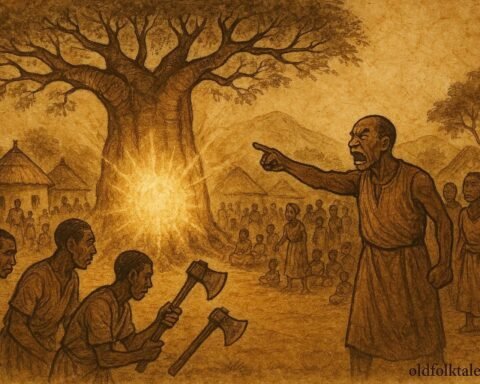
One evening, as the flames danced and leapt higher than usual, something extraordinary happened. A shining woman stepped directly from the fire itself, her form radiant and otherworldly, untouched by the flames that had birthed her.
“I am a messenger of Lesa,” she announced, her voice like wind through acacia trees. “Your prayers have been heard and answered. You have been granted a daughter.”
Love this story? Discover our full Southern African folktales collection
True to the promise, within a year, the chief’s favorite wife gave birth to a beautiful girl. They named her Savitri, after the spirit who had foretold her coming, marking her as a child touched by the divine from her very first breath.
The Woman Too Bright to Approach
Savitri grew into a woman of extraordinary beauty and profound wisdom. Her eyes shone with an inner light that reminded people of the sun itself, bright and life-giving. So radiant was her presence that villagers whispered among themselves that she could not be merely mortal surely, she must be spirit-born, a being caught between the world of humans and the realm of the divine.
When Savitri reached the age for marriage, a strange thing happened: no man dared to approach her father to ask for her hand. Warriors who had faced lions without flinching, traders who had crossed dangerous territories, even neighboring chiefs’ sons, all turned away when they thought of courting her.
Her father understood. “Weak men turn away from a fire too bright,” he told his daughter gently. “You must go out yourself and choose the man worthy of you. When you have found him, I will bless your marriage with all my heart.”
So Savitri set out on a journey with her attendants, traveling through villages dotted across the countryside, through valleys where cattle grazed, and along riversides where women washed clothes and children played. She met many men some rich, some powerful, some handsome but none moved her heart.
At last, she came to a quiet, humble homestead by the Luangwa River. There she found a blind old man, once a great chief himself, whose lands and title had been stripped away by enemies. The old man’s world had shrunk to the small compound where he lived, but he was not alone. Guiding him with infinite patience was his only son, a young man named Satyavena, whose name meant Child of Truth.
Savitri watched quietly as Satyavena led his father by the hand, speaking softly to describe everything around them, the color of the sky, the birds overhead, the path beneath their feet. She asked the women at the river about him.
“No man in all this land is richer in kindness,” they told her. “No man has a truer heart. He cares for his blind father with devotion that would shame most sons, though they live in poverty with barely enough to eat.”
Savitri knew she had found what she was seeking.
The Prophecy of Sorrow
When she returned home, Savitri found her father deep in conversation with a revered seer, a man known throughout the region for his ability to glimpse the threads of fate.
“Daughter, have you found the man you wish to marry?” her father asked hopefully.
“Yes, Father,” Savitri answered with quiet certainty. “His name is Satyavena.”
The seer’s face went pale, and he gasped audibly. “Not him! Princess, please reconsider! No man alive is more worthy of respect and admiration, but his fate is sealed his life will end in exactly one year’s time. Do not bind yourself to such sorrow. Choose another.”
The chief grasped his daughter’s hands, his eyes pleading. “My beloved daughter, I beg you choose another husband. Any man in the kingdom would be honored to wed you.”
But Savitri’s voice was firm and unwavering. “I have chosen Satyavena, and I will not choose another. However long or short his life may be, I will share it. A woman chooses her husband only once, and I have made my choice.”
No argument could move her, and so the wedding was arranged.
A Year of Joy and Silent Dread
Savitri married Satyavena in a simple ceremony by the riverside, surrounded by the smell of wild flowers and the sound of flowing water. She exchanged her royal garments for humble bark cloth, traded her golden jewelry for simple beads, and moved into the small homestead by the Luangwa. She ate fruits from the forest and wild greens from the fields, and lived joyfully by Satyavena’s side, caring for him and his father with love.
But in her heart, hidden from everyone, Savitri counted the days. Each sunrise brought her one day closer to the moment she dreaded.
When only three days remained of the prophesied year, Savitri began to fast. She sat before the sacred fire, neither eating nor drinking, neither sleeping nor lying down. She prayed to Lesa without ceasing, her lips moving constantly in whispered invocations, her eyes fixed on the dancing flames.
The Day of Destiny
On the final day, as dawn broke pink and gold over the hills, Satyavena took up his ax to fetch firewood for cooking. Savitri, weak from her three-day fast but determined, insisted on walking beside him.
They wandered through hills alive with morning birdsong, doves cooing, hornbills calling, weaver birds chattering. They paused by streams so clear and cold that they could see every pebble on the bottom, watching small fish dart between the stones. It was a morning of perfect beauty, cruel in its loveliness.
But as Satyavena raised his ax to strike a dead branch, he suddenly staggered backward. “My head, it burns with terrible pain,” he groaned, pressing his hand to his temple. His ax fell from his grip, and he collapsed beneath a great tree, its branches spreading like protective arms above him.
Savitri rushed to him and cradled his head in her lap, smoothing the hair back from his feverish forehead. Her heart hammered against her ribs, but her hands remained steady.
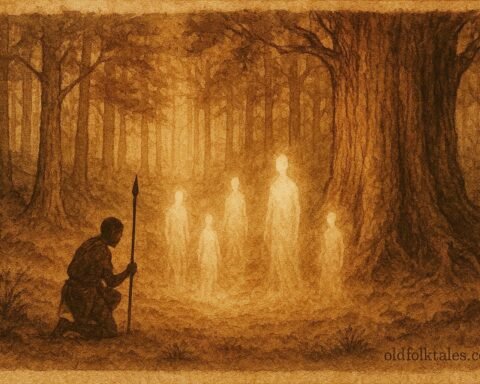
Then she saw him, a tall figure approaching through the morning mist, cloaked in shadows that seemed to devour the light around him. His skin was darker than midnight itself, his eyes glowed red like burning embers, and his robe was the deep crimson color of freshly spilled blood.
“Who are you?” Savitri whispered, though in her heart she already knew.
“I am Kaliloze, spirit of death,” he replied, his voice like wind through a graveyard. “Only through your fasting and prayer have you gained the sight to see me as I perform my duty. Now I must take the spirit of Satyavena to the land where all mortals must eventually journey.”
Savitri watched, her throat tight, as Kaliloze produced a noose made of living shadow. With practiced efficiency, he drew out a tiny likeness of Satyavena, no larger than a man’s thumb, perfect in every detail,and placed it carefully inside his crimson robe.
Satyavena’s chest, which had been rising and falling with shallow breaths, grew completely still. His warmth began to fade.
Kaliloze turned southward, toward the lands of the dead, and began to stride away with long, purposeful steps. But Savitri gently laid her husband’s head on the grass, stood up, and followed.
The Journey into Shadow
After walking for some distance, Kaliloze stopped and turned. “Princess, you cannot walk to the land of the dead!” he said, surprised to find her still behind him. “Return to the world of the living where you belong.”
“Lord of the Departed,” Savitri replied with calm respect, “your duty is to take my husband to his appointed place. But my duty as his wife is to follow wherever he goes. I am only fulfilling my obligation, just as you fulfill yours.”
Kaliloze studied her face, seeing the determination etched there. Despite himself, he felt moved by her loyalty. “Your devotion is extraordinary. I grant you one favor, anything you desire, except your husband’s life, which is not mine to give back.”
“Then restore the sight and honor of my father-in-law,” Savitri said immediately. “Let the blind man see again, and let him reclaim the chieftainship that was stolen from him.”
“It shall be done as you have asked,” Kaliloze promised. “Now return home.”
But when he resumed his journey, Savitri continued to follow, pushing through thorny bushes that tore her bark cloth and scratched her skin, wading through tall grass that cut like knives. Her feet bled, but she did not stop.
Kaliloze halted again, his patience thinning. “Go back!” he commanded, his voice sharp. “Even love must bow to fate. Death cannot be negotiated with or bargained away. Yet…” He paused, looking at her torn clothes and bleeding feet. “Your devotion deserves recognition. I grant you another gift, anything except his life.”
“Give many children to my father,” Savitri said. “Let his house be filled with the laughter and voices he has prayed for.”
“It shall be so,” Kaliloze agreed. “Now surely you will return.”
But again, when he moved forward, Savitri followed. The path grew steeper, climbing a rocky hill where loose stones slipped beneath her feet. She stumbled, fell, rose again, and kept climbing. Her lungs burned with effort, her legs trembled with exhaustion, but her will remained unbroken.
At the top of the hill, Kaliloze wheeled around, his red eyes blazing with frustration and, perhaps, a hint of admiration. “You will go no farther! The gateway to the land of the dead lies just ahead, and no living soul may pass through it. Yet your courage compels me to honor you. One final gift, anything but his life!”
Savitri met his gaze steadily. “Then give me many children, all born of Satyavena as their father.”
The Clever Victory
Kaliloze’s eyes widened with sudden realization. For a long moment, he stood frozen, then a smile slowly spread across his face a smile of respect for one who had outwitted even Death itself.
“Clever one!” he said, his voice mixing reproach with admiration. “You did not directly ask for his life, yet your wish cannot be fulfilled without it. You have bound me with my own word.”
He reached into his robe and drew out the tiny spirit of Satyavena. With careful fingers, he removed the shadow-noose from around its neck and opened his hand. The spirit flew northward like a bird released from captivity, vanishing into the morning air like mist touched by sunlight.
“Return, Savitri,” Kaliloze said quietly. “You have won him back through wisdom and unwavering love. Few mortals have ever bested me, but you have done so fairly. Go in peace.”
When Savitri looked down, she found herself back beneath the great tree, Satyavena’s head still resting in her lap. But now his chest rose and fell with breath. Color returned to his cheeks. His eyes fluttered open, confused but alive.
“Is the day gone already?” he asked, his voice hoarse. “I must have slept long. But why do you smile and weep together, my love? Why are there tears on your face?”
Savitri helped him to his feet, her heart so full she could barely speak. “Come, my husband,” she said softly. “Let us return home.”
The Promises Fulfilled
And everything that Kaliloze had promised came to pass, for the spirit of death keeps his word. Satyavena’s father woke that very day to find his sight miraculously restored. He could see his son’s face for the first time in years, could see the devoted wife his son had chosen, could watch the birds fly overhead and the sun paint the sky at sunset. Soon after, his enemies were defeated, and he was restored to his rightful position as chief of his lands.
Savitri’s father, the mighty chief who had prayed for eighteen years, was blessed with many more children. His compound rang with the voices of sons and daughters, and his heart finally knew complete joy.
In time, when Satyavena’s father grew old and ready to rest, Satyavena himself became chief. Savitri ruled beside him as his queen, beloved by all their people for her wisdom and compassion. They were blessed with many children who grew strong and wise, carrying forward their parents’ legacy of devotion and courage.
They lived long lives filled with purpose and love. And when at last Kaliloze came again, as he must come for all mortals, they did not fear him. For they had already met the spirit of death once before, and Savitri had already conquered him, not with weapons or magic, but with the greatest power of all: unwavering love joined with clever wisdom.
The Moral of the Story
This profound tale teaches us that true love is not passive acceptance but active devotion paired with intelligent action. Savitri’s victory over death came not from defying her destiny through force, but from fulfilling her duty as a faithful wife while using wisdom to find a path forward. Her story reminds us that loyalty, courage, and cleverness together can overcome even the most impossible obstacles. The greatest strength lies not in fighting against our circumstances, but in remaining steadfast in our commitments while using intelligence to transform what seems unchangeable. Love, when combined with wisdom and determination, possesses power that even Death itself must acknowledge and respect.
Knowledge Check
Q1: Who is Savitri and why is she considered special in this Zambian folktale?
Savitri is a princess born in answer to her father’s eighteen years of prayer to Lesa (the Creator). She is described as spirit-born, with eyes that shine like the sun, possessing both extraordinary beauty and profound wisdom. Her divine origins make her so radiant that ordinary men fear to approach her for marriage.
Q2: What does Kaliloze represent in African spiritual tradition?
Kaliloze is the spirit of death in this Zambian tale, depicted as a tall, shadowy figure with red eyes and a crimson robe who carries souls to the land of the dead. He represents the inevitable fate that all mortals must face, serving as a bridge between the world of the living and the realm of the departed ancestors.
Q3: How does Savitri outsmart the spirit of death?
Savitri uses clever wordplay and wisdom to reclaim her husband. After Kaliloze grants her three wishes (but forbids her to ask for her husband’s life directly), she requests “many children, all born of Satyavena.” Since this wish cannot be fulfilled if Satyavena remains dead, Kaliloze must return his soul to life to keep his own promise.
Q4: What is the significance of Savitri’s three-day fast before Satyavena’s destined death?
Savitri’s three-day fast, during which she neither eats, drinks, nor sleeps while praying before the sacred fire, is a spiritual preparation that grants her the supernatural ability to see Kaliloze when he comes to claim her husband. This demonstrates the power of devotion, sacrifice, and spiritual discipline in African traditional beliefs.
Q5: Why does Savitri choose to marry Satyavena despite knowing he will die within a year?
Savitri chooses Satyavena because she recognizes his true worth, his kindness, truthfulness, and devotion to his blind father despite poverty. She declares that “a woman chooses her husband only once,” showing that authentic love is based on character rather than circumstances, and that true commitment means accepting both joy and sorrow.
Q6: What cultural values does this folktale emphasize?
The story emphasizes several African values: respect for elders (Satyavena’s care for his blind father), the power of prayer and connection to Lesa (the Creator), wifely devotion and duty, the importance of wisdom over brute force, keeping one’s word (even Death honors his promises), and the belief that love and loyalty can transcend even death itself.
Cultural Source: Zambian folktale, adapted from traditional stories of the region.