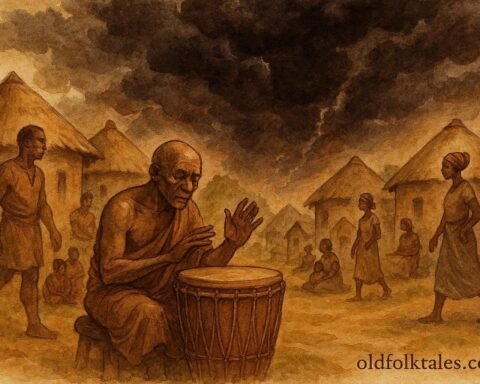
In the plateau lands between the Save and Manyame rivers lived Nyasha, a potter whose hands made bowls so smooth that even the moon envied them. Yet Nyasha hid beneath her hut a secret cloak made from the discarded husks of night moths. When she wore it, her face dulled and her body bent like old clay; when she removed it, she shone as bright as dawn after drought.
Her husband, Tawanda, a hunter, loved her songs but grew curious about her nightly vanishings. One evening he followed her to the granary and saw her peel away the moth cloak. His fear outweighed his wonder. He seized the cloak and threw it into the fire. Nyasha screamed, not from pain but from knowing the balance was broken. You burned my shadow! she cried. Now my truth has nowhere to hide.
Days passed, and her radiance grew painful to look upon. Villagers called her moon-woman. Children hid, dogs howled. Without her shadow, Nyasha could not sleep; she glowed through the night, her skin silvering the walls. Tawanda begged forgiveness. She said softly, When you destroy mystery, you destroy comfort. She walked to the Manyame River and asked the spirits for counsel. The water answered with ripples of light: Balance what was divided.
She molded a pot from river clay, mixing ash from the burnt cloak into the clay, shaping it like a heart. Into it she poured water and whispered, Half truth, half shade. When the pot dried, she bathed her face in its reflection. Her glow softened; her form steadied. She returned to the village, not as the flawless moon-woman, not as the bent old figure, but as herself—complete.
When she passed, the pot remained at her doorway, and to this day Shona potters drop a pinch of ash into clay to honor her craft. Elders still say, A pot without shadow leaks truth.
Moral: Harmony lives between perfection and imperfection.
Author’s Note: This Shona adaptation turns the motif toward balance rather than escape. Pottery symbolizes integration—the merging of visible and hidden selves. The Manyame River motif ties the folktale to ancestral water spirits central to Shona cosmology.
Knowledge Check
Craft: What is Nyasha’s skill? Answer: Pottery.
Symbol: What object replaces the second skin? Answer: A pot formed with ash from the cloak.
Conflict: Who destroys the cloak and why? Answer: Her husband Tawanda, out of fear.
Resolution: How does Nyasha restore balance? Answer: She mixes shadow and light through clay.
Proverb: What do elders say about pots? Answer: A pot without shadow leaks truth.
Lesson: What does the story teach about perfection? Answer: That harmony needs both flaw and glow.
Origin: Shona, Zimbabwe