Gather close, children, let the firelight touch your faces and let the night carry my words. This tale is not new; it is as old as the earth under our feet. It comes from the time when spirits walked freely among men, when the whisper of a tree was not to be ignored, and when yam was not just food but life itself. What I tell you tonight is the story of the Yam Farmer and the Spirit of the Forest.
There once lived a man called Adétókunbọ̀ in the lands of Ìjẹ̀bú. He was a strong man with arms thick like the trunks of palm trees, and his back was hardened by years of farming. His love was yam, and his wealth was yam. He would say proudly, “When a child is named, yam feeds the guests. When a man dies, yam feeds the mourners. Yam is life, yam is wealth!” And indeed, the yam grew for him. His barns were full, his mounds spread far, and his neighbors envied his fortune. But envy did not move Adétókunbọ̀. He loved only his farm and his own belly. He did not share with the hungry. He did not lend seed yams to the poor. He kept everything for himself, laughing as he ate while others starved.
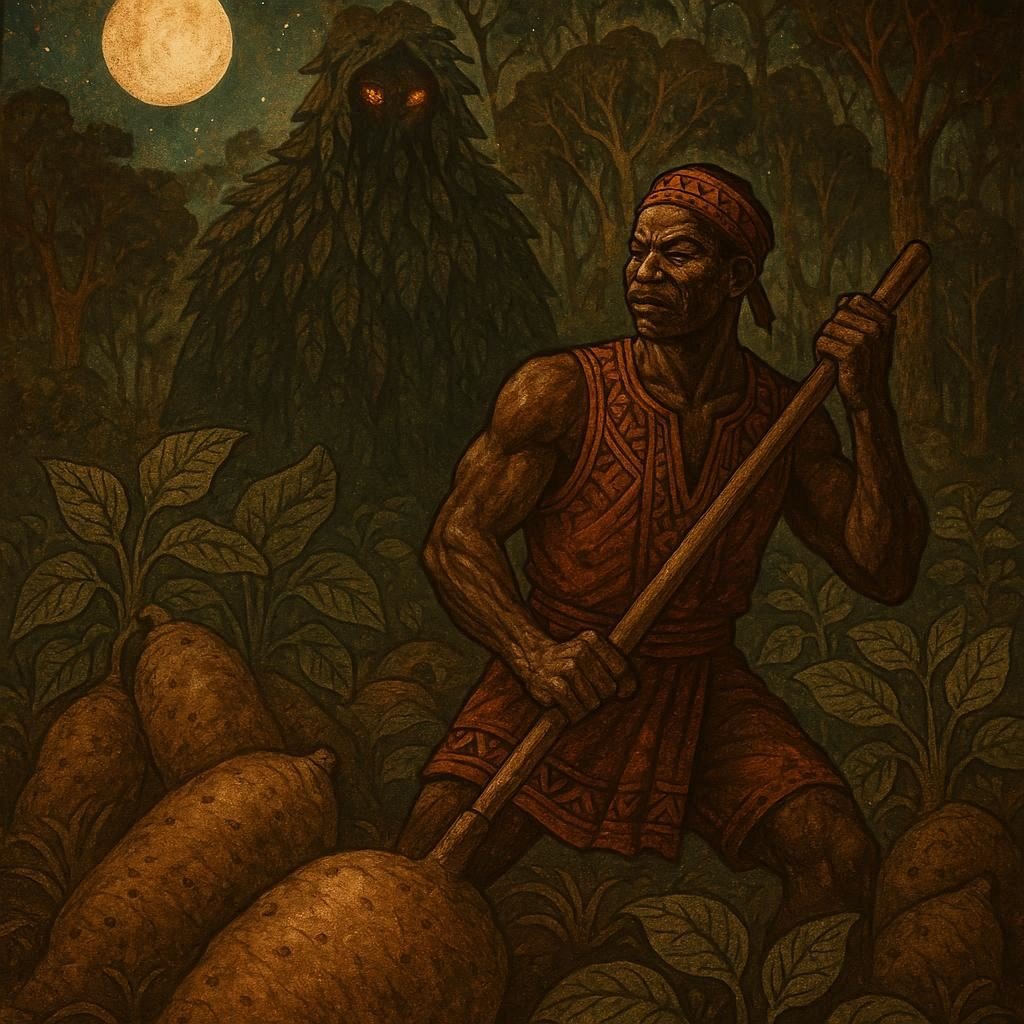
One year, when the rains returned, Adétókunbọ̀ grew bold. He cleared land not only on his farm but deeper, deeper still into the forest that elders had warned was sacred. The old men told him, “Do not trespass there, for the spirits of the forest guard that land. To farm it is to provoke what you cannot fight.” But Adétókunbọ̀’s ears were like closed doors. He said, “Did the spirits give me a hoe? Did the spirits feed my children? Yam is mine to plant wherever I wish.” And so, he struck his hoe into the forbidden soil.
As he dug, a voice rose from the trees, deep and hollow, a voice that carried more power than thunder. It said, “Farmer! Farmer! This land is not yours to claim. Leave now, before the wrath of the forest falls upon you.” Adétókunbọ̀ stopped and looked about, but he saw no man, only the swaying of tall iroko and silk-cotton trees, only the rustling of leaves. He spat into the earth and laughed. “Which spirit eats yam? Which ghost boils pounded yam with palm oil? Let me work!” And he bent again to his mounds. The voice came once more, heavier than before. “Greedy heart, beware! Sow here, and the plenty you seek will be your undoing.” But Adétókunbọ̀ struck his hoe harder into the soil, deaf to the warning. “I fear nothing but hunger!” he cried.
The yams grew that year beyond all imagination. They grew fat and long, so large that two men were needed to carry one tuber. His barns overflowed until they groaned under the weight. The people came to him in wonder. They said, “Adétókunbọ̀, share your seed yams with us, so our children too may eat well.” But he turned them away with mocking laughter. “Did you sweat with me? Did you cut down the trees with my cutlass? Go and find your own yam!” Even when the poor came to beg, he pointed at their rags and said, “Eat cassava! Yam is for men of wealth.” His greed grew as tall as the iroko, and his pride filled the air like dust. But the spirits do not forget, and the spirits of the forest do not sleep.
One night, when the moon was round and the drums of crickets played, a traveler came to Adétókunbọ̀’s gate. He was tall, thin, and cloaked in leaves. His eyes glowed faintly like embers. He called, “Farmer, I am a traveler. Share with me some yam that I may not starve.” Adétókunbọ̀ frowned. “Who begs for yam in the night? Go away before I set my dogs on you!” But the stranger stepped closer, his shadow stretching like a giant across the ground. “Do you not know me?” he said. “I am the Spirit of the Forest. I warned you, but you mocked me. I gave you plenty to test your heart, but your heart has failed. You hoarded what should be shared, and you spat on the poor. Now yam will be your ruin.”
The earth trembled beneath the farmer’s feet, and his barns shook as if seized by wind. Adétókunbọ̀ fell to his knees and cried, “Forgive me, Spirit! Spare me, and I will change. I will share. I will honor the forest!” But the spirit’s laugh rolled like thunder. “Too late, Farmer. The yam that you worship will bury you.” And with that, the spirit vanished into the night.
By morning, Adétókunbọ̀’s barns were empty. Not one yam remained. His fields lay bare as though no crop had ever grown there. His neighbors searched for him, but he was gone. Some say the spirit swallowed him whole. Others whisper he still roams the forest, hoe in hand, cursed to till but never harvest. And the people of Ìjẹ̀bú, seeing his fate, never again dared to farm in the forbidden forest.
Children, mark this well. Wealth that is not shared will turn to ash. The yam that feeds only one belly will rot in its barn. Greed is a bag with a hole, it never fills, no matter how much you pour inside. We must learn to give, to honor the earth and the unseen spirits who guard it, to remember that life is not ours alone. For a man who eats alone will one day be buried alone, and his name will be forgotten like dust blown by the harmattan wind.
Knowledge Check
1. What is the moral of the folktale ‘The Yam Farmer and the Spirit of the Forest’?
The story teaches a lesson about patience, humility, cleverness, or community, showing how actions can lead to lasting change.
2. What cultural group does the tale ‘The Yam Farmer and the Spirit of the Forest’ come from?
This tale originates from the Yoruba people of West Africa, known for their rich oral traditions.
3. In the tale, what action sets the story of ‘The Yam Farmer and the Spirit of the Forest’ in motion?
In the tale, a key character acts out of curiosity, pride, desperation, hunger, or loyalty, sparking the main events.
4. How does the folktale ‘The Yam Farmer and the Spirit of the Forest’ explain a natural feature or animal trait?
The story offers a traditional explanation for why an animal or natural element behaves or appears the way it does today.
5. Is ‘The Yam Farmer and the Spirit of the Forest’ considered a trickster tale, ghost story, or moral fable?
‘The Yam Farmer and the Spirit of the Forest’ is a cultural folktale that may be a trickster story, origin tale, or moral fable, reflecting Yoruba wisdom.
6. How is this folktale relevant to modern readers?
The message of ‘The Yam Farmer and the Spirit of the Forest’ remains timeless as it teaches truths about kindness, courage, respect for nature, and responsibility.
Cultural Origin: Yoruba Folktales