Long ago, in the land of the Kimbundu people of Angola, a young man set out on a journey. The sun hung high above the savanna, beating down upon the dusty path that stretched before him. He walked alone, carrying only a staff, his heart filled with restless energy and his head crowded with thoughts of his own cleverness. But fate had prepared a strange lesson for him.
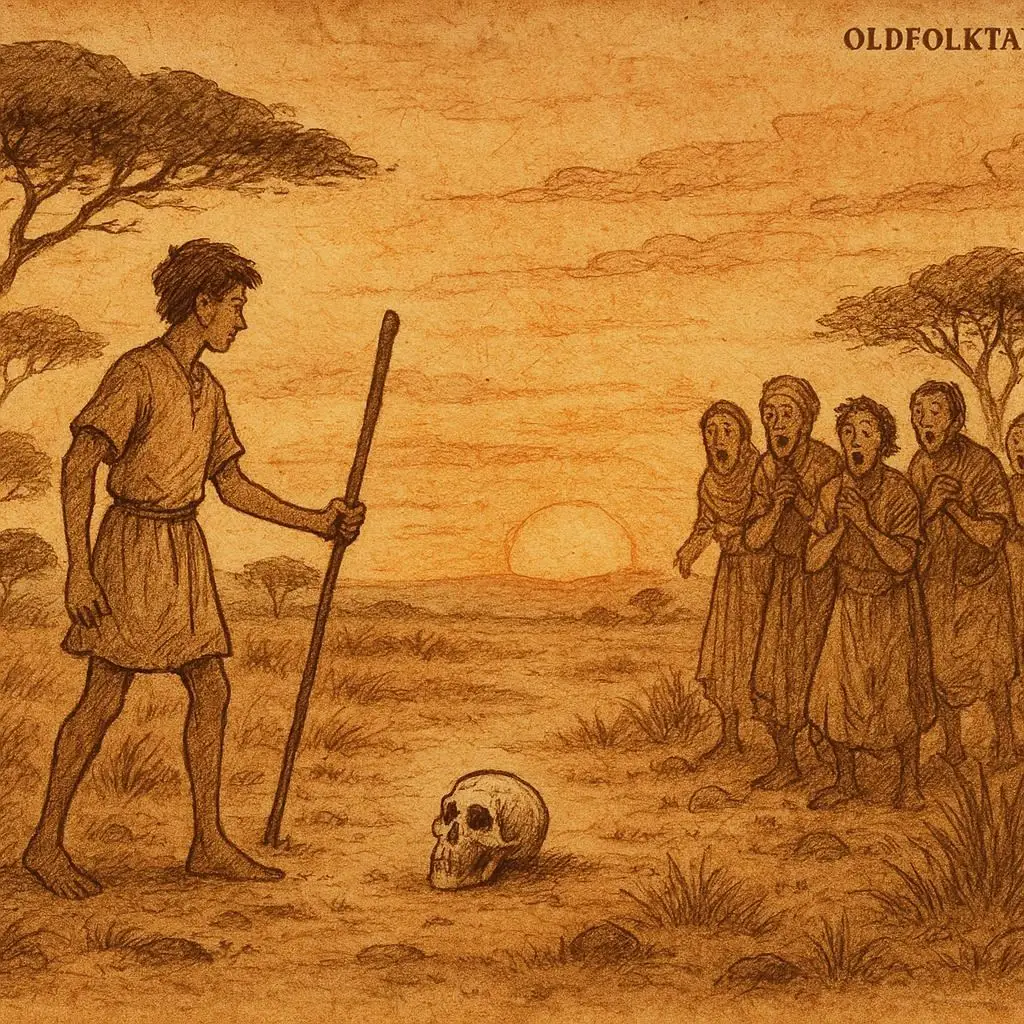
As the young man moved along the road, he came upon a curious sight: a human skull, bleached by the sun, lying at the side of the path. Other travelers had passed it many times, paying it no mind. But the young man stopped, looked down at it, and sneered. He lifted his staff and struck the skull, saying with scorn, “Foolishness has killed you!”
To his shock, the skull stirred and spoke in a dry, hollow whisper: “Yes, foolishness has killed me. But you, your cleverness will soon kill you.”
The young man stumbled backward, his heart racing. “A skull that speaks!” he exclaimed. “Surely this is a terrible omen.” His plans to continue his journey dissolved instantly. Trembling, he turned back toward his village, convinced that such a wonder must be shared with others.
When he arrived home, he sought out the elders. “Honored ones,” he said breathlessly, “I have seen an omen most strange. I found the skull of a man lying by the roadside. I struck it with my staff, and it spoke to me!”
The old men frowned and exchanged skeptical glances. One of them replied, “Young man, do not jest with us. We too have walked that path. We have seen that skull. Never once has it spoken. How can you expect us to believe such a thing?”
READ THIS: Patience and Humility: An Angolan Folktale That Teaches Lessons on True Strength in Marriage
But the young man insisted. “It is true! If you do not believe me, come with me. I will strike the skull again, and if it fails to speak, then cut off my head where I stand.”
The elders, irritated yet curious, agreed. “Very well,” they said. “Let us go and see this marvel with our own eyes.”
So the young man led them back along the road, his chest swelling with pride at the thought of proving himself right. They came at last to the place where the skull rested. The young man pointed to it and raised his staff. “Behold!” he cried, striking the skull. “Foolishness has killed you!”
The skull lay silent.
Confused, the young man struck it again. “Foolishness has killed you!” Still the skull gave no reply. A murmur rose among the gathered people.
“You see?” they said angrily. “You have lied to us.”
The young man’s face grew pale. He struck the skull a third time, more desperately than before, but the silence was unbroken. The elders, now convinced he had mocked them, declared, “You have made fools of us. You swore your life upon your claim. Now your words shall be fulfilled.”
And there, on that very road, they cut off the young man’s head.
No sooner had his blood touched the earth than the skull, at last, spoke again. Its voice rattled through the air, grim and mocking: “I, foolishness, have killed me. And you, young man, your smartness has killed you.”
The people froze. Their anger drained into shock. “We have done wrong,” they said. “We killed him unjustly, for the skull truly does speak.” But it was too late. The young man’s clever pride had led him to death, just as the skull had foretold.
And so the villagers returned home, heavy with the memory of the day when wisdom was ignored, and recklessness claimed another life.
Moral Lesson
This Kimbundu folktale reminds us that cleverness without humility can be as dangerous as ignorance. The young man believed his sharp wit would win him honor, yet his arrogance blinded him to caution. In mocking the skull, he sealed his own fate.
True wisdom is not in showing off one’s cleverness but in knowing when to be silent, when to listen, and when to tread carefully. Pride in being “too smart” can destroy just as swiftly as foolish mistakes.
Knowledge Check
1. Who did the young man encounter on his journey?
He encountered a human skull lying by the roadside.
2. What did the young man say when he struck the skull?
He said, “Foolishness has killed you.”
3. How did the skull respond the first time?
It replied, “Yes, foolishness has killed me. But your smartness will soon kill you.”
4. Why did the villagers kill the young man?
Because the skull refused to speak in their presence, making them think he had lied.
5. What lesson does the folktale teach?
That both foolishness and prideful cleverness can lead to destruction, and humility is the wiser path.
6. What is the cultural origin of this folktale?
It comes from the Kimbundu people of Angola.
Source: Kimbundu folktale, Angola.