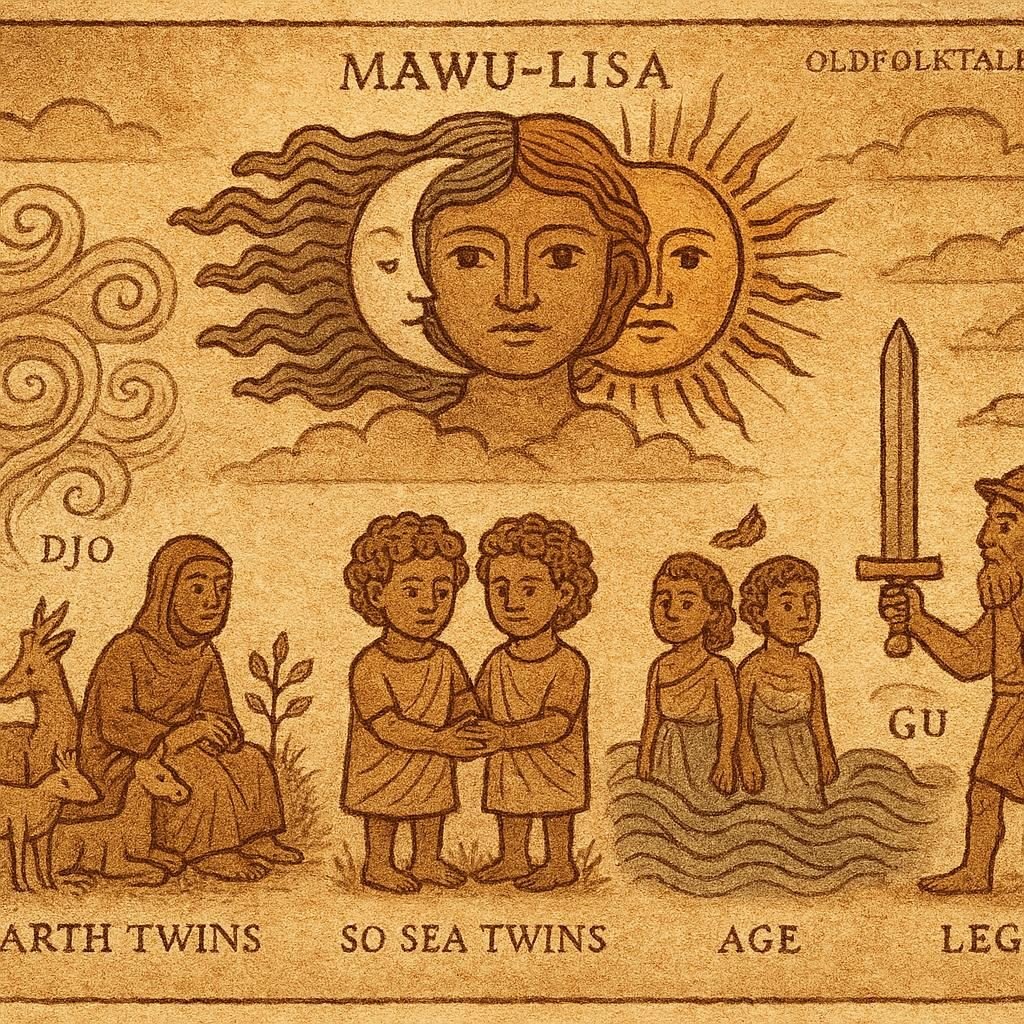
In the beginning, when the universe was still fresh and the earth had not yet settled into its order, there was Mawu-Lisa, the great parent. Mawu-Lisa was one being with two faces. One face was Mawu, the gentle mother, whose eyes shone as the Moon and who ruled over the night. She was called Filawu. The other face was Lisa, the strong father, whose blazing eyes were the Sun, and he commanded the day.
From this union of Moon and Sun, night and day, came children, gods destined to shape the world. Because Mawu-Lisa was both woman and man, the children were born in varied forms. The first birth was a pair of twins: a male child, Da Zodji, and his sister, Nyohwe Ananu. Next came So, who resembled the parent, being both man and woman combined in one body.
After So came another set of twins: Agbé and Naete, a male and female, destined for the waters. Then came Age, a solitary male, and afterward Gu, a being unlike any other. Gu’s entire body was his strength, his trunk made of stone, and from his neck protruded not a head but a great shining sword.
The sixth birth was Djo, who was not a being of flesh at all, but the very air, the atmosphere that filled the space between sky and earth. Djo was the breath of creation, the invisible life that men and gods alike would need. The last child born was Legba, the youngest. Because he was last and beloved, Mawu called him her spoiled child, destined never to feel punishment.
The Gathering of the Children
One day, Mawu-Lisa gathered all the children together to divide the realms of creation, assigning to each their dominion and role.
To the first-born twins, Da Zodji and Nyohwe Ananu, she gave all the riches of the world and commanded them to inhabit the earth. The earth, with its wealth and soil, belonged to them.
To So, who was both man and woman like the parent, she said: “Remain in the sky. You shall rule the heavens, for your nature mirrors mine.”
To Agbé and Naete, the twins of the waters, she entrusted the sea. “Go and command the oceans and rivers. You will be the lords of water, ruling all that stirs in its depths.”
To Age she gave the bush, the wilderness of animals and birds. “You shall live as a hunter, master of the creatures of the land and air.”
Then she turned to Gu, whose body was strength itself. “You are my power. That is why you were not given a head like the others. Thanks to you, the earth will not remain a wild and tangled bush. You will teach men to shape, to build, to live happily.”
To Djo, the invisible one, she gave the space between earth and sky. “You are the breath of life. To you I entrust the span of human years. Through you, your brothers shall be clothed and hidden, for your air will veil them.” That is why Djo is also called djin, the spirit.
The Languages of the Gods
When Mawu-Lisa had assigned the realms, she gave each child a language suited to their domain. To the twins of the earth, she gave the language of humankind, while stripping from them the speech of the sky. To So, Agbé, Naete, Age, and Gu, she gave their tongues but removed their memory of the parent language.
To Djo, she gave the language of men, so that breath itself could speak to humankind.
At last, she turned to Legba, her youngest. “You are my spoiled child. Because you are beloved and have never known punishment, I cannot entrust you to your brothers. You shall remain always with me. Your task will be to visit all the kingdoms of your brothers and bring me news of what happens.”
So Legba became the messenger, the linguist of the gods. He alone retained all the languages, those of his brothers, and that of Mawu-Lisa. From that day, no god or human could speak directly to Mawu-Lisa. All must first go through Legba, the keeper of tongues.
That is why Legba is found everywhere. He stands even before the shrines of the vodun, because before one approaches God, one must first speak to Legba.
Moral of the Story
This tale teaches that every being has its role and dominion, as given by divine order. Power lies not in rivalry but in harmony, with each fulfilling their purpose. It also reminds us that communication is sacred, and even gods must rely on an intermediary, Legba, the bridge between worlds.
Knowledge Check
1. Who is Mawu-Lisa in Dahomey mythology?
Mawu-Lisa is a dual god, both male (Lisa, the Sun) and female (Mawu, the Moon).
2. Which children were given dominion over the sea?
Agbé and Naete, the twin siblings, were entrusted with command of the waters.
3. Why does Gu have no head?
Gu represents strength and power; instead of a head, he bears a great sword.
4. What role was given to Djo?
Djo, the air, was entrusted with the life-span of humans and the space between earth and sky.
5. Why is Legba considered Mawu’s linguist?
Because he alone knows all languages of the gods and of Mawu-Lisa, serving as the messenger.
6. What central lesson does this folktale teach?
That each being has a divine role and purpose, and harmony arises when all fulfill their duties.
Source: Beninese Folktale