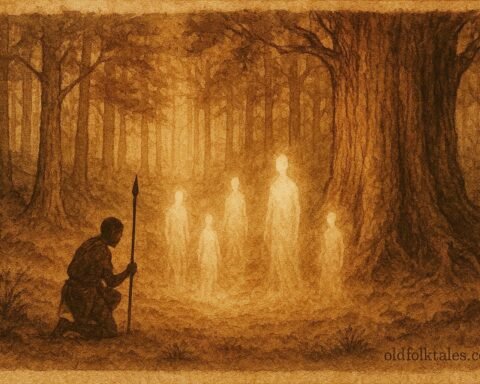
In the heart of West Africa, the people of Dahomey, today’s Benin, have long passed down stories that explain where humanity came from and why animals live as they do. These tales are more than myths; they are living lessons woven with wisdom, warning, and wit. In one story, we hear of Adanhu and Yewa, the first humans shaped by divine hands, and of Legba’s mistake that gave rise to the monkey. In another, Monkey himself almost earns a place among mankind, but his pride and boasting cost him the chance. Together, these stories remind us that creation is sacred, work is honorable, and arrogance leads only to loss.
The First Humans: A Dahomean Version Against the Missionaries
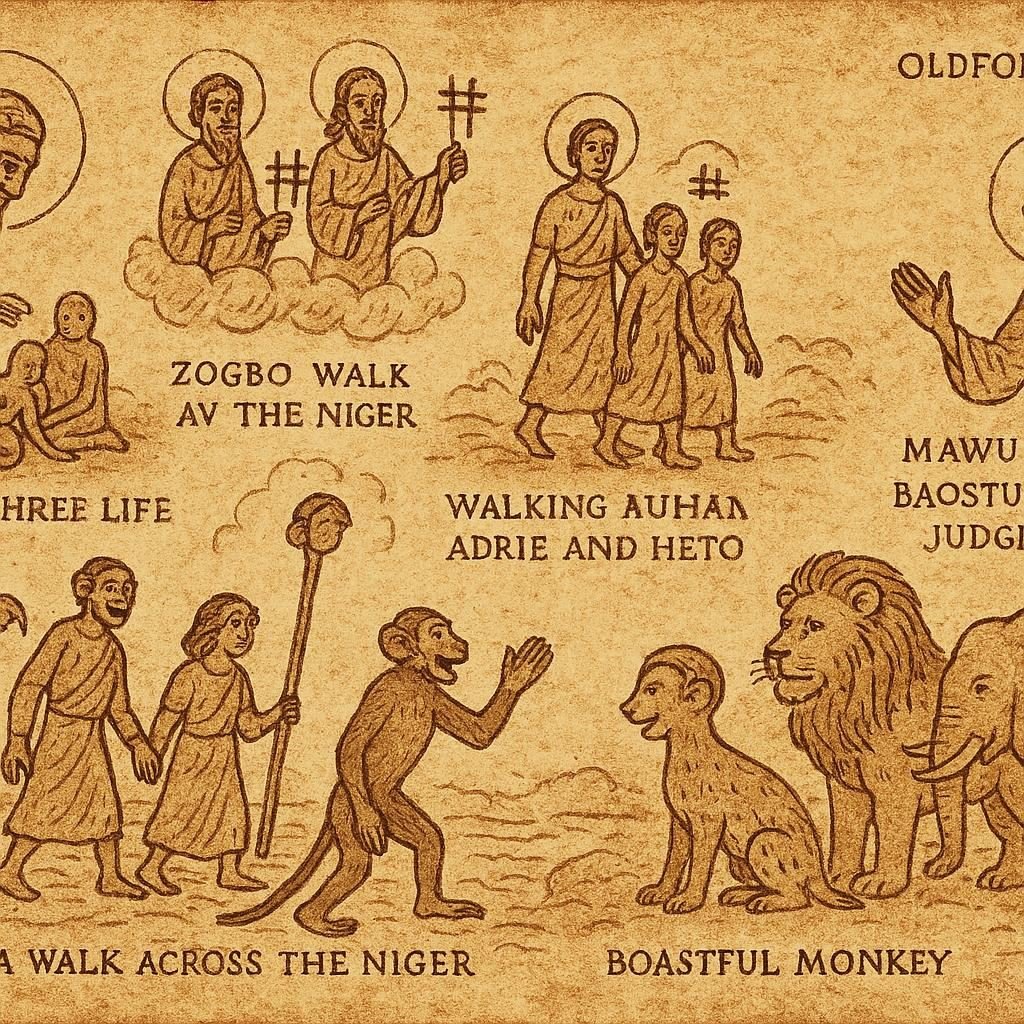
Long ago, before the land knew the shade of trees or the coolness of rivers, Africa was said to be nothing but desert. Across the great Duwaya, the mighty Niger River, journeyed a man named Zogbo. With him were two women: Heti and Heto. Together, they sought a place to settle, carrying the weight of beginnings upon their shoulders.
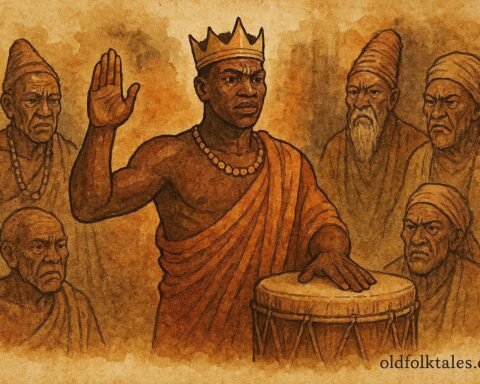
Not long after their arrival, the skies opened, and from above descended five prophets. They came not as ordinary men but as bearers of wisdom, bringing with them the teachings of Fa, the sacred system of divination. Before this divine moment, people lived long lives, four hundred, even six hundred years, filling the earth with many children. But it was only after the prophets shared the mysteries of Fa that humanity truly flourished and multiplied.
In the earliest of times, before Zogbo’s journey and before the prophets, there were but a single man and woman: Adanhu and Yewa. They were the first to populate the world, and through them, all mankind traces its roots.
The story of their creation is told in Dahomey: The Creator shaped four figures out of clay, two men and two women. Yet they lay lifeless, still and silent. Then came Legba, trickster and messenger. In secret, he attempted to give life to two of them. But Legba, not knowing the sacred craft of life-giving, failed. The beings he touched did not rise as men or women but instead became monkeys.
The other two, untouched by Legba’s fumbling hands, received life directly from God. These rose as Adanhu and Yewa, the first true humans. And so, mankind was born of divine breath, while the monkey stands as a living reminder of Legba’s mistake.
The tale told by missionaries, that of forbidden fruit and temptation, is not known in Dahomey. Instead, the people say: “When one man claims he is greater than another, ask him, ‘Are you Zogbo?’” For in their memory, it is Zogbo, Adanhu, and Yewa whose names carry the weight of human beginnings, not fruit nor temptation.
Why Monkey Did Not Become Man
In another time, Mawu, the great Creator, shaped all the animals. Yet they were unfinished, for they had no names. Mawu spoke to them:
“Before I give you your names, you must work the clay for me, so that I may complete the making of creatures.”
Each animal bent to the task. The lion pressed with heavy paws, the elephant stirred with its trunk, the hyena scraped with restless claws. Then Mawu turned to Monkey. She said:
“Because you have five fingers on each hand, if you work diligently, I will count you among men instead of animals.”
Monkey’s heart leapt. Joy filled him so greatly that he could not contain it. He clapped his hands, jumped about, and began to boast to the other animals.
“To Lion,” he declared, “tomorrow I will no longer live among you. I shall be a man!”
“To Hyena and Elephant,” he repeated, “soon I will walk upright, no longer beast but human!”
He spread his secret to every creature who would listen. But in his endless boasting, he forgot his task. While others labored with clay, shaping and smoothing, Monkey did nothing but laugh and chatter.
When Mawu returned, her eyes saw all. She found Monkey idle, his hands empty of work but full of pride.
She struck him and said sternly:
“You shall remain Monkey. You will never walk upright as man. You chose pride over labor, and boasting over effort. Forever shall you stay among the animals.”
And so it has remained. Because of his own folly, Monkey lost his chance to join mankind. His hands, though like ours, never lifted him into the company of men.
Moral Lesson
These Dahomean stories remind us that destiny is shaped not by pride or folly, but by humility, work, and respect for divine order. From Adanhu and Yewa’s creation, we learn that human life is a sacred gift, not an accident. From the tale of Monkey’s boasting, we see how arrogance and idleness rob us of opportunity. Together, the stories teach that wisdom, humility, and diligence are the paths to fulfillment.
Knowledge Check
1. Who were Adanhu and Yewa in Dahomean tradition?
They were the first true humans, created directly by God.
2. What mistake did Legba make during creation?
He tried to give life to clay figures but failed, turning them into monkeys.
3. Why is Zogbo remembered in Dahomean lore?
He crossed the Niger with Heti and Heto, beginning human settlement in Dahomey.
4. Why did Monkey fail to become human?
Because he boasted of his future instead of working diligently with the clay.
5. What values do these two folktales highlight?
Humility, hard work, and respect for divine order over pride and laziness.
6. Where do these stories originate?
They are traditional folktales from Dahomey, in present-day Benin.
Source: Beninese Folktales