In a village where the red earth stretched toward distant hills and palm trees swayed in the tropical breeze, there lived an elderly man whose heart carried a burden heavier than the harvest baskets his sons should have filled. This father had been blessed with three sons, whom he had lovingly named after the men who had shaped his own life: Anyindep after his father, Mbaka after his beloved uncle, and Jikwu after his older brother. Yet these names, meant to honor family bonds, seemed to mock him daily.
The old man’s sons lived like wild cats thrown into the same compound, always snarling and clawing at one another with a ferocity that left their father’s spirit wounded. From sunrise to sunset, they quarreled over everything and nothing, their voices rising in anger like storm clouds gathering before the rains. If their father asked them to perform the simplest task, their bickering would begin before his words had finished echoing in the air.
When he sent them to clear grass from the family farm, they would return looking like warriors from a lost battle. One would stumble home with an eye swollen shut like a ripe fruit, another would nurse a broken tooth that left him speaking with a lisp, and the third would limp on a wounded leg. The crops suffered while the brothers nursed their wounds and their wounded pride.
Also read: Funyi’s Quest
The palm wine season brought no better results. The father would send his sons to tap the precious sap from their palm trees, hoping that the sweet reward of fresh wine might sweeten their temperaments. Instead, they would fight over who carried the collection jug, and return with nothing but broken calabashes and bitter stories of sabotage. The final straw came when they returned completely empty handed and thoroughly drunk, having consumed their meager harvest while Anyindep had somehow managed to lose the valuable tapping knife entirely.
This was particularly devastating because heavy rains made palm wine tapping treacherous work. During the rainy season, tappers skilled and lucky enough to coax good wine from their ntso trees could earn substantial profits to carry their families through the lean months. But these three sons never looked beyond their own immediate quarrels to see the bigger picture of family survival.
Their father’s anguish grew so deep that neighbors whispered he had begun to curse his own sons. Some claimed they had heard him in his darkest moments wishing that his ancestral line would die with him rather than continue through such disgraceful offspring.
It was during the height of the rainy season, when the air hung heavy with moisture and the sound of falling water drummed constantly on the roof, that the old man fell gravely ill. Half their crops still waited in the flooded fields, and his heart burned with worry that he might join his ancestors without making peace with his sons or teaching them the wisdom they would need to survive.
One gray morning, when the rain had paused but the clouds still pressed low over the village, he summoned his three sons to his bedside. His voice, once strong enough to call across the compound, had grown weak and threadlike.
“My sons,” he began, his words carrying the weight of years of disappointment, “I am a dying man. My heart smolders inside of me because of you three. It might turn to ashes right before your eyes. I know that when I die, you will kill one another.”
The sons shuffled uncomfortably, perhaps hearing truth in their father’s words for the first time.
“If I say, ‘Bring me some water to drink,’ you complain. If I say, ‘Go plant some seeds in the farm,’ you fight. If I say, ‘Go tap some palm wine,’ you tap your blood instead. It is truly a curse to be here with you without my wife, your mother. I thank the gods every day that she did not live to see what irresponsible men you have become. She would have asked the ancestors to strike you down herself.”
His voice grew stronger with emotion as he continued. “You are all like the man who cuts down forest trees and then runs to the pathway asking, ‘Who’s making all that noise?’ Yes, they say the mouth that ate the grain is the same one that asks, ‘What shall I plant?’ You, my sons, are young men who only want to swallow food that has been chewed for you. And even then you cannot swallow properly. You are only good at hurting one another, forgetting that a stone thrown in the dark often hits a relative.”
The old man paused, gathering strength for what he knew must be his final lesson. “I don’t have the strength to call on the ancestors to rain their wrath on you, so I have decided to join your mother instead. But before I go, I will give you one last task to perform for me.”
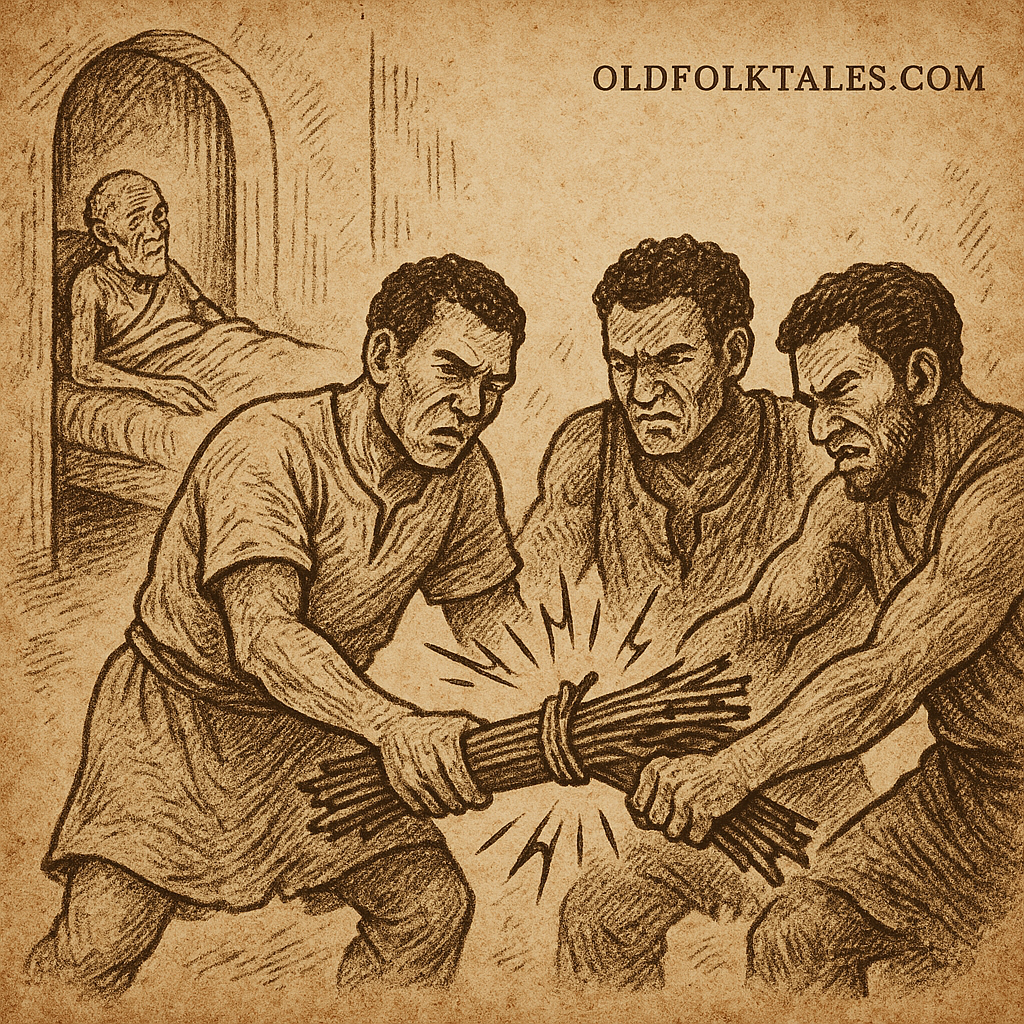
He pointed a trembling finger toward the hearth, where a bundle of dry twigs lay bound with rope. “Anyindep, pick up that bundle of dry twigs and break it.”
Anyindep approached the bundle with the swagger he usually displayed before a fight. He picked it up, examining it as if it were an opponent he could intimidate. Holding his hands out in front of him, he applied pressure, expecting the twigs to snap easily. When nothing happened, he bent double, sucked air deep into his lungs until his cheeks puffed out, and made another attempt with all his might.
“You fight with your brothers every single day,” their father observed sadly. “I want you to display that strength right now.”
Anyindep tried again, arching his back until his spine curved like a drawn bow. His muscles contracted and bulged with effort. Sweat began to drip down his forehead as he strained against the stubborn bundle. Finally, breathing heavily, he threw it down and wiped the moisture from his brow.
“Father, I have failed,” he admitted, his voice smaller than usual.
“What do you mean, you have failed?” Mbaka scoffed, his competitive nature flaring. “The person who’s carried on another’s back does not appreciate how steep the climb is.”
“My brother, you should remain silent,” Anyindep snapped back, his failure making him defensive.
Their father turned his tired eyes to Mbaka. “Yesterday you came home with a broken tooth. Show me how strong you are.”
Mbaka approached the bundle with determination, perhaps thinking his brother had simply been weak or lazy. But despite his best efforts, straining until his face turned red with exertion, he too failed to break the bound twigs.
Finally, the old man’s gaze fell on Jikwu. “It’s your turn now.”
Jikwu cracked his knuckles methodically, the sound sharp in the quiet room. He picked up the bundle with confidence, arched his back, and strained every muscle in his body. His biceps trembled with the effort, and one small twig made a tiny cracking sound that gave him hope. He groaned and tried again, pushing himself until veins stood out on his forehead and neck like rivers on a map. His jaws locked with concentration, and little red spots danced before his eyes from the strain.
Finally, he screamed in frustration: “Father, this bundle has defeated me too!”
The old man’s voice carried a note of sadness mixed with wisdom. “Look at you, whimpering like scavenger dogs. My sons, a single stick smokes but does not burn. Have you ever heard that one hand cannot tie a bundle? That shoulders cannot grow above the head? Pick up that bundle, put all your hands on it together, and break the twigs as one.”
The three brothers looked at each other uncertainly. For once, they moved without arguing, each placing their hands on different parts of the bundle. Together, they held both ends, untied the ropes that bound the twigs, and easily broke the bundle into two pieces.
The old man’s eyes brightened with his final teaching. “My sons, our people say that life is like a river right after a heavy rainstorm. It prepares itself for the waters raging down gullies to flood its bed. When lips come together, the mouth can whistle. When you act together, you can always find a shoulder on which to rest your head. Union is strength. If you keep fighting, you will never become true men. The more divided you are, the more miserable your lives will be. I am finished.”
With those words, the old man closed his eyes and was reunited with his wife in the realm of the ancestors. For the first time in their lives, the three sons acted together without quarreling, giving their father a funeral that honored the wisdom and patience he had shown them throughout their difficult lives.
Moral Lesson
This timeless tale teaches us that individual strength, no matter how great, cannot accomplish what united effort can achieve. The father’s demonstration with the bundled twigs shows that unity multiplies our power while division weakens us all. Just as the separate twigs could not be broken alone but were easily divided when untied, people who stand together can overcome challenges that would defeat them individually. The story reminds us that family bonds and cooperation are sources of strength that can overcome any obstacle.
Knowledge Check
Q1: What do the names Anyindep, Mbaka, and Jikwu represent in this Beba folktale?
A: The three sons were named after important male figures in their father’s life: Anyindep after his father (grandfather), Mbaka after his uncle, and Jikwu after his older brother. These names were meant to honor family connections and ancestral bonds, making their constant fighting even more painful for their father.
Q2: How does palm wine tapping serve as a metaphor for the brothers’ failures in the story?
A: Palm wine tapping requires skill, patience, and cooperation, especially during the profitable rainy season. The brothers’ inability to work together for palm wine collection represents their failure to capitalize on opportunities that require teamwork, symbolizing how their quarreling prevents them from achieving prosperity.
Q3: What is the symbolic meaning of the bundled twigs in this folktale?
A: The bundled twigs represent the power of unity versus the weakness of division. When bound together, the twigs cannot be broken by individual strength, but when separated, they become fragile and easily destroyed. This demonstrates that people united are stronger than individuals working alone.
Q4: How does the father’s deathbed speech reflect Beba cultural values about family responsibility?
A: The father’s speech emphasizes ancestral wisdom, family honor, and the responsibility of sons to work together for survival. His references to proverbs and ancestral judgment show how Beba culture values collective responsibility over individual achievement, and how family discord brings shame to the entire lineage.
Q5: What role do traditional Beba proverbs play in conveying the story’s message?
A: The story incorporates several Beba proverbs like “a single stick smokes but does not burn” and “one hand cannot tie a bundle” to reinforce the theme of unity. These traditional sayings serve as cultural wisdom passed down through generations, making the moral lesson more memorable and culturally authentic.
Q6: How does the story’s ending demonstrate the transformation of the three brothers?
A: The brothers’ ability to work together for their father’s funeral, without quarreling for the first time in their lives, shows that they finally understood his lesson. Their united action in honoring their father proves that the demonstration with the twigs successfully taught them the value of cooperation over conflict.
Source: The sacred door and other stories, Cameroon folktales of the Beba (1st ed.). Ohio University Press.