In a time long ago, across the vast plains and golden grasslands of Somalia, there lived three oxen who had formed an unbreakable bond of brotherhood. These were no ordinary cattle who simply grazed side by side by chance. No, these three had made a sacred covenant with one another, a promise to stand together against all threats, to protect one another with their very lives, and to never let the dangers of the wild tear them apart.
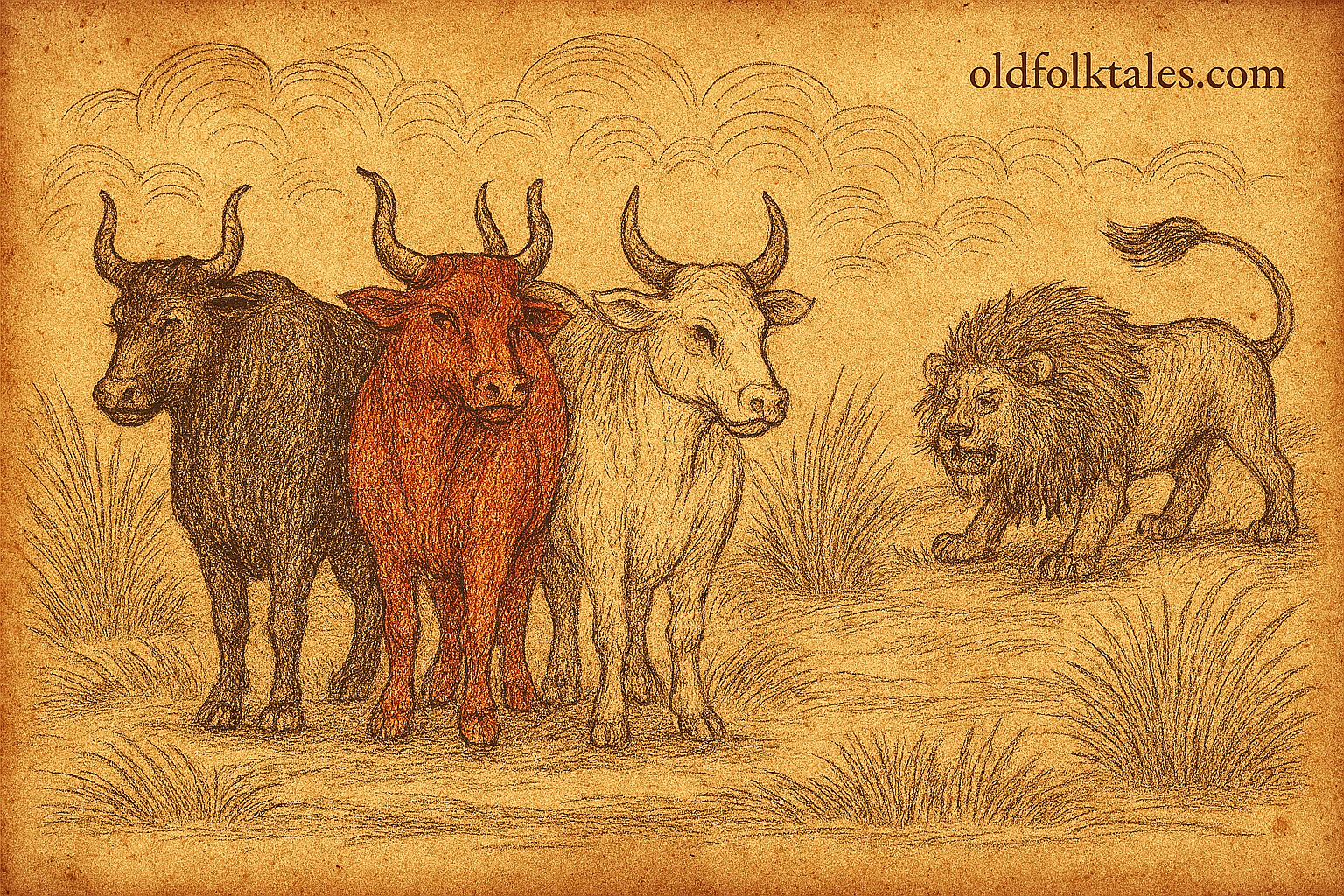
Each ox was magnificently different in appearance. The first was as black as a moonless night, his coat gleaming like polished ebony in the sunlight, his muscles rippling beneath his dark hide. The second was red as the earth during the rainy season, his russet coat the color of clay and iron-rich soil, his horns curved and formidable. The third was white as fresh milk, his pale coat brilliant and pure, standing out like a cloud against the golden grass, his presence almost luminous in the early morning light.
Together, they were a sight to behold three colors, three strengths, united as one. They grazed together in perfect harmony, moving across the grasslands like a single living entity. When one sensed danger, all three would position themselves back to back, their powerful horns facing outward in every direction, creating an impenetrable fortress of brotherhood. They slept in shifts so that one was always alert, watching for predators while the others rested. They shared the sweetest grass, the coolest water, and the shadiest trees. Their unity was their shield, their friendship was their armor.
But watching them from the shadows, hidden among the tall grasses and thorny acacia trees, was a lion, the king of predators, golden-maned and deadly. His stomach growled with hunger every time he spotted the three oxen. His mouth watered at the thought of their tender flesh. His amber eyes tracked their every movement with the patient calculation of a born hunter.
Yet despite his strength, despite his sharp teeth and powerful claws, despite his reputation as the most fearsome predator on the plains, the lion did not dare attack. He knew the truth that many predators had learned through painful experience: three oxen united were invincible. Their combined strength, their coordinated defense, their mutual protection made them untouchable. A lion might defeat one ox in battle, but three together? That was suicide.
So the lion watched, and waited, and plotted. His cunning mind turned over possibilities, searching for weakness, seeking an opportunity. And finally, he understood what he must do. If he could not break their bodies, he would break their bond. If strength could not defeat them, perhaps words could.
One bright morning, when the three oxen had separated slightly while grazing, still within sight of each other but not immediately side by side the lion saw his chance. He approached the white ox cautiously, keeping his distance, his voice smooth and friendly, like honey dripping from a comb.
“My friend,” the lion began, his tone full of false concern and sympathy, “I have been watching you for some time now, and I must confess something that troubles my heart. Are you not ashamed to be seen in the company of two such ugly companions?”
The white ox lifted his head, startled by these words.
The lion continued, his voice dropping to a conspiratorial whisper. “Look at yourself! You are magnificent, pure, bright, beautiful as the clouds themselves. You shine like the moon! But your companions… that dull red one and that dark black one… they make you look common by association. If I were you, if I possessed such radiance, I would graze proudly and alone in the forest, where everyone could admire my beauty without those ugly creatures diminishing it.”
The words were poison, sweet on the tongue but deadly in the blood. The white ox said nothing in response, but the lion could see the seeds of pride taking root. He slipped away, satisfied with his work.
That night, as the stars blazed overhead and his brothers slept peacefully nearby, the white ox could not rest. The lion’s words echoed endlessly in his mind. Ugly companions. Diminishing your beauty. Graze proudly alone. By the time dawn broke and painted the sky in shades of pink and orange, the white ox had made his decision.
Without a word of explanation or farewell, without even a backward glance at the brothers who had protected him countless times, the white ox turned and walked away in the opposite direction. His black brother called after him. His red brother followed for a short distance, trying to understand what had happened. But the white ox kept walking, his head held high, his heart swollen with foolish pride.
The moment the white ox was truly alone, separated from his brothers by distance too great for them to help, the lion struck. He emerged from his hiding place with a roar of triumph and leaped upon the isolated ox. Without his brothers to defend him, without their horns to protect his flanks, the white ox fought valiantly but hopelessly. The lion was too strong, too fast, too experienced. Within moments, it was over. The white ox became the lion’s meal, his pride having led him straight into death’s jaws.
After the lion had feasted and the white ox’s bones lay scattered on the plains, the lion’s hunger returned. His belly demanded more. And so he turned his attention to the remaining two brothers.
He found the red ox grazing sullenly, still mourning the mysterious departure of his white brother. Once again, the lion approached with false friendship and honeyed words. He spoke of ugliness and superiority, of the burden of unworthy companions. And once again, his poison worked.
The next morning, the red ox departed, leaving the black ox entirely alone. And just as before, the moment the red ox was isolated and vulnerable, the lion pounced and devoured him.
Finally, after time had passed and the lion’s hunger grew fierce once more, he approached the last remaining ox—the black one, who now stood alone on the vast plains where once three brothers had grazed together in safety.
But this time, the lion did not bother with flattery or deception. He simply stood before the black ox and spoke plainly, his voice cold and final.
“I have come to eat you, just as I have already eaten both of your friends. You stand alone now, with no one to help you, no chance of survival against me. It is better that you prepare yourself for death.”
The black ox looked at the lion with eyes that held no fear, only profound sadness and terrible understanding. When he spoke, his voice was calm, almost peaceful.
“You need not explain my fate, Lion. I already know it. The truth is, I died the day the white ox died. We all did. Our strength was never in our individual bodies, it was in our unity, our brotherhood, our covenant to stand together. When the white ox walked away, we all perished, though some of us simply hadn’t fallen yet.”
And with those words, the black ox lowered his head and offered no resistance as the lion took his life. He had spoken the deepest truth: alone, they were nothing but meat for predators. Together, they had been undefeatable.
The Moral Lesson
This powerful Somali tale teaches that unity creates strength that far exceeds the sum of individual abilities. When people stand together despite their differences in appearance, background, or character they become formidable against any adversary. But division, especially when caused by pride, jealousy, or the manipulation of others, destroys that protective power and leaves everyone vulnerable. The story warns against allowing outsiders to sow discord among friends, family, or communities, and reminds us that those who seek to harm us will always try to divide us first, knowing that separated, we fall easily. True strength lies not in individual superiority but in collective solidarity.
Knowledge Check
Q1: What made the three oxen safe from predators in this Somali folktale?
A1: The three oxen’s safety came from their unity and mutual protection. By standing together, watching over each other, and coordinating their defense with their combined strength and horns facing all directions, they created an impenetrable fortress that even the powerful lion dared not attack directly.
Q2: How did the lion use psychological manipulation to defeat the oxen?
A2: The lion used flattery and appeals to vanity, telling each ox they were superior to their companions and suggesting they were “too beautiful” or “too good” to associate with the others. By exploiting pride and creating feelings of superiority, the lion successfully divided the united oxen, making them vulnerable to individual attack.
Q3: What do the three different colors of the oxen symbolize in this legend?
A3: The three colors black, white, and red, symbolize diversity and difference. Despite their distinct appearances, the oxen were united in purpose and protection. The colors emphasize that unity doesn’t require sameness; strength comes from embracing differences while maintaining solidarity against common threats.
Q4: What is the significance of the black ox’s final statement about dying when the white ox died?
A4: The black ox’s statement reveals profound wisdom: their true death occurred not when the lion physically killed them, but when their unity was broken. Once the white ox left, their collective strength was destroyed, making their individual deaths inevitable. It shows that their power existed only in their togetherness, not as individuals.
Q5: What does this Somali tale teach about the tactics of enemies and oppressors?
A5: The tale teaches that enemies who cannot defeat a united group through direct force will attempt to divide them through psychological warfare, using flattery, creating jealousy, appealing to pride, or highlighting differences. The story warns communities to recognize these “divide and conquer” tactics and resist manipulation that separates allies.
Q6: How does this folktale reflect Somali cultural values about community and brotherhood?
A6: This tale reflects the Somali emphasis on collective strength, loyalty, and the importance of maintaining unity despite differences. In Somali pastoral culture, where survival often depends on cooperation and mutual protection against harsh conditions and threats, the story reinforces that individual pride must never override communal bonds and solidarity.
Source: Somali folktale (Hooyo.Web )