Long ago, in the ancient villages of Equatorial Guinea, when the bond between humans and animals was still strong and full of mystery, a man named Njambo lived with his wife. Together, they bore many children, twenty-three in total, but tragedy struck, and all their children died. Njambo’s first wife also passed away, leaving him with only one aging wife by his side. Against all odds, when both parents were already old, the wife conceived again and gave birth to a son. Filled with relief and hope, she called Njambo to name the child. He looked upon the boy and declared, “His name shall be Utigebode,” a word meaning He Who Saves People.
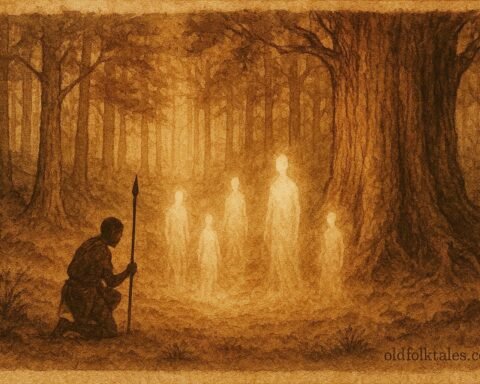
Utigebode grew into a strong young man, tall and broad-shouldered, with a heart full of kindness. One morning he told his father, “Paia! I am going into the forest to set snares so that we may eat.” Njambo, hungry and hopeful, agreed: “Yes! Go, my son, and catch me food.” Utigebode set his traps and returned later that day.
When he checked his snares again in the afternoon, he found two partridges caught. Overjoyed, he exclaimed, “At last! My father will eat one today, and the other will be kept for tomorrow.” But to his surprise, the partridges spoke: “What is your name?” He answered proudly, “I am called One-Who-Saves-People.” The birds replied, “If you are truly the savior, why do you plan to kill us?” Their words pierced his heart. Ashamed, Utigebode freed them, letting them fly away.
Another day he returned and found two antelopes in his snares. Again, he thought of his father’s hunger. Yet the antelopes asked him the same question, and when he replied, “One-Who-Saves-People,” they rebuked him: “Why then would you harm us?” Struck by their words, he released them.
READ THIS: The Origin of the Ivory Trade: An Equatorial Guinean Folktale
So it continued, gazelles, elephants, oxen, tortoises, leopards, porcupines, and even small birds like the inani, all fell into his traps, and all were set free. Not one beast was ever brought to the village.
Njambo grew suspicious. “My son,” he said sternly, “since you began setting snares, I have not seen even a single rat brought home for food. What are you doing? You are meant to save me now in my old age, but you bring nothing.” Utigebode evaded the truth, saying, “I have not caught even a bird.”
Unconvinced, Njambo traveled to the prophet Njambi Yungu, the wise eagle. He asked, “Tell me about my son. Does he kill beasts, or does he spare them?” The prophet replied, “Because of the name you gave him, he frees them all. He is indeed One-Who-Saves-People.” To prove his words, the prophet advised, “On your way home, you will meet a gazelle. Order your men to set nets, and watch how your son behaves.”
True to the prophecy, Njambo met a gazelle near the village. He called his men, “Spread the nets! Catch it!” The villagers shouted and beat the ground to drive the gazelle forward. The terrified animal, recognizing Utigebode, ran toward him instead of the nets. Utigebode caught it, but the gazelle cried out, “Eh! Savior, will you be the one to kill me?” Moved, Utigebode let it go.
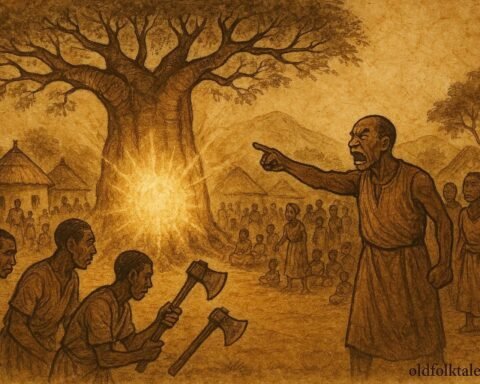
Njambo was furious. “So! You deceived me. You have released every beast.”
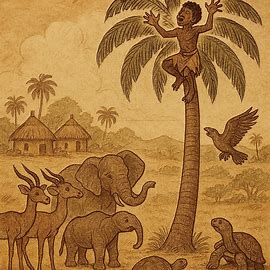
Determined to punish his son, Njambo commanded him, “Climb that coconut tree and bring me a nut.” As Utigebode climbed, Njambo used magic to make the tree grow taller and taller until his son was trapped at the top. From above, Utigebode cried, “Father! Help me down!” But Njambo replied coldly, “Call upon your friends, the beasts and birds you saved. Let them rescue you, for I will not.”
Desperate, Utigebode called to Eagle, “Yungu! Save me!” But Eagle said, “You are too heavy for me to carry.” He called to the animals below, but they answered, “We cannot climb, nor can we fly. We cannot help you.”
For two weeks, Utigebode remained at the top, surviving only on coconuts. Weak and abandoned, he eventually died, and his body fell lifeless to the ground. Njambo looked upon his dead son and said bitterly, “You have perished because of disobedience. You spared the beasts, but they could not save you.”
Njambo and his wife lived one more year, but with no children left to care for them, they too died. People from neighboring villages came to bury them, remembering the tragic tale of Utigebode, the one who saved others but could not save himself.
Moral Lesson
This tale teaches that compassion, while noble, must be balanced with responsibility and obedience. Utigebode’s mercy earned him respect among animals but drew the wrath of his father, leaving him unprotected when he needed help most. It reminds us that kindness should be guided by wisdom and that disobedience to rightful authority can lead to downfall, even when done with good intentions.
Knowledge Check
Who was Utigebode, and what does his name mean?
Utigebode was Njambo’s son, and his name means One-Who-Saves-People.
Why did Utigebode release the animals he trapped?
Because they reminded him of his name and mission to save, not kill.
How did Njambo test whether his son was sparing animals?
By following the prophet’s advice and staging a trap with a gazelle.
What punishment did Njambo give Utigebode?
He trapped him atop a magically growing coconut tree.
Why could neither the beasts nor the eagle save Utigebode?
The animals lacked wings or strength, and the eagle could not carry his weight.
What lesson does the story emphasize?
Balance between compassion, responsibility, and obedience to authority.
Source: Equatorial Guinean Folktale