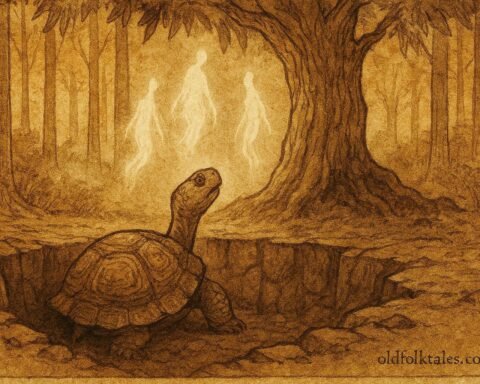
Long ago, in a time when animals lived together as neighbors in one village, peace lasted only briefly. Among them were Mbwa the Dog, Mbala the Squirrel, and Kudu the Tortoise, each with families and households of their own. For two weeks, harmony reigned, with all eating the same food and sharing the same fires. But soon, restlessness stirred in the hearts of Dog and Squirrel. They longed for their own spaces, for places where they could rule their homes without interference. And so, division crept into the village.
Squirrel and Dog spoke with Tortoise one morning. “Kudu,” they said, “let us separate. You and the others may remain here if you wish, but we will each go and live apart.”
Tortoise agreed, though with sadness, and so the companions parted. Squirrel moved three miles north to build his hamlet. Dog traveled three miles south and established his own. Tortoise stayed behind, watching his friends drift further from one another.
Not long after settling, Squirrel said to his wife, “I will visit my friend Mbwa.” Together with one of his wives, he set out on the path. After walking for hours, he arrived at Dog’s home. Dog, pleased to see his friend, greeted him warmly. He played with him and, in honor of the visit, killed a fowl for their dinner.
The wives prepared the meal inside the house while Dog and Squirrel sat in the ikenga, the reception room where friends gathered to talk. They laughed and reminisced, the bonds of friendship softening the sting of separation. After a while, Dog excused himself. “Let me see about the food,” he said, slipping into the kitchen. But instead of helping, he lay down beside the fire, soaking in its warmth.
READ THIS: The Quarrel of Squirrel and Adder: An Equatorial Guinean Folktale on Friendship, Pride, and Betrayal
Only when the food was ready did Dog return. The wives set the table, and the four sat to eat, Dog and his wife, Squirrel and his wife. Between bites, Squirrel asked curiously, “My friend, when you left me earlier, where did you go?”
Dog laughed sheepishly. “Ah, you know me. I love fire. While we talked, I grew cold. So, I went to warm myself.”
Squirrel shook his head. “You love fire too much, my friend. One day, it will be the death of you.”
After eating, Squirrel returned home with his wife. To his family he reported all that he had seen, adding with concern, “My friend Mbwa is enslaved by fire. I fear it will destroy him.”
Two days later, true to his word, Dog set out to visit Squirrel. Squirrel, delighted, slaughtered a fowl for his guest. Again the wives cooked while the friends sat in the ikenga exchanging news. Then Squirrel excused himself. “I shall return soon,” he said, and left for his garden.
There, he climbed a tall banana tree and feasted greedily on the ripe fruit at the top of the bunch. When satisfied, he descended and prepared the table. Soon the meal was served: Dog, his wife, Squirrel, and Squirrel’s wife sat together.
During the meal, Dog asked, “My friend, when you left me, where did you go?”
Squirrel answered proudly, “Ah, you know I love bananas. I was up the tree eating the fruit.”
Dog frowned. “You love bananas too much. One day, they will be the death of you.”
When the meal was done, Dog returned to his hamlet. But only two days passed before tragedy struck. While warming himself near the fire, he stumbled into the flames. His fur caught alight, and before anyone could save him, he perished. Word spread swiftly: “Mbwa is dead by fire.”
When Squirrel heard, he sighed, “I knew it. He loved fire too much.”
Not long after, fate came for Squirrel. In the village of Man, a farmer noticed that his bananas were being eaten high at the top of his tree. Suspecting an animal thief, he set a snare among the stalks.
The next day, Squirrel, driven by his craving, muttered to himself, “Wherever I find bananas, I must eat.” He climbed the banana tree in Man’s garden and was caught in the snare. He struggled, but the trap held fast. By the time the farmer returned, Squirrel was dead. The man laughed coldly, “Good! My fruit is safe again.”
News traveled quickly back to Squirrel’s family: “Your father has died at the banana tree.”
His children answered sorrowfully, “It is true. He warned Mbwa that love of fire would destroy him. Yet he too was consumed by his own desire. For our father loved bananas too much.”
Moral Lesson
This tale reminds us that unchecked desire leads to ruin. Dog’s obsession with fire and Squirrel’s craving for bananas blinded them to danger, even when they saw the truth in each other. It is easy to warn others, but harder to master oneself.
The story teaches moderation: love and enjoy, but never be consumed. For what we cling to most tightly can be the very thing that destroys us.
Knowledge Check
Who were the three main animal characters in the story?
Mbwa the Dog, Mbala the Squirrel, and Kudu the Tortoise.
Why did Dog and Squirrel leave the original village?
They wanted peace and independence by living in separate hamlets.
What was Dog’s fatal weakness in the tale?
His excessive love of fire, which eventually led to his death.
What habit caused Squirrel’s downfall?
His uncontrollable craving for bananas, which trapped and killed him.
What lesson does the tale emphasize about desire?
That unchecked or excessive desire ultimately leads to destruction.
Where does this folktale originate?
It is an Equatorial Guinean folktale.
Source: Equatorial Guinean folktale