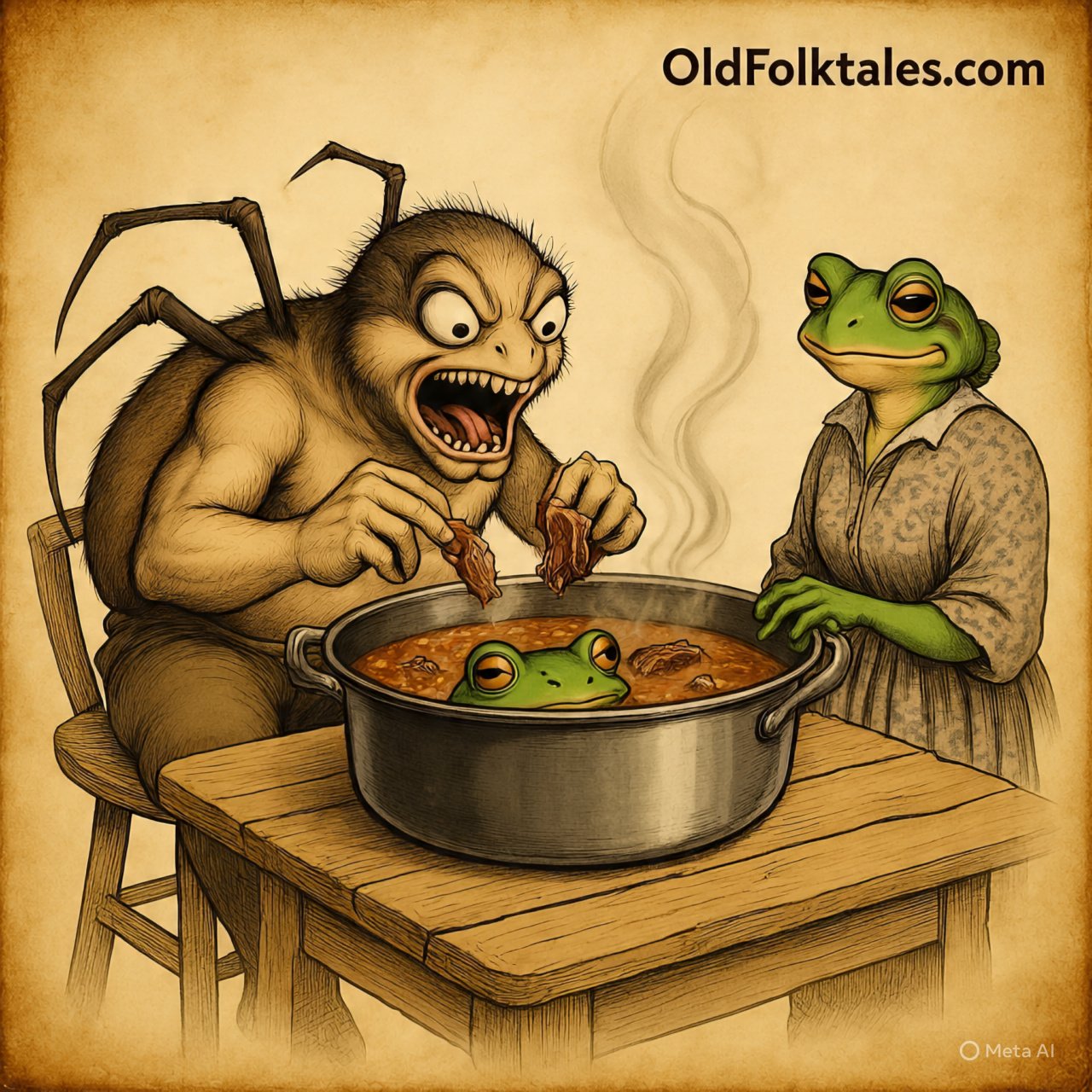
In the heart of West African folklore, where stories are passed around the fire at night, there is a tale about Spider and Frog. These two were once the closest of friends, always walking together, hunting together, and eating together. Yet, Spider had a terrible flaw: his greed. Even though Frog treated him as a brother, Spider would never share food fairly. Each time they cooked meat or fish, Spider would sneak out the best parts for himself before serving Frog. The lesson of this tale still speaks today, teaching us what greed can do to friendship.
The Friendship Tested
For many moons, Frog endured Spider’s selfish ways. Frog was generous and just, always dividing meals with care, making sure Spider received his fair portion. But Spider, blinded by greed, thought only of himself. He grew fat and satisfied while Frog went hungry. Frog’s kindness was met with betrayal, and his patience began to wear thin.
At last, Frog decided that the only way to cure Spider of his greed was to teach him a lesson he would never forget. Frog thought deeply, and soon he formed a plan. He told his wife to cook a special meal, but he instructed her not to season it with too much salt or pepper. The pot was set on the fire, and the aroma of the stew filled the compound.
The Trick is Set
By evening, the food was ready. Frog sat with his wife and pretended to remember something. “Ah,” he said, “I left my hunting knife at the farm. If Spider comes, give him the food. Do not wait for me.” With that, Frog slipped away, but instead of going to the farm, he jumped secretly into the steaming stew and hid at the bottom of the pot.
Not long after, Spider arrived, smiling as always but with hunger burning in his belly. Frog’s wife welcomed him warmly and served the stew, just as her husband had instructed. Spider wasted no time. With greedy hands, he scooped out every piece of meat, swallowing each bite quickly. He thought he had outsmarted his friend again. But in his greed, Spider swallowed not only the meat but also Frog, hidden inside the stew.
The Greed Exposed
When Spider had finished, he wiped his mouth and prepared to leave. But before he could take a step, a strange sound came from deep within him. “Greedeep! Greedeep!” The noise startled him. He pressed his stomach, but the sound grew louder. “Greedeep! Greedcep!” it cried. Terrified, Spider began to run, hoping to shake the voice loose.
No matter how fast he ran, the voice followed him. At night, the sound echoed in his belly, keeping him from sleep. By day, it made him lose his appetite. For forty days, Spider lived in torment, the voice of greed haunting him. He grew thin and weak, wishing only for peace.
At last, Frog sprang out from Spider’s mouth, alive and unharmed. Standing tall, he said, “I have known of your greedy ways for long, my friend. You have taken what was not yours, time and again. Let this be your lesson. Greed destroys even the strongest of friendships.”
The Lesson of the Story
From that day on, Spider never forgot the sound of “Greedeep! Greedeep!” echoing in his stomach. The people say that his children and grandchildren carry the same greedy streak, but the memory of Frog’s trick still lingers as a warning. This folktale reminds us that when invited to share a meal, we must let the one who provides it serve fairly. If greed rules us, it will consume us in the end.
Moral of the Story
The moral of this West African folktale is simple: Greed destroys trust, friendship, and peace. To live in harmony with others, one must learn fairness and respect. A greedy heart will always end up empty.
Knowledge Check
1. What is the main lesson of the West African folktale “What Spider Learned from Frog”?
The folktale teaches that greed leads to suffering and can destroy friendships.
2. How did Frog trick Spider into revealing his greed?
Frog hid inside the stew, knowing Spider would greedily eat all the meat without sharing.
3. Why did Spider suffer for forty days in the story?
Because Frog’s voice echoed inside him, reminding him of his greed until he could bear it no more.
4. What does the sound “Greedeep! Greedcep!” symbolize in the folktale?
It symbolizes the haunting consequences of greed and the guilt it brings.
5. How does this folktale reflect traditional African values?
It emphasizes fairness, communal sharing, and the dangers of selfishness.
6. What can modern readers learn from this story about greed?
Modern readers can learn that selfishness in relationships whether in friendships, family, or business can destroy trust and lead to ruin.
Cultural Origin
This story comes from West African oral tradition, where Spider often appears as a trickster figure and Frog represents wisdom, patience, and fairness.