“Yes, my baasjes,” Outa Karel began, his ancient voice rich with meaning, “so was Oom Jakhals he always pretended to forget all about what he had done, and he acted as if he thought all the others forgot too, quick-quick. He is maar so schelm so very crafty.”
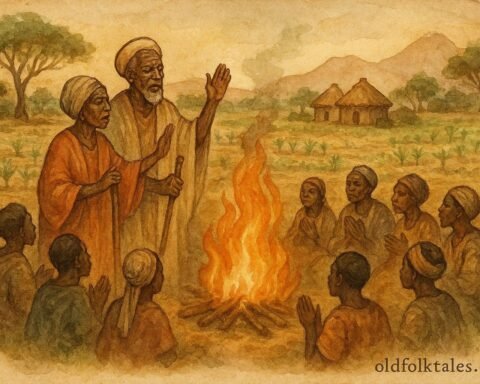
The old Bushman storyteller paused dramatically, taking full advantage of the pinch of snuff he held delicately between his right forefinger and thumb. He sneezed with evident pleasure two or three times, his whole face crinkling with satisfaction, before continuing his tale.
“When Jakhals thought Hyena was quite well again after their last adventure, he went to visit her in the veld. Now, you must understand that Jakhals was always thinking, always scheming, always planning his next trick.
Love this story? Discover our full Southern African folktales collection
“‘It’s very dull here in the veld,’ he said to her with a great sigh, as if life had become unbearably tedious. ‘And food is so scarce these days a fellow can hardly find enough to fill his belly. So I’m going to hire myself out to a farmer. He’ll give me lots to eat and drink, and when I’m nice and fat, I’ll come home again. Would you like to go too, Brown Sister?’
“Hyena’s ears perked up immediately. She smacked her lips when she heard about all the nice things to eat. The very thought of regular meals made her mouth water. She thought it was a very good plan indeed perhaps the best plan Jakhals had ever suggested. So together they set off to find work on a farm, and Jakhals talked so sweetly and convincingly that the farmer hired them both on the spot.
“Ach! my baasjes, it was a beautiful place everything a hungry creature could dream of! There were plump chickens scratching in the yard and little ducks waddling near the dam. There were Afrikander sheep with large, fat tails that could be rendered down for soap and candles. There were eggs in the hen house, and doves and pigeons cooing in the rafters all things that made Jakhals’s mouth water. He just felt in his very stomach that he was going to have a jolly life indeed.
“During the day, while pretending to work diligently, Jakhals peeped all about in this corner, in that corner his clever eyes missing nothing. He discovered where the farmer kept the precious rendered fat from the sheep’s tails, stored carefully in the cool darkness. His mind began working immediately, spinning a web of deceit as intricate as a spider’s.
“In the middle of the night, when all the people were fast asleep and the farm lay silent under the stars, Jakhals rose from his sleeping place. He moved quietly, my baasjes, quietly like a shadow gliding across the ground, making not even the whisper of a sound. He crept to the place where the fat was stored and helped himself to a generous lump.
“But here was where his true cunning showed itself. Instead of simply eating the fat and risking discovery, he carried it carefully to where Brown Sister lay sleeping, trusting and innocent. While she snored softly, dreaming perhaps of the good meals to come, Jakhals smeared the stolen fat all over her tail, working it into the fur until her tail was thick and sticky with the evidence of theft.
“Only then did he return to the fat storage and eat all that remained, n-yum, n-yum, n-yum, licking his chops with satisfaction. When his belly was pleasantly full, he crept quietly to the wagon-house and settled down to sleep, a picture of perfect innocence.
“Early the next morning, when the farmer went out to begin his day’s work and tend to the cows, he discovered that the fat was missing. His face grew red with anger.
“‘Lieve land! Where is all my fat?’ he exclaimed. ‘It must be that vagabond Jakhals I hired yesterday. But wait, I’ll get him! I’ll teach him not to steal from me!’
“He grabbed a thick leather riem and his sjambok, that fearsome whip and stormed toward the wagon-house, fully intending to catch Jakhals and give him the beating of his life. But when he confronted Jakhals and demanded to know about the missing fat, the crafty creature spoke in the tiniest, most innocent voice imaginable.
“‘Ach no, Baas! Would I then do such an ugly, terrible thing? Look at me, I am an honest worker! And look at my tail, Baas.’ He turned around smartly. ‘There’s no fat on it at all. The one whose tail is full of fat, that’s the thief you’re looking for.’
“He waved his clean, fluffy tail right in the farmer’s face, and anyone could easily see that there wasn’t a speck of fat on it. His fur was perfectly clean and innocent.
“‘But the fat is gone,’ insisted the farmer, his anger not diminished. ‘Someone must have stolen it.’ And he went on hunting, searching every corner of the wagon-house, determined to find the culprit.
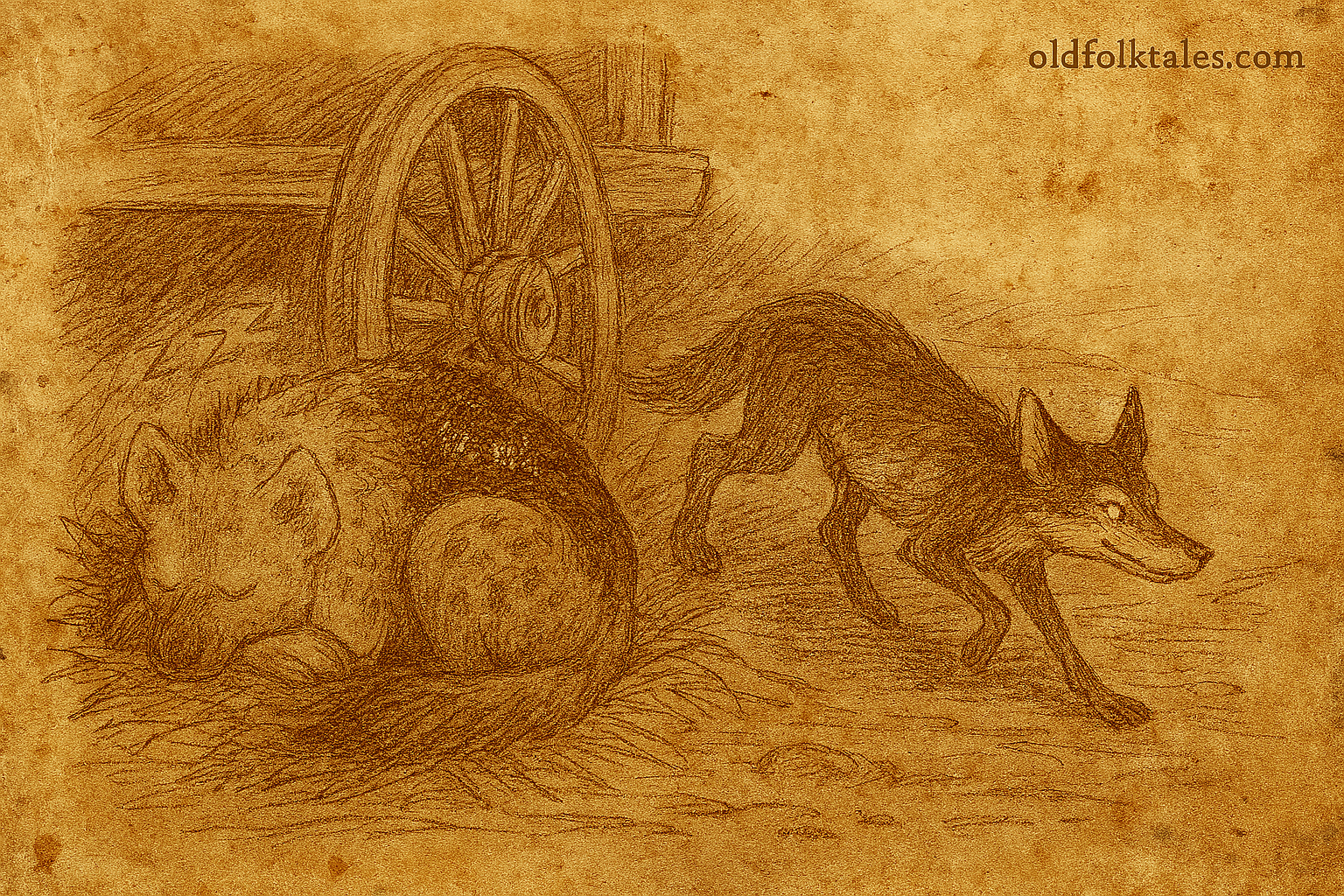
“At last he came to where Hyena was sleeping, curled up just like a baby, baasjes so peacefully, so innocently. She was snoring softly: not the loud snoring like sawing planks, gorr-korrr, gorr-korr but the gentle, rhythmic snoring that people make when they sleep very deeply see-uw, see-uw. It is the deepest sleep of all when a person snores see-uw, see-uw, the sleep of the completely innocent. Her head rested comfortably on some chaff, and her tail stuck out behind her, stiff and matted with damning evidence fat!
“‘Aha! Here is the thief!’ declared the farmer triumphantly, and he immediately began tying the riem around her.
“Old Brown Sister sat up suddenly, rubbing her eyes in confusion. ‘What’s the matter?’ she asked groggily. ‘I was having such a beautiful dream. I dreamt I was eating fat the whole night, and’
“‘And so, you were MY fat!’ interrupted the farmer furiously, pulling the rope tighter around her. ‘And now I’m going to teach you never to steal again!’
“Poor old Brown Sister’s confusion turned to panic when she realized what was happening. She jumped about desperately, trying to understand how this could be. She ran round and round the wagon-house, frantically seeking escape. She called out again and again that she knew nothing about the fat, that she had never tasted it, had never even seen it! But her protests fell on deaf ears.
“‘Look at your tail!’ shouted the farmer. ‘Will you tell me that your tail went by itself and rubbed itself in my fat? Do you take me for a fool?’
“So he tied her firmly to the wagon wheel and beat her mercilessly, ach! she was quite sore, covered in welts and bruises. She screamed and screamed in pain and confusion, and at last, battered and broken, he drove her away from the farm with harsh words and threatened worse if she ever returned.
“Poor old Brown Sister! She didn’t even have the fat from her tail to eat as compensation for her suffering, because, baasjes see, with all the running around and the terrible beating, every bit of it had been rubbed off onto the ground. But she learned her lesson though it was a lesson she never deserved. She never went to live on a farm again; the wild veld was quite good enough for her, where at least the injustices were honest ones.”
“Is that the end, Outa?” asked Willem, his voice troubled.
“Yes, my baasje. It’s a bad end, but Outa can’t help it. The story does maar end so that’s just how it ends.”
“And where was Jakhals all the time this was happening?” enquired Pietie severely, his young sense of justice offended.
Outa’s eyes twinkled wickedly, and he demonstrated with exaggerated piety: “Jakhals, my baasje, was sitting on top of the wagon saying his prayers so, my baasjes.” He pressed his crooked, claw-like hands together and cast his eyes upward until only the yellows showed, the picture of false devotion.
“‘Bezie, bezie, brame, Hou jouw handjes same,'” he chanted in a mockingly pious voice. “In English: ‘Berry, berry, blackberry, hold your hands together.’
“And every time poor Hyena screamed in pain and confusion, Jakhals begged her loudly so everyone could hear not to steal again, but to try and behave like a good Christian. Can you imagine, my baasjes? While she suffered for his crime, he played the part of the righteous one!”
“But Jakhals was the thief!” protested little Jan indignantly, his small face flushed with anger at the injustice. “He was always the wicked one, and he was never punished. How was that, Outa? How is that fair?”
A whimsical, knowing smile played over the old man’s wrinkled face. Though his eyes danced as wickedly as ever, glittering like dark beads in the firelight, his voice became surprisingly sober and philosophical as he answered.
“Ach! my little master, how can Outa tell? It is maar so in this old world that’s just how things are sometimes. Life is like that funny thing Baas Willem saw when he visited the Kaap Cape Town. You know, that contraption that runs down one side so quickly that it just runs up on the other side, and then it can’t stop, but it has to run down again, and so it keeps going up and down, up and down, never resting.”
“You mean the switchback railway?” asked Willem, understanding dawning.
“Ach, yes! baasje, that’s what Outa means. And in this world it is the same up and down, up and down, like that machine. Often the good ones are down at the bottom while the bad ones are up at the top, laughing and enjoying themselves. But the thing, Outa can’t quite get the name right, it goes on, and it goes on, never stopping. And by-and-by, if you wait long enough, the good ones are up and the bad ones are down. The wheel turns, baasjes. It always turns.”
“But Jakhals seemed always to be up,” Willem remarked thoughtfully, still troubled by the unfairness of it all.
“Yes, my baasje,” said the old man, his voice dropping to something almost melancholy. “Jakhals seemed always to be up. It goes so sometimes, it goes so.” But his eyes suddenly took on a far-away look, as if he were seeing beyond the story, beyond the firelit room, into memories and experiences of his own long life. One could not be certain that he was still thinking only of Jakhals the trickster.
Moral Lesson
This tale illustrates the bitter reality that life is not always fair, and the cunning often prosper while the innocent suffers. However, Outa Karel’s wisdom offers hope through the metaphor of the switchback justice may be delayed, but the wheel of fortune continues to turn. The story also warns against trusting too easily and reminds us that appearances can be deceiving. While we cannot always control the injustices we face, we can choose to maintain our integrity and learn from our experiences, as Hyena did by returning to her honest life in the veld.
Knowledge Check
Q1: Who is Jakhals in South African folktales and what role does he play? A: Jakhals (Jackal) is the quintessential trickster character in South African Bushman folktales. He represents cunning, deception, and self-serving cleverness. Like trickster figures in many cultures, Jakhals uses his intelligence to manipulate others for his own benefit, often escaping punishment through elaborate schemes and false piety.
Q2: Why did Jakhals smear fat on Hyena’s tail instead of simply eating it all? A: Jakhals smeared the fat on Hyena’s tail to frame her for the theft he committed. This demonstrates his cunning nature, he not only wanted to enjoy the stolen fat but also needed to deflect suspicion from himself. By creating false evidence against the innocent Hyena, he ensured his own safety while securing his position on the farm.
Q3: What is the significance of Jakhals praying while Hyena was being beaten? A: Jakhals’s false prayers represent the ultimate hypocrisy and mockery of justice. By pretending to be pious and urging Hyena not to steal while she suffers for his crime, he adds insult to injury. This behavior highlights how the truly wicked often hide behind false righteousness, making the injustice even more bitter.
Q4: What does the “switchback” metaphor represent in this folktale? A: The switchback (a type of roller coaster or railway) serves as Outa Karel’s metaphor for the cyclical nature of justice and fortune in life. Just as the switchback goes up and down continuously, fortunes change sometimes the wicked prosper while the good suffer, but eventually the cycle reverses. This offers hope that justice, though delayed, will ultimately prevail.
Q5: What cultural values does this Bushman folktale reflect? A: This tale reflects the Bushman people’s realistic understanding of life’s injustices, particularly relevant to their own history of displacement and oppression. Rather than offering false comfort, it acknowledges that cunning often triumphs over innocence in the short term, while maintaining hope in eventual justice. It teaches wariness, resilience, and the importance of learning from hardship.
Q6: Why does Outa Karel seem melancholy when discussing how “Jakhals seemed always to be up”? A: Outa Karel’s far-away look and sober tone suggest he’s drawing from personal experience and his people’s history. As a Bushman who witnessed his race’s displacement and suffering at the hands of more powerful groups, he understands intimately how the innocent can suffer while the cunning prospers. His melancholy reflects the painful reality that justice doesn’t always come within one’s lifetime.
Cultural Origin: South African Bushman (San) folktale from the Great Karroo region, collected by Sanni Metelerkamp.