In the heart of the vast West African forest, where ancient trees whispered secrets to the wind and every creature had a story to tell, there lived two unlikely friends whose bond would teach generations about the delicate balance of friendship and justice. Have you ever heard the wise saying that Antelope despises the person who accidentally reveals her hiding place even more than the hunter who eventually captures her? This truth would ring especially clear to one of our protagonists, Nkierr-the-Monkey, whose friendship with Nyo-the-Bee began in the most unexpected way.
Their friendship had humble beginnings, born from an incident that could have easily sparked lifelong resentment instead of lasting companionship. On a particularly warm afternoon, when the sun hung heavy in the sky and the forest hummed with drowsy contentment, Bee had settled into a peaceful slumber among the flowering branches. The air was sweet with nectar, and his tiny body buzzed with satisfaction from a morning of productive work.
Meanwhile, Monkey’s playful children were enjoying their favorite pastime, swinging gracefully from branch to branch with the carefree joy that only the young possess. Their laughter echoed through the canopy as they performed acrobatic feats that would have impressed even their elders. But in their innocent enthusiasm, they inadvertently disturbed the sleeping Bee’s tranquil rest.
Also read: Monkey Outsmarts Leopard
Bee, startled from his dreams and still groggy with sleep, reacted with the instinctive defense of his kind. Without fully understanding what had awakened him, he delivered a sharp sting to whoever had disrupted his peaceful afternoon slumber. Poor Little Monkey’s face immediately began to swell like a ripe fruit, ballooning with pain and inflammation.
The moment Bee’s drowsiness cleared and he saw what his defensive reaction had caused, deep remorse flooded his tiny heart. The sight of the innocent child’s suffering moved him profoundly. Rather than fleeing in embarrassment or making excuses, Bee chose to stay and make amends through action rather than words.
For three long nights, Bee remained vigilantly by the whimpering child’s side, joining Monkey in providing comfort and care. Together, they applied cooling leaves to reduce the swelling, brought water to soothe the pain, and took turns watching over the little one as he slowly recovered. Those three nights of shared concern and mutual dedication cemented what would become a deep and lasting friendship between two very different creatures.
This was why, seasons later, the two friends were often seen together, their bond having grown stronger through shared experiences and mutual respect. They complemented each other perfectly, Monkey with her playful intelligence and quick wit, and Bee with his industrious nature and fierce loyalty.
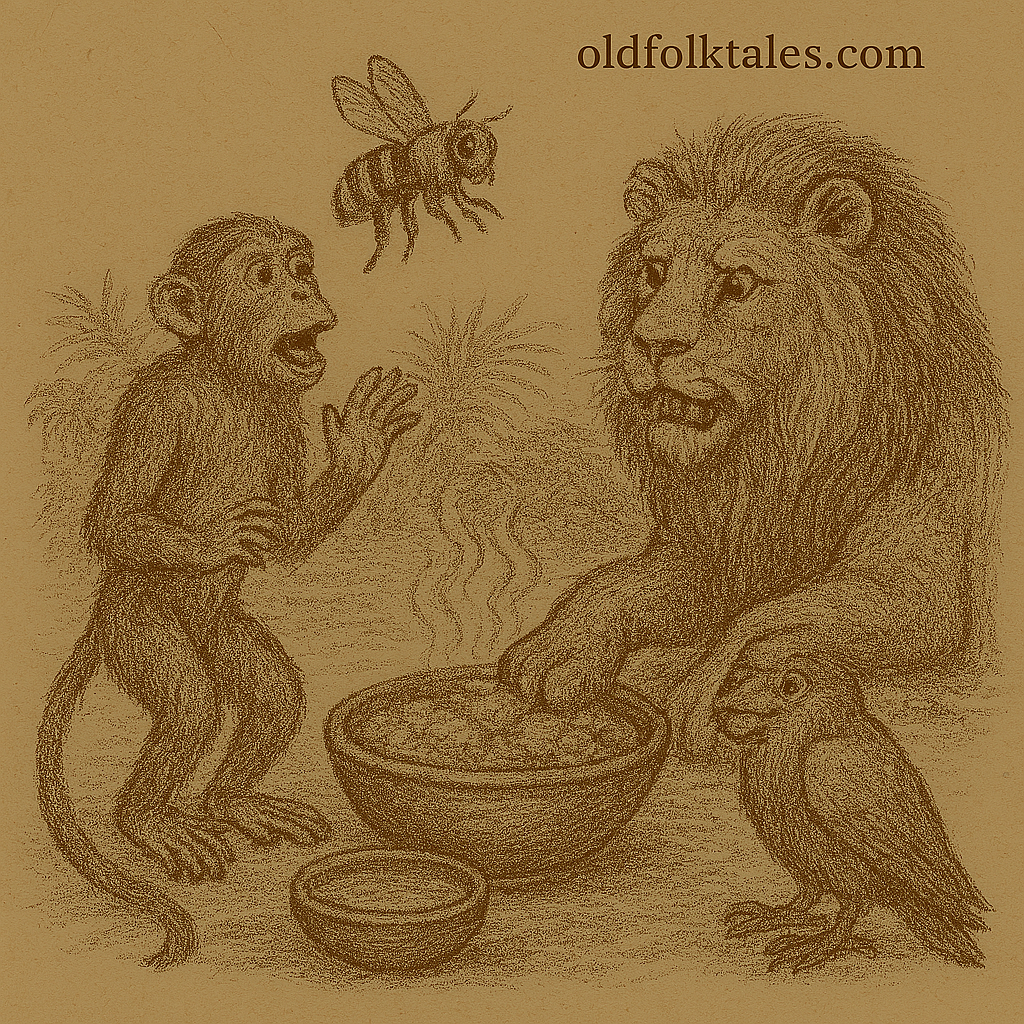
On this particular day, their friendship would face its first serious test. Together, they decided to visit Takro-the-Lion, the mighty ruler of their forest domain. Lion, known for his generous hospitality and regal bearing, welcomed them warmly into his magnificent den. The walls were adorned with the trophies of his adventures, and the air carried the rich aroma of a feast prepared with royal care.
Lion, following the ancient customs of hospitality that had been passed down through countless generations, offered his guests some of his finest food. The moment Bee tasted the magnificent egusi soup, his senses were overwhelmed with pure delight. Never in his extensive travels through the forest had he encountered such culinary perfection.
The ground pumpkin seeds had been blended with exactly the right proportion of njama njama those tender green leaves that added such distinctive flavor and seasoned with yellow peppers, which Bee had always preferred over their red counterparts for their subtle heat and complex taste. The pounded cassava was so expertly prepared that it was impossibly smooth, without even the tiniest lump to disturb its perfect texture.
“Ancestors forbid!” Bee thought to himself as waves of pleasure washed over his palate. This food was so extraordinarily delicious that a selfish desire began to grow in his heart. He wanted it all for himself, every morsel of this divine creation.
Acting on this greedy impulse, Bee turned to his dear friend with what he hoped sounded like reasonable concern. “Monkey, my friend,” he said with false politeness, “perhaps you should wash your hands before we eat from the same bowl together.”
Monkey was completely taken aback by this unexpected request. In all their years of friendship, through countless shared meals and adventures, Bee had never made such a demand. Why now? What had changed between them? Despite her confusion and growing hurt, she decided to respect her friend’s wishes and their gracious host.
She poured clean water into a nearby dish and began washing her hands carefully. Once, twice, three times she scrubbed, but her hands remained as naturally dark as they had always been. This was simply her God-given appearance, as natural and unchangeable as Bee’s yellow and black stripes or Lion’s golden mane.
But Bee, consumed by his selfish desire for the delicious food, would not relent in his unreasonable demands. “Only death likes to eat with dirty hands,” he grumbled with cruel mockery, and continued eating without offering Monkey even the smallest portion.
The more Monkey tried to clean what was already clean, the more frustrated and humiliated she became. Her best friend was ridiculing her very nature, rejecting her for something she could never change. The pain in her heart grew with each passing moment until it became unbearable. Feeling like a person who had successfully crossed a mighty river only to drown in a small spring, she departed in sullen bitterness, leaving Bee to enjoy his selfish feast alone.
Time, as it always does, continued its eternal dance through the seasons. Our people are wise when they say that life dances to the beat of the changing times, in the midst of one season, we often forget about others until they are suddenly upon us. And so it was that the two friends, despite their unresolved hurt, continued their separate lives in the great forest.
Seasons turned, and gradually the acute pain of their quarrel faded into a dull ache of lost friendship. Eventually, seeking to break the monotony of their estrangement and perhaps hoping to recapture some of their former joy, Monkey suggested they pay a visit to Ndafo-the-Tiger, another respected member of their forest community.
Tiger, who had not seen either of them since the last nwa ngeh, the sacred annual communal cleansing ritual that brought all forest creatures together in spiritual renewal was genuinely delighted by their visit. They arrived just as evening shadows began to lengthen and Tiger was putting the finishing touches on a pot of his famous achu, a traditional dish that filled his den with the most appetizing aromas.
Following the ancient customs that their ancestors had observed for countless generations, and which would continue to be passed down to future generations, Tiger graciously offered his guests some of his freshly prepared food along with sweet palm wine that had been aged to perfection.
But they had barely begun to taste the delicious meal when Monkey seized her opportunity for justice. “Bee, my friend,” she exclaimed with deliberate sharpness, “you are making far too much noise! How can we possibly enjoy our meal with such a terrible ruckus filling the air?”
Bee had not even had a chance to taste the wonderful achu soup when these words struck him like lightning. “I simply cannot eat through this unbearable noise,” Monkey continued relentlessly. “If you don’t stop making that awful racket immediately, you won’t be allowed to touch even a single drop of this delicious soup.”
To emphasize her point, she deliberately swallowed a large lump of the perfectly prepared achu, removed a choice piece of tender dry meat, and stuffed her mouth with obvious satisfaction. Bee watched in growing distress as she chewed with apparent bliss, knowing that every morsel she consumed meant less for him.
In desperation, Bee flew frantically in and out of Tiger’s house, making every conceivable effort to move silently through the air. But the harder he tried to be quiet, the louder his natural buzzing seemed to become. How could a bee possibly be silent when buzzing was the most essential aspect of his very being? It was the sound of the drum his heart lived to beat, as natural and necessary as breathing itself.
The impossibility of his situation filled Bee with rage and frustration. He screamed at Monkey, feeling exactly like the owner of a prized he-goat who had just been impaled by his own animal’s horn. But Monkey continued eating without saying another word, savoring every bite while Bee grew more desperate and defeated with each passing moment.
Finally, overwhelmed by the cruel justice of his situation and recognizing the perfect mirror of his own past behavior, Bee felt his anger transform into genuine remorse. He apologized sincerely to his friend, promising with heartfelt conviction never again to mock or reject another creature for their unchangeable nature.
Only after Monkey had finished her entire meal did she graciously inform Bee that he was forgiven. From that day forward, it is said that Bee has kept a watchful eye on the forest, punishing with swift stinging justice those who make the same mistake he had made with his dear friend. Their families lived together in harmony and mutual respect, their friendship stronger than ever, built now on the foundation of true understanding and shared experience of both giving and receiving forgiveness.
The Moral Lesson
This profound tale teaches us that friendship requires mutual respect and acceptance of each other’s natural differences. When we judge or exclude others based on unchangeable characteristics, we poison the bonds that connect us. True friendship means embracing diversity and treating others with the same kindness and acceptance we hope to receive. The story also demonstrates that justice often comes full circle, those who act selfishly or discriminatorily may find themselves experiencing the same treatment they once gave others.
Knowledge Check
Q1: Who are the main characters in this West African friendship tale? A1: The main characters are Nkierr-the-Monkey and Nyo-the-Bee, two unlikely friends whose bond began when Bee accidentally stung Monkey’s child and then stayed three nights to help nurse the little one back to health, cementing their friendship through shared care and compassion.
Q2: How did Monkey and Bee’s friendship originally begin in the story? A2: Their friendship started after Bee accidentally stung Little Monkey when the child’s swinging inadvertently woke him from his nap. Feeling remorse, Bee stayed for three nights to help Monkey care for the injured child, and this shared experience of nursing the little one created the foundation of their lasting friendship.
Q3: What cultural foods are mentioned in the story and what do they represent? A3: The story mentions egusi soup (made with ground pumpkin seeds, njama njama leaves, and peppers), pounded cassava, achu soup, and palm wine. These traditional West African dishes represent hospitality, cultural identity, and the sacred act of sharing meals that builds community bonds and friendships.
Q4: What lesson does Bee learn when Monkey refuses to let him eat at Tiger’s house? A4: Bee learns that discriminating against someone for their natural, unchangeable characteristics is wrong and hurtful. When Monkey prevents him from eating because of his natural buzzing sound (just as he had prevented her from eating because of her natural hand color), he experiences the pain of being rejected for his essential nature.
Q5: What is the significance of the nwa ngeh ritual mentioned in the story? A5: The nwa ngeh is described as the annual communal cleansing ritual that brings forest creatures together for spiritual renewal. It represents the West African cultural tradition of community purification ceremonies and collective spiritual practices that maintain social harmony and connections.
Q6: How does this folktale demonstrate the concept of justice and karma? A6: The story shows perfect poetic justice, Bee’s discriminatory behavior toward Monkey is mirrored back to him when Monkey treats him the same way. This demonstrates the African philosophical concept that our actions return to us, and that experiencing injustice ourselves helps us understand why we should treat others fairly.