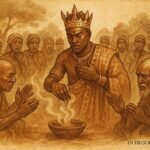
Long ago, in the forests of Equatorial Guinea, there lived a proud goat named Tomba-Ya-Taba and his mother. Goat often boasted to her of the magic-medicine he possessed, an enchanted strength that no creature could overcome. “There is no one who can cast me down,” he declared confidently. “I can defeat any challenger.” His words carried far, echoing into the ears of the other beasts of the land, stirring both curiosity and resentment.
Soon, the challengers arrived. First came the house-rats, hundreds of them, swarming into Goat’s village. They wrestled him one by one, two hundred in all, yet Goat defeated every single one. Defeated and humiliated, the rats slunk back to their holes. Not long after, the forest-rats, wilder and stronger, emerged, but they too were cast down by Goat’s relentless might.
Then the Antelopes came, leaping with grace, their horns gleaming. They wrestled bravely, but Goat overcame each of them. Next, the Elephants arrived, shaking the ground beneath their heavy steps. Even these giants, with their trunks and tusks, could not prevail. Goat cast them down as easily as the rest. One after another, every beast of the forest challenged him, and one after another they returned home defeated.
At last, only Leopard, Nja, remained. Proud and fierce, Leopard believed he would succeed where others had failed. He confronted Goat, but even Leopard was thrown down in shame. With every beast humbled, Goat’s claim seemed proven: no creature could overcome him.
But Leopard’s pride was wounded. The Father of All Leopards burned with anger. “I am ashamed that this beast should overcome me,” he vowed. “I will kill him.” He plotted his revenge, not in fair contest, but in ambush.
READ THIS: Igwana’s Forked Tongue: An Equatorial Guinean Folktale of Betrayal and Survival
Leopard went to the spring where humans fetched water. There, he lay in wait, and when men came to drink, he struck, killing two. The people fled to Goat, warning him, “Leave this place, for Leopard is killing mankind on your account.” Goat’s mother, fearful, said, “Let us flee to your uncle, Vyadu the Antelope.”
They hurried to Antelope’s village, where Uncle welcomed them bravely. “Stay here,” he said firmly. “Let me see Leopard dare come with his anger.” For two days, Goat and his mother remained in safety. But on the third morning, Leopard appeared, strolling casually as if on a walk. Goat and his mother hid while Antelope confronted him. “Why are you angry with my nephew?” he demanded.
Leopard seized Antelope by the ear. “Show me where Tomba and his mother hide,” he threatened. Trembling, Antelope bargained for his life. “Come tonight,” he whispered. “I will show you where they sleep. Kill them, but spare me.” Goat overheard this betrayal and urged his mother to flee before sunset. That night, Leopard returned, but Goat and his mother were gone. Furious, Leopard killed Antelope instead.
Leopard pursued them relentlessly. He tracked them to Elephant’s village. Again, the same exchange occurred: Elephant defended them, Goat fled, and Leopard killed Elephant. Then to Ox’s village they ran. Again Leopard followed, and again, Goat and his mother escaped, while Ox was slain.
At last, Goat’s weary mother despaired. “My child,” she said sorrowfully, “if we continue to flee to other beasts, Leopard will follow, and they too will die. Let us go to the homes of Mankind.”
So they sought refuge in the town of Man. The people welcomed Goat and his mother, giving them shelter. When Leopard came prowling, the men warned him. “Those beasts you killed could not defeat you, but if you attack us, we will find a way.” Leopard returned to his forest, but his vengeance still burned.
The people devised a great trap with two chambers. They placed Goat in one, as bait. That night, Leopard crept into town. He sniffed the air and grinned. “So! Tonight I will kill him!” He slipped into what he thought was Goat’s hut, but it was the trap. The door snapped shut. Through the cracks, Leopard saw Goat and snarled, but could not reach him. Goat mocked, “My friend, you wished to kill me, but now you are caught.”
At daybreak, the townspeople came with machetes and guns. Leopard was slain at last. Man then spoke to Goat: “You shall never return to the forest. Remain with us always.”
And from that day, goats have lived beside mankind, safe from the Leopards they once feared.
Moral Lesson
This tale teaches that unchecked pride can draw envy and destruction. Goat’s boasting led Leopard to seek vengeance, but it was humility and the protection of mankind that saved him. It also reveals the importance of community, though Goat fled from beast to beast, only humans had the wisdom and skill to defeat his enemy. Thus, the bond between humans and goats was sealed not by strength, but by trust and protection.
Knowledge Check
Who was Tomba-Ya-Taba in the story?
Tomba-Ya-Taba was the Goat who claimed invincible wrestling strength.
Which animals did Goat defeat before Leopard challenged him?
He defeated Rats, Antelopes, Elephants, and many other beasts.
Why did Leopard attack humans at the spring?
To draw Goat into danger and punish him indirectly.
What role did Mankind play in the story?
Mankind sheltered Goat and built the trap that captured Leopard.
What is the main lesson of the folktale?
Pride invites conflict, but community and wisdom bring survival.
What is the cultural origin of this story?
It is an Equatorial Guinean folktale.
Source: Equatorial Guinean Folktale