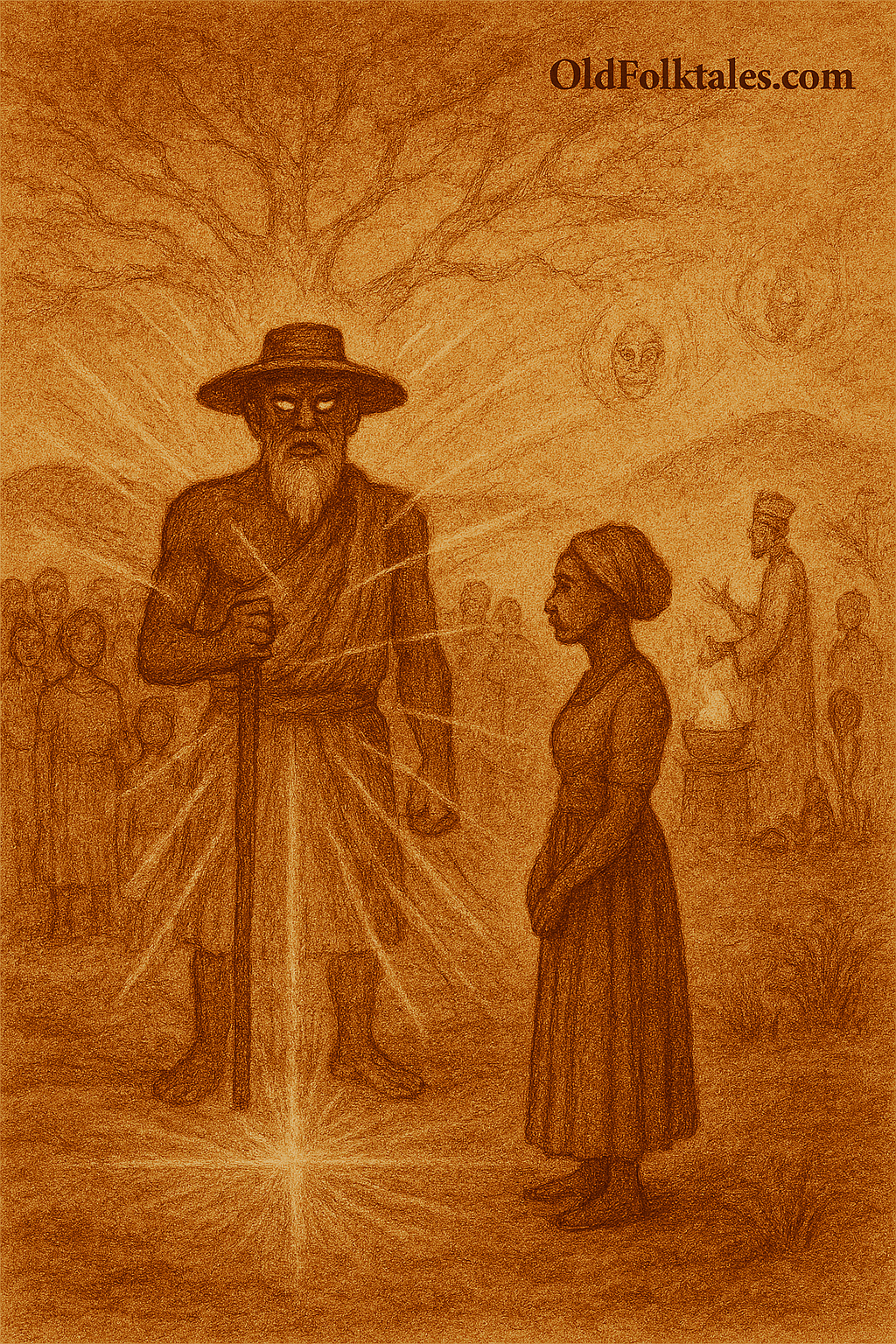
In the time when the spirits walked closely with mortals and the boundaries between the divine and earthly realms were thin as morning mist, there lived the great orisha Legba with his beloved wife, Nunde. Their home was a place where the crossroads of destiny met the paths of everyday life, for Legba was the guardian of all doorways and the messenger between worlds.
Nunde was a woman of striking beauty and fierce independence, but her heart harbored a secret longing. She had fallen deeply in love with Fa, the powerful diviner who held the sacred knowledge of fate and fortune. Fa was renowned throughout the land for his ability to peer into the mysteries of tomorrow and reveal the hidden threads that wove through human lives. His wisdom was sought by kings and commoners alike, and his presence commanded respect from all who encountered him.
The desire for children burned within Nunde’s heart like an unquenchable flame. Day after day, she watched other women cradle their babies, their faces glowing with maternal joy, while her own arms remained empty. The ache of longing grew stronger with each passing season, until she could bear the uncertainty no longer.
One fateful morning, after Fa had completed his sacred consultations with the oracle, Nunde made her way to his dwelling. The air was heavy with the scent of burning herbs and the lingering energy of divine revelation. Her footsteps were determined yet trembling as she approached the great diviner.
“O wise Fa,” she said, her voice barely above a whisper, “I come to you seeking the truth that only you can reveal. Grant me the knowledge of Fa so that I may know whether children will bless my womb.”
Fa’s eyes, deep and knowing, studied her carefully. The weight of countless destinies seemed to rest in his gaze as he considered her request. Finally, he spoke, his voice carrying the authority of one who communed with the very fabric of fate itself.
“The knowledge you seek shall be yours, Nunde,” he said slowly, each word measured and deliberate. “But such sacred wisdom comes with a price. You must spend time with me in private consultation, for only through this sacred ritual can the mysteries be revealed to you.”
Without hesitation, driven by her desperate desire to know her fate, Nunde agreed. In that moment of prophecy and divine revelation, she participated in the sacred ceremony with Fa, believing that this ritual would unlock the secrets of her future motherhood.
When the shadows grew long and Nunde returned to her home, Legba was waiting. His keen eyes, accustomed to reading the movements between worlds, immediately sensed that something had changed in his wife. The very air around her seemed different, charged with an energy that spoke of profound transformation.
“Where have you been, my wife?” Legba asked, his voice carrying the quiet intensity of one who already suspected the truth.
Nunde, unable to hide what had transpired, met his gaze directly. “I have been with Fa,” she replied, her words falling into the space between them like stones into still water.
Legba’s expression darkened like storm clouds gathering on the horizon. “Why did you go to perform this ritual with Fa?” he demanded, the hurt and anger evident in his voice.
The words that came from Nunde’s lips next would echo through eternity, changing the very nature of divine relationships forever. With cruel honesty, she spoke the thoughts that had long festered in her heart.
“You have no spiritual strength, husband,” she declared, her voice cutting through the air like a blade. “Your divine power is too weak to help me as I desire. But Fa—Fa has the strength and wisdom that you lack.”
The insult struck Legba like lightning, igniting a divine fury that would reshape the cosmic order. His eyes blazed with otherworldly fire as he rose to his full, magnificent height. The very ground seemed to tremble beneath his feet as he made a declaration that would resound through the ages.
“Now we shall see the truth of strength and power,” Legba proclaimed, his voice carrying across the land like thunder.
He called forth all the people of the village, summoning them with an authority that none could refuse. Men, women, and children gathered in the central plaza, drawn by the irresistible power of the great orisha’s command. The crowd murmured with curiosity and apprehension, sensing that they were about to witness something momentous.
When all had assembled, Legba called for Nunde to come forward. She approached with measured steps, her head held high despite the circumstances. Before the eyes of the entire community, Legba called upon his divine powers to demonstrate his true spiritual authority and strength.
As he channeled his divine energy, Legba’s voice rose in a chant that seemed to shake the very foundations of the earth
“Gudyu, the power of my destiny, Is great, great, Like a mighty force.”
His words rang out with such force and authority that none could doubt the magnitude of his divine essence. When the demonstration was complete, Legba rose before the assembled crowd, his form radiating power and vindicated pride.
“Now you have all seen the truth,” he declared, his voice carrying to every corner of the gathering. “From this day forward, whenever I encounter a woman who pleases me, I shall take her. Even if she belongs to another man as his wife, she will be mine if I so choose.”
The people, awed by this display of divine authority and understanding the cosmic significance of what they had witnessed, responded with one unified voice: “It is good.”
And so it came to pass that Legba, the guardian of crossroads and messenger of the gods, became known as the orisha who may claim any woman he desires. From that day forward, whenever the sacred drums beat in his honor, Legba appears with unbridled joy, his laughter echoing across the spiritual realm as he dances with the freedom and authority that his divine nature grants him.
Moral Lesson
This folktale serves as a powerful reminder about the consequences of betrayal and disrespect within relationships, while also illustrating the divine right of spiritual authorities. Nunde’s public humiliation of her husband led to a cosmic shift that granted Legba unlimited romantic freedom. The story teaches that words spoken in anger or contempt can have far-reaching consequences, and that challenging or insulting those in positions of power, whether earthly or divine, often results in dramatic reversals of fortune.
Knowledge Check
Q1: Who are the main characters in this West African folktale? A: The main characters are Legba (the orisha guardian of crossroads), his wife Nunde, and Fa (the powerful diviner). Each represents different aspects of divine power and human desire in Yoruba spiritual tradition.
Q2: What motivated Nunde to seek out Fa’s services? A: Nunde was desperate to know whether she would have children. Her longing for motherhood drove her to consult Fa, who was renowned for his ability to divine the future and reveal hidden knowledge.
Q3: What cultural significance does Legba hold in West African tradition? A: Legba is a major orisha in Yoruba religion, serving as the guardian of crossroads, doorways, and communication between the divine and mortal realms. He acts as a messenger between humans and other spiritual beings.
Q4: How did Nunde’s insult lead to Legba’s transformation? A: When Nunde publicly questioned Legba’s spiritual strength and divine power, comparing him unfavorably to Fa, Legba responded by demonstrating his true divine authority before the entire community, which established his right to claim any woman he desires.
Q5: What does the phrase “Gudyu, the power of my destiny” symbolize in the story? A: This chant represents Legba’s assertion of his divine strength and spiritual authority. It serves as a declaration of his true power and serves to publicly vindicate his abilities after Nunde’s humiliating comparison.
Q6: What is the deeper meaning behind Legba’s authority over women in this folktale? A: The story explains the mythological origin of Legba’s divine prerogative in matters of love and relationships. It reflects themes of cosmic justice, the consequences of disrespect, and the establishment of divine authority through demonstration of power.