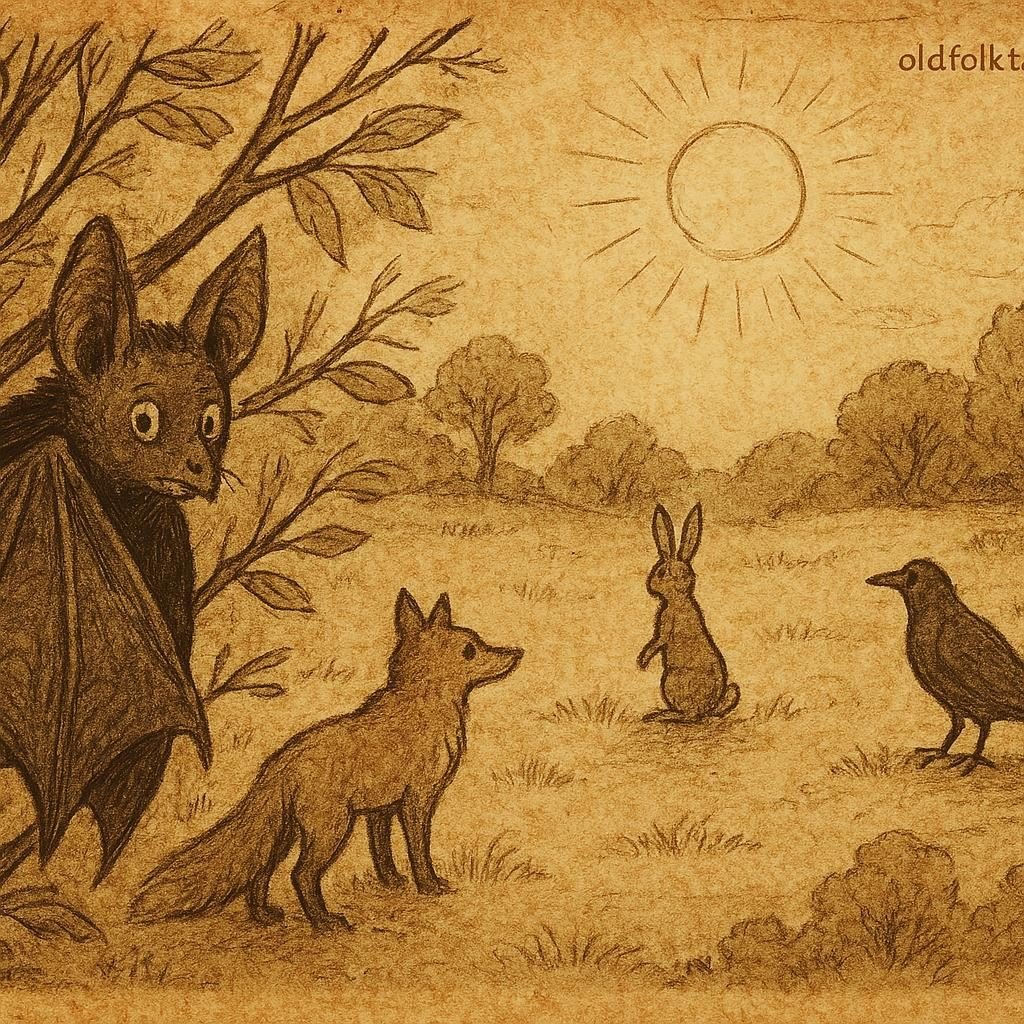
Long ago, when animals spoke and shared the earth more openly with humans, the Bat lived comfortably among them. In those days, the Bat was not the shy creature we know today. He flew freely in the daylight, mingling with other animals without fear. He was clever, sharp-minded, and proud of his cunning ways.
Among his closest companions was the Rat. The Rat, small but resourceful, often relied on the Bat for advice. Together they roamed the fields and forests, exchanging stories and schemes. To anyone who saw them, they looked like true friends, sharing food, laughter, and company.
But the Bat, for all his cleverness, was also sly and self-serving. His friendship with the Rat was not as deep as it appeared. One day, this hidden nature came to light in the most tragic way.
The Deceptive Invitation
The Bat once invited the Rat to join him on a journey. “Friend,” he said smoothly, “come with me to the farmland. There is much food to be gathered, and with both our strengths, we will return full and satisfied.”
Trusting him, the Rat agreed. Together, they went into the fields. But on the way back, the Bat grew cunning. He looked at the Rat and thought, Why share food when I could keep everything for myself?
When they returned, the Bat prepared a meal. He killed the Rat secretly, cut him into pieces, and cooked him in a stew. Soon, the aroma filled the air. When the Bat’s neighbors asked, “What are you cooking?” the Bat smiled and replied, “A fine dish of meat.”
They ate together, praising the meal. But none of them knew that the Bat had fed them the flesh of his own companion, the Rat.
The Truth Is Revealed
The next day, word spread quickly: the Rat was missing. His family searched everywhere, calling his name, but he did not return. Suspicion grew among the animals.
Finally, the Bat’s crime was uncovered. Someone had seen him with the Rat before the disappearance, and whispers reached the community that the Bat had betrayed his friend.
The animals gathered to hold judgment. The Rat’s family cried out for justice, their grief echoing through the forest. “This Bat has deceived us all,” they said. “He killed his own friend and fed him to us. Such treachery must not go unpunished.”
The elders of the animal kingdom agreed. They resolved that the Bat must answer for his crime.
The Bat’s Flight into Darkness
When the Bat heard that the truth had been revealed, fear gripped him. He knew the animals would not forgive his betrayal. If they caught him, he would surely be punished with death.
So the Bat fled. No longer could he walk among the animals in daylight. No longer could he laugh with them as he once did. From that day onward, he hid in caves, roofs, and hollow trees, coming out only at night when darkness concealed him.
Even now, when the sun shines, the Bat hides in shame. He knows that his betrayal can never be forgotten, and he cannot bear to face the judgment of the world.
And so, the Bat’s shame explains why he flies only at night, cloaking himself in shadows, avoiding the accusing eyes of the day.
Moral Lesson
This Nigerian folktale teaches that betrayal destroys trust, and treachery against a friend carries heavy consequences. No matter how clever one may be, deceit will eventually be uncovered, and shame will follow. True friendship is built on loyalty, not cunning.
Knowledge Check
1. Why was the Bat once free to move about during the daytime?
Because before his betrayal, he was accepted among the animals and had nothing to hide.
2. What did the Bat do to the Rat in the story?
He killed the Rat, cooked him, and deceived others by serving the meat as food.
3. How did the other animals discover the Bat’s crime?
Suspicion arose after the Rat’s disappearance, and the Bat was connected to it through witness accounts and investigation.
4. What consequence did the Bat face for his betrayal?
He fled in fear and has since hidden during the day, coming out only at night.
5. What does the Bat symbolize in this folktale?
The Bat symbolizes betrayal, shame, and the consequences of treachery against a friend.
6. What cultural tradition does this story come from?
It is a Nigerian folktale, part of the country’s rich oral storytelling heritage.
Source: Nigerian folktale